
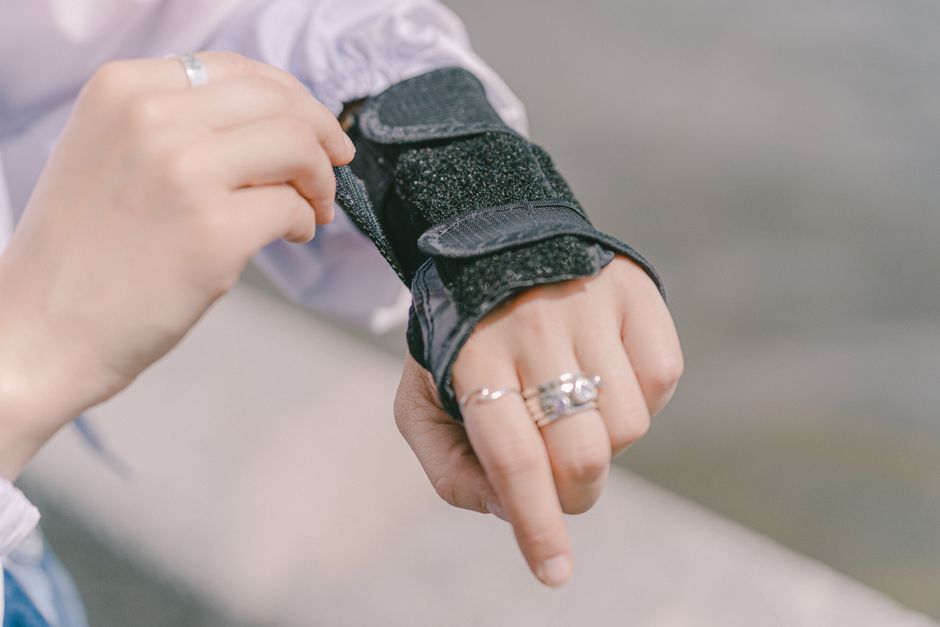
Wrist guards are a simple piece of gear with a clear job: they protect your hands and wrists when you fall. They work by using rigid splints to keep your wrist from bending backward too far. When you land on an outstretched hand, the guard absorbs the initial impact and transfers the force to your forearm, which is built to handle it better than the small bones in your wrist.
How Do Wrist Guards Work To Prevent Injuries?
Wrist guards work through a combination of rigid support and energy absorption. The hard plastic or metal splint runs along the palm side of your hand and up your forearm. This splint blocks the wrist from extending backward beyond a safe angle.
When you fall, your natural reflex is to reach out and catch yourself. That motion forces the wrist into extreme extension. Without a guard, the impact can crack the scaphoid bone or tear the ligaments holding the wrist together. The guard stops that motion before it reaches the danger zone.
The straps on the guard also matter. They keep the splint locked in place against your skin. A loose guard slides around on impact and does little to protect you. A snug fit transfers the force of the fall across the entire length of the splint, spreading it over a larger area of the forearm.
What Injuries Do Wrist Guards Actually Prevent?
Research consistently shows that wrist guards reduce the risk of wrist fractures during falls. This is especially well documented in snowboarding and inline skating. Studies have found that skaters who wear wrist guards have a significantly lower rate of wrist injuries than those who do not.
The injuries guards prevent most effectively are fractures of the distal radius and the scaphoid bone. The distal radius is the larger bone on the thumb side of your forearm. It is the most commonly broken bone in the body when people fall on an outstretched hand.
Wrist guards are less effective at preventing ligament sprains. A sprain happens when the ligaments stretch or tear. The guard limits range of motion, but it cannot stop all twisting forces. A severe fall at an awkward angle can still sprain the wrist even with a guard on.
They also do nothing for injuries higher up the arm. A forceful fall can transmit energy past the wrist to the elbow or shoulder. Some research suggests that while wrist guards reduce wrist fractures, they may shift some injury risk to the forearm bones higher up. This is not fully settled in the literature, but it is worth knowing.
Do Wrist Guards Work for Skateboarding and Snowboarding?
Yes, but the evidence is strongest for snowboarding. Several studies have examined wrist injuries in snowboarders who wear guards. The results are consistent: guards significantly reduce the risk of wrist fractures in this group.
For skateboarding, the evidence is thinner but still supportive. Skateboarders fall at higher speeds and often onto harder surfaces. The same biomechanical principles apply. The guard blocks hyperextension, which is the primary mechanism of wrist fracture in a fall.
Inline skating has the most direct evidence. A well-known study of inline skaters found that wrist guards reduced the risk of wrist injury by more than half. This is one of the clearest findings in protective gear research.
For other activities like roller skating, roller derby, and mountain biking, the logic holds. Any sport where you can fall forward onto your hands is a sport where a wrist guard can help. The key is that the guard must be worn correctly and fit properly.





Are All Wrist Guards the Same?
No. There are two main styles, and they protect differently.
The first style is the full glove with a built-in splint. These are common in snowboarding and skateboarding. They cover the palm and often the back of the hand. The splint is sewn into the glove, so it stays in place as long as the glove fits well.
The second style is the splint with straps only. These have a rigid plate held against the palm and forearm with velcro straps. They are lighter and less bulky. Many athletes prefer them because they allow more finger movement and grip.
There is also a difference in splint placement. Most guards have the splint on the palm side to block extension. Some also include a splint on the back of the hand to block flexion. Flexion injuries are less common, but they happen. Double-sided guards offer more protection but are bulkier.
Material quality varies too. Cheap guards use thin plastic that can crack on impact. Better guards use thicker polycarbonate or aluminum. The strap quality matters as well. Velcro that wears out quickly means the guard will not stay tight when you need it most.
How Should a Wrist Guard Fit?
A wrist guard should fit snugly without cutting off circulation. The splint should sit directly against the palm and extend up the forearm. There should be no gap between the splint and your skin.
When you put the guard on, flex your wrist backward. The splint should stop the motion before it becomes uncomfortable. If you can bend your wrist back to a 90-degree angle or beyond, the guard is too loose or too weak.
The straps should be tight enough that the guard does not slide when you shake your hand. But they should not leave deep marks in your skin. If your fingers tingle or go numb, the guard is too tight.
Replace guards that show visible wear. Cracks in the plastic or stretched-out straps mean the guard has lost its protective function. A cracked guard can break completely on impact, leaving your wrist exposed at the worst possible moment.
What Are the Limitations of Wrist Guards?
Wrist guards are not a guarantee of safety. They reduce risk, but they do not eliminate it. A fall from significant height or at high speed can still cause injury despite wearing a guard.
Guards do not protect against all types of wrist injuries. They are designed primarily for hyperextension injuries. Twisting injuries, where the wrist rotates abnormally, are less well protected. High-energy impacts can still fracture bones even with a guard in place.
There is also the question of whether guards give users a false sense of security. If you feel invincible with a guard on, you might take more risks. This is a behavioral concern, not a mechanical one. The guard itself works as designed, but it cannot compensate for reckless riding or skating.
Some people find wrist guards uncomfortable and stop wearing them. This is the biggest practical limitation. A guard that sits in a drawer does nothing. Finding a style that fits comfortably and allows you to move naturally is essential for consistent use.
Wrist Guards vs. Wrist Wraps and Braces
Wrist wraps and braces are different products with different purposes. Understanding the difference matters.
Wrist wraps are elastic bands that compress the wrist. They provide warmth and mild support. They are common in weightlifting, where they help stabilize the wrist under heavy loads. They do not have rigid splints and will not prevent fractures in a fall.
Wrist braces are medical devices used after an injury or for conditions like carpal tunnel syndrome. They often have a rigid splint, but they are designed for immobilization, not impact protection. A brace restricts motion to allow healing. A guard allows normal motion but blocks dangerous extremes.
If you are doing an activity with fall risk, you need a guard, not a wrap. A wrap will not stop your wrist from bending backward on impact. It may even give you a false sense of support.
For weightlifting, a wrap may be appropriate. For skateboarding, snowboarding, or roller skating, a rigid guard is the correct choice.
Frequently Asked Questions
Can wrist guards prevent all wrist injuries?
No. Wrist guards significantly reduce the risk of fractures from falls, but they cannot prevent all injuries. Severe impacts, twisting forces, and falls at high speed can still cause damage even with a properly fitted guard.
Should I wear wrist guards for weightlifting?
Wrist guards are not designed for weightlifting. Lifters typically use elastic wrist wraps for compression and stability under heavy loads. A rigid guard would restrict the wrist motion needed for many lifts.
How often should I replace my wrist guards?
Replace them when you see visible wear such as cracks in the splint, torn fabric, or straps that no longer tighten. If you take a hard fall on the guard, inspect it carefully and replace it if there is any damage.
Do wrist guards work for kids?
Yes, wrist guards are effective for children who participate in skating and snowboarding activities. The same biomechanics apply to children’s wrists. Make sure the guard fits properly and is sized for a child, not an adult.
