
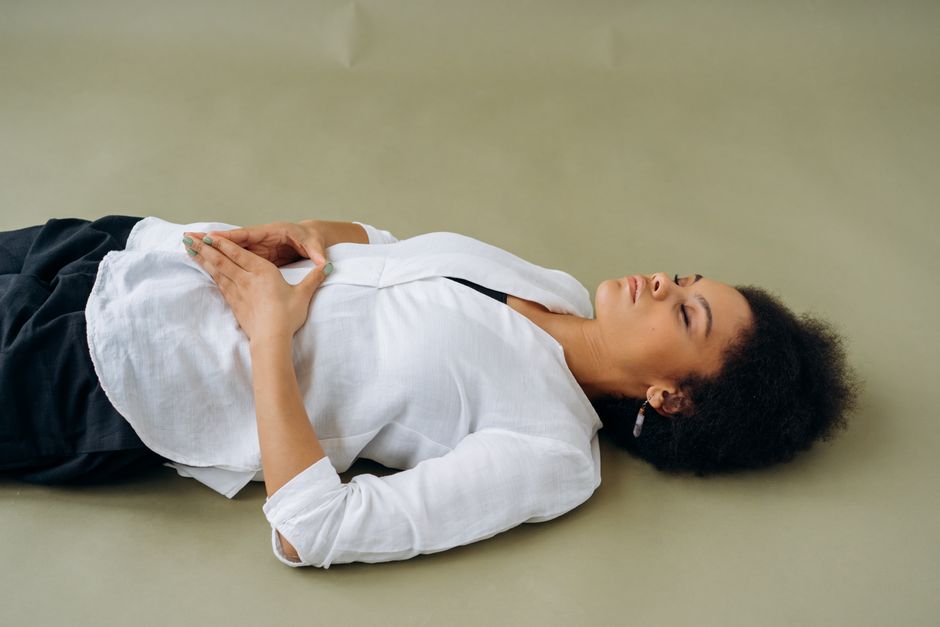
Anxiety can feel like your body has taken over. Your heart races, your chest tightens, and your mind spins through worst-case scenarios. The real answer to calming down is not about eliminating anxiety completely. It is about sending your nervous system a clear signal that you are safe, right now, in this moment. Grounding techniques, breathing exercises, and physical movement can shift your body out of its alarm state within minutes, even when your thoughts are still racing.
What Happens in Your Body During Anxiety
Anxiety triggers your sympathetic nervous system. This is the fight-or-flight response, designed to protect you from danger. Your adrenal glands release adrenaline and cortisol. Your heart beats faster to pump blood to your muscles. Your breathing becomes quick and shallow. Blood flow shifts away from your digestive system toward your limbs.
This response is not a flaw. It kept your ancestors alive when they faced predators. The problem is that your brain cannot always tell the difference between a real threat and a stressful thought. A deadline, a difficult conversation, or a memory can trigger the same physical alarm as a physical danger.
Understanding this mechanism matters. When you know that your racing heart is just adrenaline doing its job, the sensation becomes less frightening. You are not having a heart attack. You are not losing control. Your body is responding to a perceived threat, and you can help it stand down.
How Do I Calm Myself Down from Anxiety Quickly?
The fastest way to calm anxiety is to change your breathing pattern. Slow, extended exhales activate the parasympathetic nervous system, which is your rest-and-digest response. This is the physiological opposite of fight-or-flight.
Try the 4-7-8 breathing pattern. Breathe in through your nose for four counts. Hold for seven counts. Breathe out slowly through your mouth for eight counts. Repeat this cycle four times. The extended exhale is the key part. It stimulates the vagus nerve, which sends a signal to your brain that the threat has passed.
Physical grounding works quickly too. The 5-4-3-2-1 technique uses your senses to pull your attention away from anxious thoughts and back to the present. Name five things you can see. Four things you can touch. Three things you can hear. Two things you can smell. One thing you can taste.
Cold water can also interrupt an anxiety spiral. Splash cold water on your face or hold an ice cube in your hand. The sudden temperature change triggers the mammalian dive reflex, which slows your heart rate and redirects blood flow toward your brain. This is a well-established physiological response, not a folk remedy.
Why Deep Breathing Works and What to Do When It Does Not
Deep breathing works because it mechanically changes your heart rate. When you inhale, your heart rate naturally increases slightly. When you exhale, it decreases. This is called respiratory sinus arrhythmia. Slow breathing amplifies this natural rhythm and strengthens the baroreflex, which helps regulate blood pressure.
Research has consistently shown that slow breathing at around six breaths per minute produces the strongest calming effect. Most people breathe between 12 and 20 breaths per minute when anxious. Slowing that rate down shifts the balance of your autonomic nervous system toward calm.
But breathing does not work for everyone in every situation. If you have experienced trauma, deep breathing can sometimes make things worse. It can make you hyperaware of your body, which increases distress. If this happens to you, do not force it. Physical movement is an alternative that works through a different pathway.
Brisk walking, jogging in place, or doing ten jumping jacks burns off the adrenaline that is circulating in your bloodstream. Adrenaline has a half-life of about two to three minutes. Movement helps your body process it faster, which is why exercise often feels like a release valve for anxiety.
What to Do When Anxiety Feels Overwhelming in the Moment
When anxiety peaks, your thinking brain goes offline. This is why trying to reason with yourself often fails during a panic episode. You cannot think your way out of a state that is driven by your body. You have to work with your body first.
Try the physiological sigh. Take two sharp inhales through your nose, then one long exhale through your mouth. The double inhale reinflates tiny air sacs in your lungs called alveoli, which improves gas exchange. The long exhale activates your parasympathetic system. This technique has been studied in controlled laboratory settings and produces measurable reductions in stress arousal.
Tense and release muscle relaxation is another body-first approach. Start at your feet and work up. Tense each muscle group for five seconds, then release. This breaks the cycle of muscle tension that often accompanies anxiety. It also gives your mind a concrete task, which interrupts the loop of anxious thoughts.
If you are in a public place and cannot do breathing exercises or movement, use an anchor object. Carry something small with a distinct texture, like a smooth stone or a textured keychain. Focus entirely on how it feels in your hand. This is a form of tactile grounding that requires no one else to notice what you are doing.
Long-Term Habits That Reduce How Often Anxiety Strikes
Managing acute anxiety is different from reducing how often it happens. The habits you build on a daily basis influence your baseline anxiety level. Regular aerobic exercise is one of the most consistent findings in anxiety research. Exercise increases GABA, a neurotransmitter that inhibits excessive neural activity. It also provides a regular outlet for stress hormones.
Sleep quality strongly affects anxiety. Sleep deprivation amplifies activity in the amygdala, the brain region that processes threat. It also weakens the prefrontal cortex, which normally puts the brakes on amygdala activity. Prioritizing consistent sleep is not a luxury. It is a direct anxiety management strategy.
Caffeine is worth examining honestly. Caffeine blocks adenosine receptors and increases adrenaline. For people prone to anxiety, even moderate amounts can trigger or worsen symptoms. If you notice that your anxiety spikes after coffee, try reducing your intake or switching to half-caffeine for two weeks and observe the difference.
Alcohol is more complicated. It can temporarily reduce anxiety, but the rebound effect is real. As alcohol leaves your system, your nervous system can overcorrect, producing a spike in anxiety the next day. This is sometimes called hangover anxiety. If you use alcohol to manage stress, consider whether the next-day effects are making your overall pattern worse.
When to Seek Professional Help for Anxiety
Self-management techniques are valuable, but they have limits. If anxiety is interfering with your work, relationships, or daily functioning, professional support is appropriate. This is not a failure. It is a sensible response to a real medical condition.
Cognitive behavioral therapy has the strongest evidence base for anxiety disorders. It helps you identify and change thought patterns that maintain anxiety. It also uses exposure techniques to help you gradually face feared situations. Many people see meaningful improvement within 12 to 20 sessions.
Medication is another option. Selective serotonin reuptake inhibitors are commonly prescribed for anxiety. They take several weeks to work and are not appropriate for everyone. A psychiatrist or primary care physician can help you weigh the risks and benefits. Do not start or stop any psychiatric medication without medical supervision.
Seek immediate help if you experience thoughts of harming yourself, or if anxiety is accompanied by chest pain, shortness of breath, or fainting that you have not discussed with a doctor. These symptoms need medical evaluation to rule out physical causes.
What Does Not Work for Calming Anxiety
Some strategies are popular but lack evidence. Telling yourself to just relax does not work because anxiety is not a choice. Avoiding anxious situations can provide short-term relief but tends to make anxiety worse over time. Avoidance reinforces the belief that the situation is dangerous, which strengthens the anxiety response.
Supplements marketed for anxiety are a mixed category. Some evidence supports magnesium and certain herbal preparations, but the quality of evidence varies widely. No supplement has been proven to match the effectiveness of established treatments like therapy or medication. If you choose to try a supplement, tell your doctor. Some interact with prescription medications.
Alcohol and benzodiazepines both provide rapid relief but carry significant downsides. Regular use of either can lead to tolerance and dependence. They treat the symptom without addressing the underlying pattern. They are not sustainable long-term solutions for chronic anxiety.
Frequently Asked Questions
What is the fastest way to calm anxiety?
The physiological sigh, two sharp inhales followed by one long exhale, produces the fastest measurable calming response. It activates the parasympathetic nervous system within seconds.
Can deep breathing make anxiety worse?
Yes, for some people, especially those with a history of trauma, focusing on breathing can increase body awareness and distress. If this happens to you, use physical movement or grounding techniques instead.
How long does it take for anxiety to go down?
Acute physical symptoms like a racing heart typically begin to subside within 10 to 20 minutes once you start a calming technique. The cognitive worry may take longer to fade because thoughts are slower to change than body states.
When should I see a doctor for anxiety?
See a doctor if anxiety interferes with daily functioning, occurs frequently, or is accompanied by physical symptoms like chest pain or shortness of breath. Professional treatment is appropriate when self-management is not enough.
