
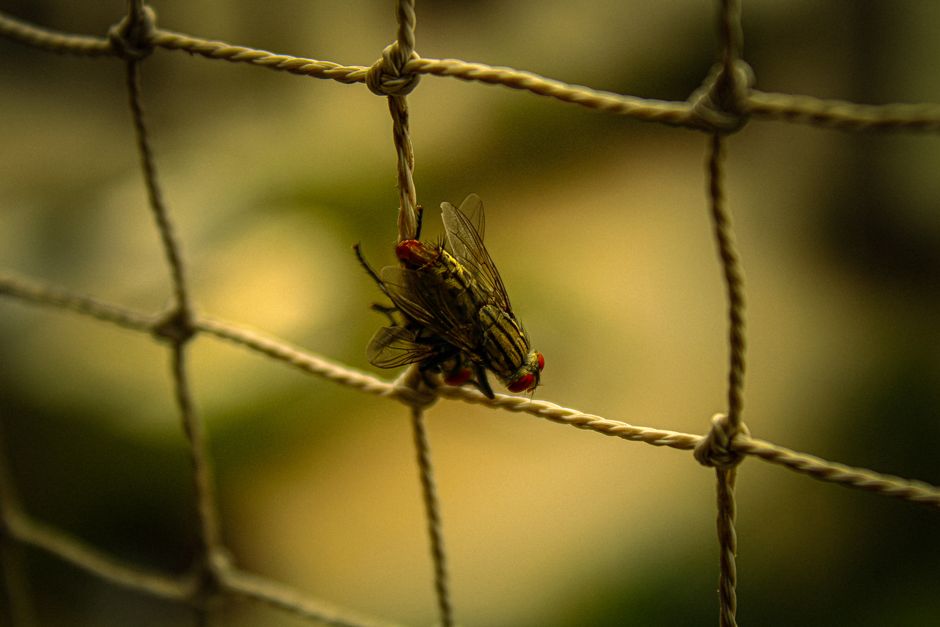
House flies get in through openings you may not think of as openings. An open door is obvious. But a fly can also come in through a torn window screen, a gap around a window air conditioner, a chimney flue, a dryer vent, or a crack under a door. They can also enter as eggs or larvae on garbage, compost, or produce you bring inside. Once indoors, a single fly can mean a one-time visitor or the start of a breeding cycle somewhere in your home.
How Do House Flies Get In?
House flies enter homes through any gap wide enough to pass through, and that gap is smaller than most people assume. An adult house fly is roughly 6 to 7 millimeters long and about 3 to 4 millimeters wide at the body. A gap of a quarter inch — about 6 millimeters — is generally enough for a fly to walk or squeeze through. That is roughly the thickness of a pencil.
The most common entry points are:
- Doors that are propped open, left ajar, or have worn weatherstripping
- Windows with missing, torn, or loose-fitting screens
- Gaps around window air conditioning units and portable AC vent kits
- Chimneys and fireplace flues, especially in warm months when they are not in use
- Dryer vents, bathroom exhaust fans, and kitchen range hoods that vent outside
- Cracks in foundation walls, basement windows, and crawl space access points
- Attic vents, soffit gaps, and roof vents
Flies are also strong fliers. A house fly can travel several miles from where it developed, though most stay within a few hundred yards of a food source. That means a neighbor’s trash, a nearby dumpster, or a livestock facility can supply flies to your home even if your own yard is clean.
Do House Flies Come In Through Screens and Windows?
Screens stop flies only when they are intact and fit tightly. A screen with a tear the size of a dime is enough. So is a screen that has pulled loose from its frame at one corner.
Window air conditioners are a common and overlooked entry point. The accordion panels that seal the sides of a window unit often leave small gaps at the top and bottom. Flies can walk through these gaps even when the unit is running. Portable air conditioners that vent through a window have the same problem — the vent kit rarely seals the full window opening.
Windows that open without screens are an open invitation in warm weather. So are windows with screens that have been pushed out of their tracks by pets or by the window itself.
Why Do Flies Appear Inside Even When Windows Are Closed?
If windows and doors stay closed and flies still show up, the source is usually inside the home — not outside it.
House flies lay eggs in moist, decaying organic material. Indoors, that can mean:
- Garbage that has sat too long, especially in a can without a tight lid
- Food waste in a kitchen trash can or under a sink
- Overripe or rotting fruit and vegetables in a bowl or refrigerator drawer
- Recycling bins with food residue on cans, bottles, or cartons
- Pet food bowls left out with wet food
- Compost containers kept indoors
- Dead rodents or other animals in walls, attics, or crawl spaces
- Damp organic debris in basements or under appliances
A single female house fly can lay multiple batches of eggs in her lifetime, and each batch can contain well over 100 eggs. Under warm conditions, eggs can hatch within a day, and the full cycle from egg to adult can be completed in as little as a week to ten days. That is why a few flies near a trash can can become a noticeable problem quickly.
If you are seeing many flies and cannot find a source, the source may be hidden — behind a wall, under a floor, or in an appliance. In that case, a pest control professional can help locate it.





What Time of Year Are House Flies Most Active Indoors?
House flies are most active in warm weather. In most of the United States, that means late spring through early fall. Flies are cold-blooded, so their development and activity slow down as temperatures drop.
In heated homes, however, flies can remain active year-round if a breeding source exists indoors. Some species that overwinter as adults — such as cluster flies — may appear inside on warm winter days, especially near windows on the sunny side of a house. Cluster flies look similar to house flies but are typically larger and slower. They usually enter through gaps around windows, doors, and eaves in the fall and then emerge on mild days.
Fruit flies and drain flies are often mistaken for house flies. They are different insects with different sources. Fruit flies breed in overripe produce and fermenting liquids. Drain flies breed in the slime layer inside drains. If the flies you are seeing are small and hover near a sink or fruit bowl, the source is likely one of these — not house flies.
How Can You Keep House Flies From Getting In?
Exclusion — blocking entry — is the most reliable approach. Traps and sprays address flies that are already inside. They do not stop new ones from coming in.
Practical steps that reduce entry:
- Keep doors closed when not in use. If a door must stay open for airflow, use a screen door that closes fully on its own.
- Repair or replace torn screens promptly. Check screens on windows, doors, and attic vents.
- Seal gaps around window air conditioners with foam or weatherstripping made for that purpose.
- Check weatherstripping on exterior doors. If you can see light around the edges when the door is closed, flies can likely get through.
- Keep a tight lid on outdoor trash cans and clean them periodically.
- Rinse recyclables before placing them in bins.
- Take kitchen trash out frequently during warm months.
- Store produce in the refrigerator rather than on the counter when flies are active.
- Check dryer vents and exhaust fan covers for damage or missing flaps.
Some clinicians and public health sources note that house flies can carry bacteria on their bodies and in their digestive tracts because they feed on waste and decaying material. This is one reason food safety guidance emphasizes keeping flies away from food preparation areas. The risk is real but generally low in a clean home with only occasional flies. It becomes more significant when flies have access to food or surfaces where food is prepared.
Do Ultrasonic Repellers or DIY Traps Work?
Ultrasonic pest repellers have not been shown to reliably repel house flies. The evidence for their effectiveness against flies is weak, and some studies have found no effect. If you are considering one, it is worth knowing that the scientific support is limited.
Simple traps can help reduce fly numbers indoors. Sticky fly strips and ultraviolet light traps are commonly used. Their effectiveness depends on placement — light traps work best when placed away from windows and doors so they do not draw flies in from outside. Bait traps can also help but need to be placed carefully and emptied regularly.
Insecticide sprays and foggers can kill flies that are present, but they do not address the source. If a breeding site remains, flies will return. Foggers also leave residue and should be used according to label directions, with people and pets out of the area during application.
When Should You Call a Pest Control Professional?
Call a professional if you are seeing a large number of flies consistently, if you cannot find the source, or if the flies keep returning after you have addressed obvious sources. Large numbers of flies indoors can sometimes indicate a dead animal in a wall, attic, or crawl space — a situation that is difficult to resolve without professional help and can also pose other health concerns.
A pest control professional can identify the species, locate the breeding site, and recommend treatment. This is often faster and more effective than repeated DIY attempts when the source is hidden.
Frequently Asked Questions
How do house flies get inside a house?
House flies enter through gaps as small as about a quarter inch, including open doors, torn screens, and gaps around window air conditioners, vents, and chimneys. They can also be brought in as eggs or larvae on garbage, compost, or produce.
Can house flies come up through drains?
House flies generally do not breed in drains. Small flies hovering near sinks are more likely drain flies or fruit flies, which breed in drain slime or overripe produce.
Why do I suddenly have a lot of flies in my house?
A sudden increase usually means a breeding source is present indoors, such as overdue garbage, rotting produce, or a dead animal in a wall or attic. Warm weather speeds up their life cycle, so numbers can rise quickly.
Do house flies lay eggs inside homes?
Yes, if they find moist decaying organic material indoors, such as food waste or garbage. A single female can lay multiple batches of eggs, and the full cycle from egg to adult can take as little as a week to ten days in warm conditions.
