
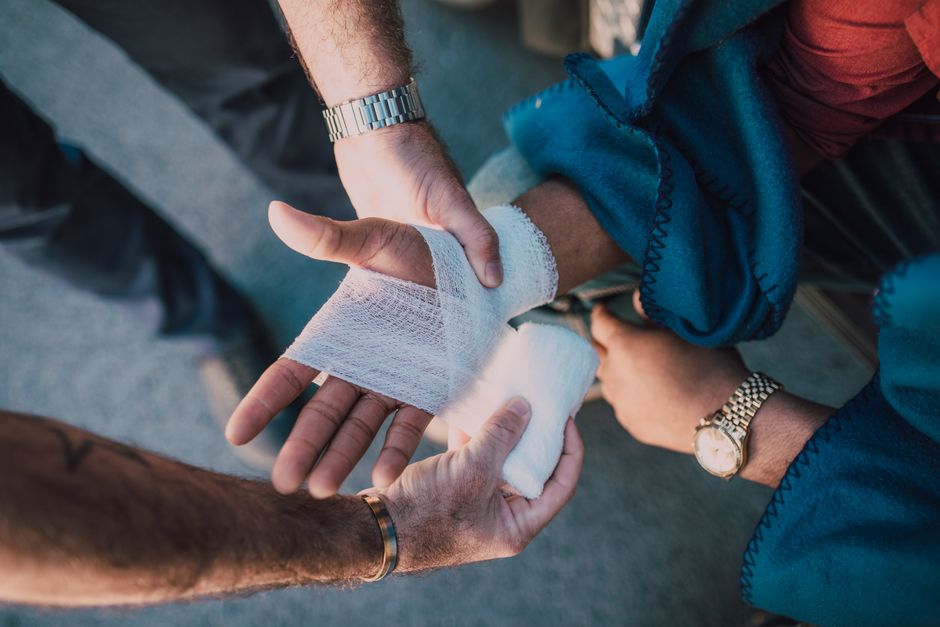
Severe bleeding from a limb can kill in minutes. Hemostatic bandages are designed to change that timeline by delivering a concentrated clotting agent directly into the wound, where it works with the body’s own blood-clotting system to form a stable clot fast. They are one of the most significant advances in battlefield and emergency trauma care in recent decades, and they are now standard in many trauma kits, ambulances, and military medics’ bags.
How Do Hemostatic Bandages Stop Severe Bleeding?
Hemostatic bandages stop bleeding by combining three actions at once: pressure, concentration of clotting factors, and a physical scaffold for a clot to form on. A plain gauze dressing mostly just absorbs blood and applies pressure. A hemostatic dressing does that plus actively accelerates coagulation at the wound site.
When a major artery or vein is torn, the body’s normal clotting cascade is overwhelmed. Blood flows out faster than fibrin — the protein mesh that forms a clot — can be built. A hemostatic agent floods the wound with material that either mimics part of that cascade or gives fibrin a surface to grab onto immediately.
The result is not a chemical seal in the way a glue works. It is a scaffold plus a catalyst. The clot that forms is still made of the patient’s own blood. The dressing just makes it happen faster and holds it in place long enough to survive the trip to a hospital.
What Are the Different Types of Hemostatic Agents?
There are three main categories in clinical and military use, and they work differently.
- Factor concentrators — these absorb the water in blood, leaving clotting factors and platelets concentrated at the wound. The result is a thicker, faster-forming clot. They are generally safe and do not generate heat.
- Mucoadhesive agents — these stick to wet tissue and form a physical barrier. They are effective on bleeding surfaces but historically have had problems with swelling and, in rare cases, nerve damage when used in confined spaces.
- Procoagulant agents — these deliver an actual clotting precursor, typically a form of chitosan or a mineral like zeolite, that triggers the clotting cascade directly. Some early mineral-based versions generated enough heat to cause burns, which drove reformulation.
The specific product matters less than the technique. A well-applied plain gauze with sustained direct pressure outperforms a poorly applied hemostatic dressing. The dressing is an addition to pressure, not a replacement for it.
How Do You Apply a Hemostatic Bandage Correctly?
Application technique is the single biggest factor in whether a hemostatic dressing works. The steps below reflect the general approach taught in military and civilian trauma training. They are not a substitute for hands-on certification.
First, apply direct pressure to the wound. If bleeding is not controlled and the wound is on a limb, pack the dressing deep into the wound — all the way to the source of bleeding, not just over the surface. Superficial placement is the most common reason these dressings fail.
Hold firm, continuous pressure for at least three minutes before checking. Some protocols call for longer. Do not lift to peek. If bleeding continues, add more gauze on top and press harder — do not remove what is already in the wound, because that tears away any clot that has started to form.
Once bleeding is controlled, wrap a pressure bandage tightly over the wound and monitor for rebleeding. For junctional wounds — the groin, armpit, or neck — a hemostatic dressing combined with a junctional tourniquet is often required, because a standard tourniquet cannot reach those areas.




When Should You Use a Hemostatic Bandage Instead of a Tourniquet?
Tourniquets and hemostatic dressings solve different problems, and in many severe limb injuries both are used.
A tourniquet stops all blood flow to the limb by compressing the artery above the wound. It works fast and reliably for bleeding that a dressing cannot reach. The tradeoff is that it cuts off circulation entirely, which is why it is reserved for life-threatening extremity bleeding that pressure has not controlled.
A hemostatic dressing is used when bleeding is severe but the source can be packed and compressed — typically a deep wound in the thigh, upper arm, or shoulder where the bleeding point is reachable. It is also the first choice for junctional wounds where a tourniquet cannot be applied.
Current trauma guidance generally favors trying a hemostatic dressing with firm pressure first for compressible wounds, and moving to a tourniquet if bleeding is not controlled. For wounds that are clearly not compressible, or where the bleeding is catastrophic, a tourniquet is applied immediately. The two are not competing options — they are sequential tools.
What Do Hemostatic Bandages Actually Do to the Body?
Understanding the mechanism helps explain why technique matters so much.
Clotting is a chain reaction. When a blood vessel is injured, platelets stick to the exposed tissue and release signals that recruit more platelets. At the same time, a cascade of clotting proteins activates in sequence, ending with fibrinogen being converted into fibrin — long strands that mesh together and trap red blood cells into a solid plug.
In severe bleeding, this process is happening, but it is losing the race. Blood is leaving the body faster than the plug can build. A hemostatic dressing changes the race in two ways: it concentrates the clotting factors that are already there, and it gives fibrin a surface to build on immediately rather than waiting for the body to create one.
It does not replace the patient’s own clotting system. People with severe clotting disorders, or those on strong blood thinners, may not respond as well to any hemostatic dressing, because the raw materials for a clot are compromised. This is one reason these dressings are a bridge to surgery, not a substitute for it.
Do Hemostatic Bandages Have Risks or Limitations?
They are effective, but not risk-free, and not a substitute for definitive care.
Early mineral-based products could generate enough heat to burn tissue. Modern formulations have largely addressed this, but heat generation remains a consideration with some products. Mucoadhesive agents have been associated with swelling and, in rare reported cases, nerve injury when used in confined anatomical spaces. These are uncommon but documented.
Improper application is a bigger practical risk than the dressing itself. Placing the dressing on the skin surface instead of packing it into the wound, releasing pressure too early, or removing saturated gauze are the most common failure points. Any hemostatic dressing that fails to control bleeding should be backed up with a tourniquet if the wound is on a limb and the situation allows.
Even when bleeding stops, the patient is not out of danger. Hemostatic dressings control external hemorrhage — they do not repair the vessel, replace lost blood, or address internal bleeding. Anyone who required a hemostatic dressing for severe bleeding needs urgent surgical evaluation.
Are Hemostatic Bandages Available to the Public?
Yes. Several hemostatic dressings are sold for civilian use, and many are carried in workplace first-aid kits, by law enforcement, and by wilderness and travel medicine providers. Some are marketed directly to consumers.
The evidence for their effectiveness comes largely from military and prehospital trauma settings, where they are used by trained personnel on severe wounds. Whether an untrained civilian can apply one effectively is a separate question, and the honest answer is that training matters more than the product.
If you carry a hemostatic dressing, the most useful thing you can do is take a hands-on bleeding control course. The Stop the Bleed program, developed by the American College of Surgeons, teaches the packing and pressure technique that makes these dressings work. A dressing in a bag without training is far less useful than the same dressing in trained hands.
Frequently Asked Questions
How long does a hemostatic bandage take to stop bleeding?
With correct packing and firm pressure, bleeding often slows or stops within a few minutes. Current trauma protocols typically call for holding continuous pressure for at least three minutes before reassessing.
Can you use a hemostatic bandage on any wound?
They are designed for severe, compressible bleeding on the limbs and junctional areas like the groin or armpit. They are not intended for minor cuts, and they are not a substitute for a tourniquet on non-compressible or catastrophic bleeding.
Do hemostatic bandages hurt or burn?
Some early mineral-based products could generate heat and cause burns, but most modern formulations have reduced this risk. Application itself is painful because it involves deep packing and firm pressure into an injured wound.
Should you remove a hemostatic bandage once bleeding stops?
No. Once bleeding is controlled, the dressing should be left in place and covered with a pressure bandage. Removing it can tear away the clot and restart bleeding, so removal is typically done by a surgeon.
