
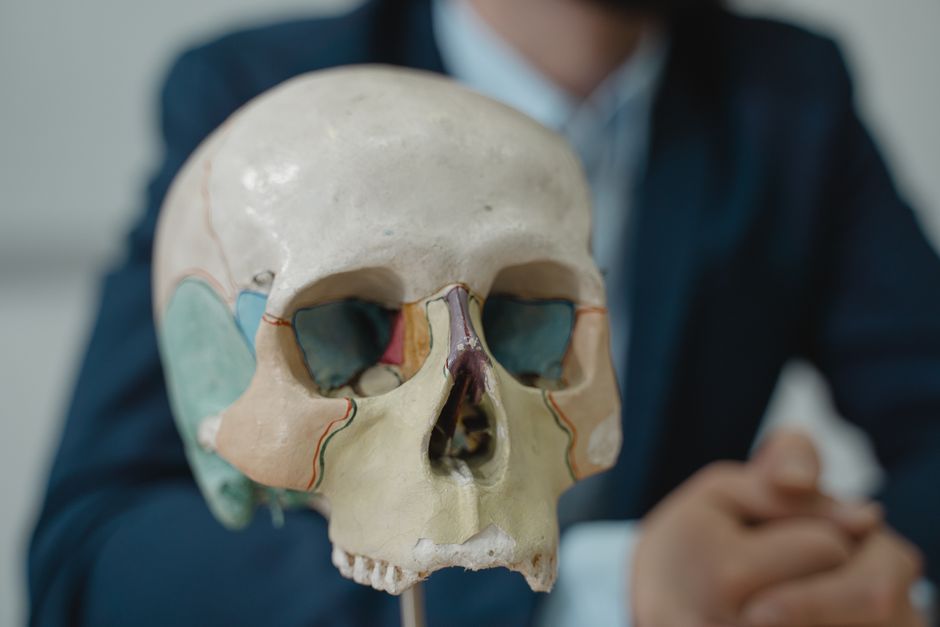
Bones are living organs that rebuild themselves throughout your life. They have a hard outer shell of compact bone, a spongy inner layer, and a network of cells that constantly break down old tissue and lay down new tissue. That ongoing process is how a broken bone heals and how your skeleton stays strong for decades.
Most people picture bone as a dry, static scaffolding. It is closer to a busy construction site that never closes. Understanding how that site is organized, who works there, and what happens when something breaks explains a lot about bone health, aging, and recovery.
What Is Bone Actually Made Of?
Bone is a composite material, and that is the source of its strength. It combines a flexible protein framework with a hard mineral filler, and neither part works well alone.
Roughly half of bone by volume is mineral, mostly a form of calcium phosphate called hydroxyapatite. This mineral gives bone its hardness and its ability to resist compression. The other major component is a protein called collagen, which gives bone flexibility and the ability to bend slightly without snapping. Think of reinforced concrete: collagen is the steel mesh, mineral is the cement.
There is also water and a small population of living cells embedded throughout. Those cells are the part most people never think about, and they are the reason bone can repair itself.
At the structural level, bone comes in two main types:
- Cortical bone is the dense, solid outer layer. It makes up about 80 percent of your skeleton and forms the shaft of long bones like the femur.
- Trabecular bone is the spongy inner material, arranged in a lattice of struts. It is lighter but surprisingly strong, and it is concentrated near joints and in the spine.
Inside many bones is marrow, which produces blood cells. Bone is not just a frame. It is an organ that houses the factory for your entire blood supply.
What Are the Cells That Build and Break Down Bone?
Four cell types do essentially all the work of maintaining your skeleton. Their names are worth knowing because they explain almost everything about how bone behaves.
Osteoblasts build bone. They produce the collagen framework and help deposit mineral into it. When they finish their job, many of them become trapped inside the bone they made.
Osteocytes are former osteoblasts that got buried in the matrix. They extend tiny tentacles through channels in the bone and act as sensors. They detect mechanical stress and damage, and they signal the other cells when repair is needed. This is the network that lets bone respond to exercise.
Osteoclasts break bone down. These are large, multinucleated cells that dissolve both mineral and protein. This sounds destructive, but it is essential. Without breakdown, old and damaged bone would accumulate and calcium levels in the blood could not be maintained.
Bone lining cells cover most bone surfaces and regulate what gets in and out of the bone fluid.
The key idea is that building and breaking down are not opposites at war. They are partners in a continuous cycle called remodeling. Osteoclasts remove a small packet of old bone, and osteoblasts fill the gap with new bone. In a healthy adult, the two sides stay roughly balanced.
How Do Bones Work Structure Cells Healing Together?
Healing a fracture is remodeling turned up to maximum. The same cells that quietly maintain your skeleton every day switch into a repair mode that follows a fairly predictable sequence.
First comes inflammation. When a bone breaks, blood vessels in and around the bone tear, and a clot forms between the broken ends. This clot acts as a temporary scaffold and releases signals that call repair cells to the site. This phase begins within hours and can last for days.
Next comes the soft callus. Cells from the surrounding tissue and from the bone’s own covering build a bridge of cartilage and fibrous tissue across the gap. This bridge is not yet hard, but it holds the ends together.
Then the hard callus forms. Over the following weeks, that soft bridge is gradually replaced with woven bone, an immature type of bone that is laid down quickly and in a disorganized pattern. This is the stage where the fracture becomes mechanically stable.
Finally comes remodeling. Over months, the woven bone is slowly replaced with mature, organized bone. The excess material around the break is removed, and the bone gradually returns toward its original shape. In young children this reshaping can be remarkably complete. In adults it is usually good but not perfect.
The timeline varies widely depending on which bone broke, how severe the break is, and the person’s age and health. A small fracture in a healthy young adult may heal in several weeks. A major fracture in an older adult, or one in a bone with poor blood supply, can take many months.




Why Does Bone Constantly Rebuild Itself?
Remodeling serves three separate purposes, and all three are necessary for survival.
The first is repair. Everyday activity creates microscopic cracks in bone. The osteocyte network detects them, and remodeling replaces the damaged sections before they can grow into a full fracture.
The second is calcium balance. Bone acts as the body’s calcium bank. When blood calcium drops, hormones signal osteoclasts to release calcium from bone. When calcium is plentiful, the balance shifts toward storage. This is why bone is sometimes described as a metabolic organ rather than just a structural one.
The third is adaptation to load. Bone responds to mechanical stress by getting stronger where it is needed. This is a well-established principle in bone physiology, often summarized as bone forming where it is loaded and being lost where it is not. It explains why weight-bearing exercise supports bone density and why prolonged bed rest or immobility leads to bone loss.
Here is a point that surprises many people: your skeleton is not the same skeleton it was a decade ago. Because remodeling continuously replaces old tissue with new, most of the mineral in your body is gradually turned over. The structure persists, but the material is in constant rotation.
What Happens When Bone Remodeling Goes Out of Balance?
When breakdown outpaces building, bone is lost. When building outpaces breakdown in the wrong place, bone can become too dense or form in unwanted locations. Both directions matter.
The most common imbalance is bone loss with age. After roughly age 30, most people slowly lose bone mass because resorption slightly exceeds formation. This is a normal part of aging, but the rate varies widely between individuals.
Osteoporosis is the condition where bone loss becomes severe enough to raise fracture risk. It develops silently, often without symptoms until a fracture occurs. The spine, hip, and wrist are common sites. Risk factors include age, sex, family history, certain medications, and some medical conditions.
Osteopetrosis is the opposite problem, where osteoclasts do not function properly and bone becomes abnormally dense but also brittle. It is far less common than osteoporosis.
Other conditions affect specific steps in the process. Paget’s disease of bone involves disordered remodeling that produces enlarged, weakened bone. In rare cases, bone can form in soft tissues where it does not belong, a process called heterotopic ossification.
The takeaway is that healthy bone depends on balance, not just on having more bone. The body manages that balance through hormones, mechanical signals, and nutrient availability.
What Supports Healthy Bone Remodeling?
The factors that support bone health are well established, even if the details of how much each one matters are still debated.
Calcium and vitamin D are the two nutrients most directly tied to bone. Calcium is the raw mineral. Vitamin D supports calcium absorption from the gut. Dietary reference intakes vary by age and sex, and official guidance from the National Institutes of Health and the USDA provides specific daily amounts for each group.
Protein supplies the collagen framework. Adequate protein intake is important for bone, though the optimal amount for bone health specifically is still an area of active research.
Weight-bearing and resistance exercise create the mechanical load that signals bone to maintain or increase its strength. Walking, running, jumping, and lifting weights all count. Swimming and cycling are excellent for the heart and muscles but do not load bone the same way.
Avoiding smoking and limiting heavy alcohol use is supported by consistent evidence linking both to lower bone density and higher fracture risk.
What does not have strong evidence is the idea that any single supplement or food can dramatically rebuild bone. Marketing for bone health products often outpaces the research. If a claim sounds like a shortcut around the fundamentals, it usually is.
How Does Age Change Bone Healing?
Older bone heals more slowly and less completely than younger bone. This is well documented, though the reasons are multiple rather than a single cause.
With age, the number and activity of osteoblasts tends to decline, while osteoclast activity continues. The result is slower formation during the repair phase. Blood supply to bone also tends to decrease, and the pool of stem cells available for repair shrinks. Chronic conditions and some medications can add to the effect.
This does not mean fractures in older adults cannot heal. Most do. But recovery often takes longer, and the risk of complications is higher. This is one reason fracture prevention matters more with age than fracture treatment alone.
Children are at the other end of the spectrum. Their bones heal quickly and can reshape substantially after a break, which is why some childhood fractures that would be concerning in an adult resolve with excellent outcomes.
Frequently Asked Questions
How long does it take for a broken bone to heal?
Most fractures take several weeks to a few months to heal, depending on the bone, the severity of the break, and the person’s age and health. Complete remodeling can continue for a year or more after the bone is stable.
Do bones heal themselves without treatment?
Bone has a genuine capacity to repair itself through the same remodeling process that maintains it. However, many fractures need immobilization, alignment, or surgery to heal in a usable position, so medical evaluation is important.
What cells are responsible for bone healing?
Osteoblasts build new bone, osteoclasts remove damaged bone, and osteocytes sense damage and direct repair. All three work together during fracture healing.
Does exercise really make bones stronger?
Yes. Weight-bearing and resistance exercise create mechanical loads that signal bone to maintain or increase its strength, a principle well established in bone physiology. Exercise that does not load the skeleton, such as swimming, does not have the same effect on bone.
