
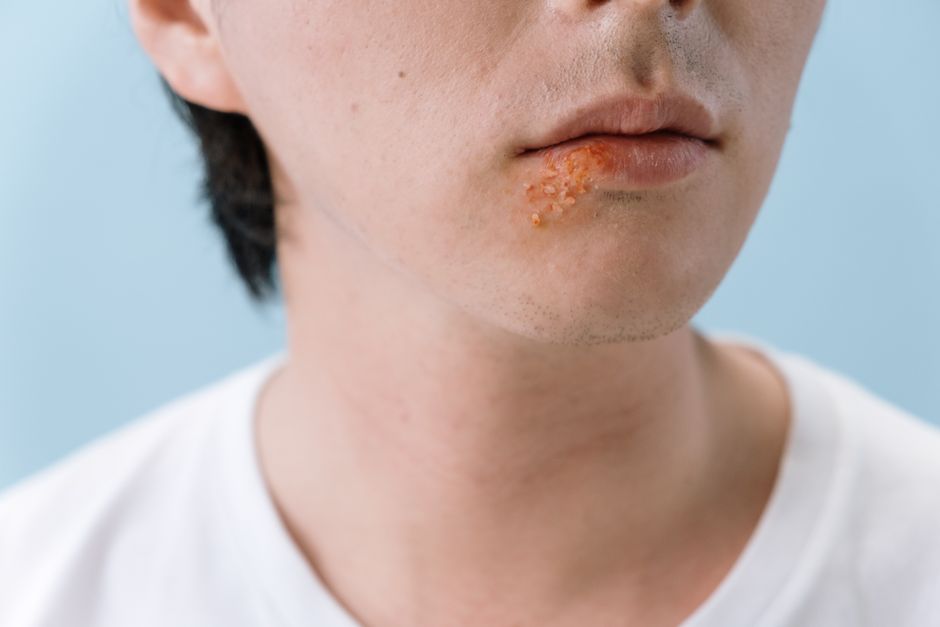
Cold sores are caused by the herpes simplex virus type 1 (HSV-1), and they are contagious from the moment the virus reactivates — often a day or two before a blister even appears — until the sore has fully crusted over and new skin has formed underneath. That window usually lasts about one to two weeks. The virus spreads through direct skin-to-skin contact with the sore or with the fluids inside it, not through the air, and not by sharing a room with someone who has one.
Most adults carry HSV-1. The World Health Organization estimates that roughly two-thirds of people under 50 worldwide are infected. Many of them never get visible sores at all, which is one reason cold sores spread so easily — a person can shed virus without knowing it.
How Contagious Are Cold Sores?
Cold sores are most contagious when a blister is visible and weeping, but the contagious period begins before that. HSV-1 can be present on the skin and in saliva a day or two before a sore shows up, and it stays transmissible until the blister has dried, crusted, and healed completely.
The virus does not travel through the air on its own. It needs direct contact — a kiss, a shared lip balm, a shared cup, touching the sore and then touching someone else’s skin. This is why cold sores tend to spread within households and between romantic partners rather than through casual proximity.
One detail that surprises many people: HSV-1 can also be spread through asymptomatic shedding. That means a person with no visible sore can still pass the virus through saliva or skin contact. Asymptomatic shedding is less efficient than shedding from an active blister, but it happens, and it accounts for a meaningful share of new infections.
How Does HSV-1 Actually Spread?
HSV-1 enters through small breaks in the skin or through the mucous membranes of the mouth, nose, or eyes. Once inside, it travels along nerve endings to a cluster of nerve cells called the trigeminal ganglion, near the base of the skull. There it stays for life.
The virus does not leave the body. It goes dormant, and for most people it reactivates from time to time. When it does, it travels back down the same nerve pathway to roughly the same spot on the lip or around the mouth.
Transmission requires contact with infected skin, saliva, or fluid from a blister. Common routes include:
- Kissing someone with an active sore
- Sharing utensils, cups, water bottles, or lip balm
- Touching a sore and then touching your own mouth, eyes, or broken skin
- Oral sex with a partner who has an active oral sore, which can transmit HSV-1 to the genitals
- Sharing towels or razors with someone who has an active sore
HSV-1 is not the same as HSV-2, the virus most often associated with genital herpes, though both can cause sores in either location. HSV-1 now accounts for a growing share of new genital herpes cases in some countries, largely through oral-to-genital contact.
When Are Cold Sores Most Contagious?
The highest risk of transmission is when a blister is open and releasing fluid. That fluid is loaded with virus particles. But the contagious window opens earlier than that.
Most people feel a tingling, itching, or burning sensation at the spot where a sore is about to appear. This is called the prodrome, and it usually starts a few hours to a day or two before the blister forms. During the prodrome, the virus is already replicating in the skin and can be passed to others.
The sore remains contagious through these stages:
- Prodrome: tingling or itching, no visible sore yet — contagious
- Blister: fluid-filled bump appears — highly contagious
- Weeping: blister breaks and releases fluid — highly contagious
- Crusting: sore dries and forms a scab — still contagious
- Healed: scab falls off, new skin forms — no longer contagious from that sore
The full cycle typically runs seven to ten days in healthy adults, though it can be longer in children or people with weakened immune systems. The sore is not considered fully healed until the scab has come off on its own and the skin underneath has closed.



Can You Spread Cold Sores Without a Visible Sore?
Yes. This is one of the most misunderstood parts of HSV-1. Asymptomatic shedding — releasing virus without any visible sore — happens in people who carry the virus, and it can transmit infection to others.
Asymptomatic shedding is less frequent and less intense than shedding during an active outbreak, so the risk of passing the virus is lower. But it is not zero. Many people who develop cold sores cannot identify who they got them from, and asymptomatic shedding is a common explanation.
This is also why someone who has never had a cold sore can still carry and transmit HSV-1. Most people infected with HSV-1 either never develop symptoms or have outbreaks so mild they go unnoticed.
Who Is Most at Risk of Getting Cold Sores?
Anyone who has not been infected with HSV-1 can get it. But some groups face higher risk of serious infection.
Newborns are the most vulnerable. Their immune systems are not developed enough to control the virus, and HSV-1 infection in a newborn can become life-threatening. This is why people with an active cold sore should not kiss infants, and why anyone with a cold sore on the lip or face should wash their hands carefully before holding a baby.
People with weakened immune systems — from chemotherapy, organ transplant medications, or certain chronic illnesses — can have more severe and longer-lasting outbreaks. The virus can also spread more widely in these individuals.
People with eczema or other skin conditions that break the skin barrier may be more susceptible to a serious complication called eczema herpeticum, where the virus spreads across large areas of skin. This requires medical attention.
For most healthy adults and children, cold sores are uncomfortable but not dangerous. The first infection is often the worst, sometimes accompanied by fever, swollen lymph nodes, and multiple sores inside and around the mouth. Later outbreaks tend to be milder.
How Can You Reduce the Risk of Spreading Cold Sores?
Avoid direct contact with the sore while it is active. That means no kissing, no sharing drinks or utensils, and no sharing lip balm or towels until the sore has fully healed.
Wash your hands often, especially after touching your face or applying anything to the sore. If you use a cream or ointment, apply it with a clean cotton swab rather than your finger to avoid contaminating the product and your hands.
Do not squeeze, pick, or pop a cold sore. This can spread the fluid to nearby skin and to your fingers, and it can introduce bacteria that lead to a secondary infection.
Be especially careful around infants, people with eczema, and anyone with a weakened immune system. If you have an active sore, avoid close contact with these groups until it heals.
Some clinicians recommend antiviral medications — such as acyclovir or valacyclovir — to shorten outbreaks and reduce shedding. These are prescription drugs in the United States, and they work best when started at the first sign of tingling. Over-the-counter creams may soothe symptoms but do not reliably shorten the outbreak or reduce transmission. The evidence for most OTC products is limited, and no topical product has been shown to prevent spread to other people.
Do Cold Sores Mean You Have Herpes?
Yes, in the medical sense. Cold sores are caused by the herpes simplex virus. But the word “herpes” carries a stigma that does not match the reality of HSV-1.
HSV-1 is extremely common. Most people who have it got it in childhood, often from a relative’s kiss. It is not a sign of sexual activity, and it is not the same as HSV-2, though both viruses belong to the same family.
Having HSV-1 does not mean you will have frequent outbreaks. Some people get one cold sore and never get another. Others get several a year. Outbreaks can be triggered by sun exposure, fever, stress, fatigue, hormonal changes, or a weakened immune system, but triggers vary widely between individuals.
There is no cure for HSV-1. The virus stays in the body for life. But for most healthy people, it causes occasional cold sores and nothing more.
Frequently Asked Questions
How long are cold sores contagious?
Cold sores are contagious from about a day before the blister appears until the sore has fully crusted over and new skin has formed, usually one to two weeks. The virus can be passed even during the tingling stage before anything is visible.
Can you get cold sores from kissing someone who has no sore?
Yes. HSV-1 can be shed in saliva and on the skin without any visible sore, a process called asymptomatic shedding. The risk is lower than during an active outbreak, but it is not zero.
Are cold sores contagious through sharing drinks or utensils?
Yes, if the person has an active sore or is shedding the virus. The virus can be present on the rim of a cup, a spoon, or a straw and can enter through small breaks in the mouth or lips of the next person.
When can you kiss someone again after a cold sore?
Wait until the sore has completely healed — the scab has fallen off and the skin underneath has closed. Until then, the virus can still be passed through direct contact.
