
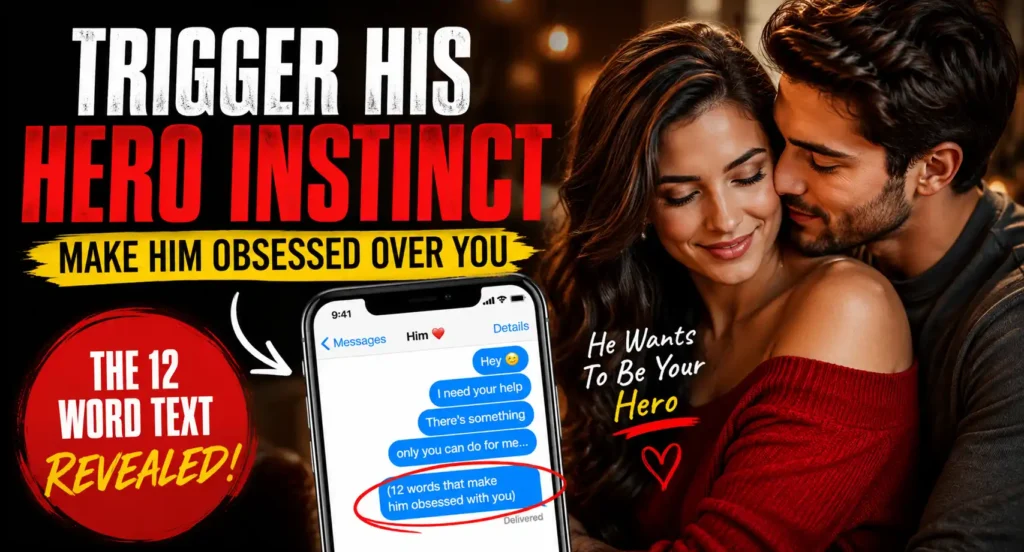
If you’ve spent any time on relationship advice sites or watched a few dating coach videos, you’ve probably come across the phrase “hero instinct.” Maybe you saw it in a YouTube ad, or a friend mentioned it, or you stumbled on it while scrolling late at night, wondering why the man in your life seems distant one week and completely devoted the next.
Here’s the good news: there’s a real, well-documented psychological pattern behind this phrase, and once you understand how it actually works, you can start using it — genuinely, not manipulatively — starting today.
This article covers what the hero instinct means, where the idea came from, what real psychology says about it, concrete examples and phrases, how to trigger it in a man you care about, and the “12-word text” everyone’s asking about.
Want To Learn More About the 12-Word Text That Triggers Hero Instinct in Men? Then Watch the Video Below
Watch: the full breakdown, explained in under 5 minutes
What Is the Hero Instinct?
The hero instinct is the idea that men have a deep, built-in drive to feel needed, useful, and respected — especially by the people they care about. When a man feels like he’s playing the role of a protector or provider for someone, he becomes more emotionally invested and committed to that relationship.
In simple terms: men don’t just want to be loved — they want to feel like they matter. They want to feel like they’re solving a problem, protecting someone, or being genuinely useful. When that need gets met, a man becomes more drawn to the person who makes him feel that way.
Here’s a simple way to picture what this actually looks like. Imagine two relationships side by side.
In the first, one partner regularly notices what the other does and says so out loud — something as ordinary as “thanks for handling that, I don’t know what I’d have done without you.” In the second, the same kind of effort goes unnoticed or is met with criticism rather than acknowledgment.
Over time, the man in the first relationship ends up far more emotionally invested than the one in the second. That gap in how appreciated he feels is really what the hero instinct is describing — and it’s something you have far more influence over than most women realize.
Hero Instinct Meaning: Breaking It Down
At its core, the hero instinct concept rests on three ideas:
- Men want to feel needed, not just wanted.
- Being useful to someone they love creates emotional attachment, not just gratitude.
- Small, specific moments — not grand gestures — are what activate this feeling.
This is often what explains why a man can seem distant in a relationship where he doesn’t feel “needed” for anything, and why he opens up and leans in more when a partner genuinely relies on him for support, advice, or help.
Is the Hero Instinct Real?
Yes and no — and that split answer is actually the most useful one available.
The desire to feel appreciated, respected, and useful to someone you love is very real, and it’s backed by decades of relationship research.1Understanding the need to be loved, PubMed Central. What’s more marketing shorthand than hard science is the idea that this is some singular, secret “instinct” hiding inside every man, waiting for one magic phrase to switch it on.
What psychologists actually point to, when explaining the same underlying feeling, includes:
- Self-determination theory, a well-established framework in psychology, which identifies competence (feeling capable and effective) as one of three core human needs, alongside autonomy and relatedness.
- Attachment theory, which describes how feeling emotionally safe and valued by a partner shapes how securely two people bond over time.
- Reciprocity and emotional validation, both studied extensively in relationship psychology,2Emotion Regulation and Relationship Satisfaction in Couple Therapy: What Happens Across Sessions?, PubMed Central. show that feeling one’s efforts are noticed and appreciated — not just tolerated — measurably improves relationship satisfaction.
- “Need to be needed” research in social psychology has shown that feeling useful to others boosts self-esteem and relationship satisfaction, again in people generally, not just men.
- Evolutionary psychology, which points to real sex differences in how mate-provider roles evolved — likely where the “hero instinct” framing borrows its logic.
So, the feeling being described is real and well-documented across several branches of psychology. That’s exactly why the technique works when it’s used sincerely — you’re tapping into something genuinely wired into how men bond, not a gimmick.
Is the Hero Instinct a Male Trait?
The idea is framed specifically around men, and that framing isn’t baseless — evolutionary psychology and research on male identity both point to provider and protector roles as historically central to how many men experience self-worth.
That said, “hero instinct” itself packages this into a tidier, more absolute story than the underlying research actually supports. Women benefit from feeling appreciated too, of course — but the specific dynamic of feeling like the protector, the one she needs, is something a lot of men do describe as mattering to them distinctly.
That’s worth knowing if you want this to actually land: the goal isn’t generic niceness. It’s making him feel specifically, personally needed — not replaceable, not one of several options, but genuinely relied on by you.
How to Trigger the Hero Instinct in Men
This is the part most articles skip past, so let’s get concrete. Triggering this response isn’t about tricks — it’s about consistently creating specific moments where he feels useful, capable, and needed. Here’s what that looks like in practice:
Ask for his help with something specific, not generic. “Can you help me with this?” is weak. “I’m stuck on this, and you’re so much better at figuring these things out than I am — can you help?” is strong. The specificity is what makes it land.
Let him solve the problem before you solve it yourself. If something breaks, a decision needs to be made, or you’re stressed about something — resist the urge to handle it solo first and then mention it after the fact. Bring him in while it’s still unresolved.
Say the appreciation out loud, and be specific about what he did. Generic praise (“you’re great“) fades into background noise. Specific appreciation (“the way you handled that call for me today — I really needed that, thank you“) sticks.
Trust his judgment on something and tell him so. “I trust your read on this more than mine” is a sentence that does more emotional work than most people realize.
Give him a role only he can fill. Frame things — genuinely — as needing him specifically, not just any help. That sense of being irreplaceable is where this really deepens.
None of this works as a one-time script. It works as a pattern, repeated consistently, because that’s how genuine emotional bonds actually form.
Want to go deeper than a single article can cover? There’s a more detailed video breakdown that walks through this concept step by step, with real-world examples of how it plays out — you can watch it below.
Watch: the full breakdown, explained in under 5 minutes
The “12 Words” and Hero Instinct Phrases
A huge share of the search interest around this topic comes from one specific claim: that there’s a “12-word text” you can send a man to trigger his hero instinct.
Here’s the honest answer: there’s no single universally “revealed” 12-word phrase that works for every man in every situation — anyone claiming to hand you an exact universal script for free is oversimplifying something that’s actually about timing, tone, and genuine connection, not just word choice.
What does hold up is the category of phrase that tends to work, because it follows the same psychological pattern:
- Asking for help with something specific (“I could really use your help with…“)
- Expressing that you trust his judgment on something (“I trust you to figure this out more than I trust myself“)
- Acknowledging a specific strength of his (“You always know exactly what to say when I’m stressed“)
- Requesting that only he, specifically, can fulfill (“I don’t want anyone else’s opinion on this but yours“)
Phrases like this work because they tap into genuine emotional needs — not because of secret wording, but because of what they communicate: you, specifically, matter to me here.
If you want the exact framework — including the full text message approach this concept is built around — there’s a video that breaks the whole thing down in detail.
Watch The Video Now →Hero Instinct Examples
To make this concrete, here’s what triggering the hero instinct actually looks like in real, everyday relationship moments:
- At home: Instead of quietly fixing something yourself, you say, “Can you take a look at this? You’re so much better at this than me.” He feels useful; you get help; the relationship gets a small deposit of connection.
- During a hard day: Instead of venting and expecting nothing back, you say, “I don’t know what to do about this — what would you do?” This invites him in as a problem-solver, not just a listener.
- After he does something for you: Instead of a quick “thanks,” you say, “That actually meant a lot — I don’t think you realize how much that helped me today.” Specific, genuine, and remembered.
- When making a decision together: Instead of deciding alone and informing him, you say, “I really want your take on this before I decide.” Small, but it signals his judgment matters to you.
- When you’re overwhelmed: Instead of trying to appear like you have it all handled, you let him see the moment and say, “I really need you right now.” Vulnerability, used genuinely, is one of the most consistent triggers here.
The common thread in every example: specificity, genuineness, and making him feel like the go-to person — not just a person who happened to help.
Signs You Already Trigger His Hero Instinct
If you’re wondering whether you already do this naturally, here are the commonly cited signs:
- He goes out of his way to help you, even with small things
- He seems more relaxed and open with you than with others
- He remembers details about your life and brings them up later
- He makes an effort to protect your time, energy, or feelings
- He seeks your approval or opinion on decisions
If several of these already describe your relationship, you’re likely already doing more of this than you realize — and there’s real value in doing it more deliberately rather than only by accident.
Hero Instinct in Movies and Mythology
The underlying pattern — someone becoming devoted to a person after being needed by them — is one of the oldest storytelling structures there is. You can see it in:
- Classical mythology, where heroes like Odysseus or Hercules are defined by trials undertaken to protect or rescue someone
- The “hero’s journey” structure identified by scholar Joseph Campbell, where a call to action often centers on saving or helping someone else
- Modern films, where romantic leads frequently fall for each other during moments of shared crisis or mutual rescue — a very common trope in action and adventure movies
This is worth noting because it shows the feeling being described — devotion built through being needed — is a genuinely old and recognizable human pattern that storytellers have understood for centuries, long before it got a modern name.
Hero Instinct Training: What People Mean by This
“Hero instinct training” usually refers to structured guides or programs that teach specific communication techniques for relationships, built around this concept — things like:
- Scripted phrases and text message approaches for different situations
- Guidance on when and how to ask for help from a partner
- Frameworks for building deeper emotional connections over time
The honest framing here is that no phrase or technique overrides how two specific people actually feel about each other — but having a structured approach, rather than guessing at what to say in the moment, tends to make it easier for most women to apply this consistently instead of only reaching for it occasionally.
This is exactly what the full video breakdown covers in more depth — the specific language, timing, and situations where this works best:
Watch The Video Now →Characteristics of a Hero (In This Context)
When people search for “characteristics of a hero” alongside this topic, they’re usually asking what qualities make someone feel like they’re fulfilling that protector/provider role. Commonly cited traits include:
- Reliability — showing up consistently, not just in big moments
- Competence — being capable in a way that’s useful to others
- Selflessness — helping without expecting something in return
- Confidence — acting decisively when it matters
- Emotional steadiness — staying calm and supportive under stress
Recognizing these traits in him — and telling him you notice them — is itself a form of triggering this response. Men rarely hear these things said out loud, which is exactly why it lands so effectively when you do say them.
The Bottom Line
The hero instinct describes a real, well-documented human need: the desire to feel useful, capable, and needed by people we care about — and for many men, this appears to matter in a particularly direct way. Understanding it gives you a genuinely useful lens for building a stronger, closer relationship.
What matters most isn’t a single magic phrase — it’s understanding the pattern well enough to apply it consistently, in your own words, in the moments that come up naturally in your relationship. If you want to see exactly how this plays out step by step, with real language and real scenarios, the video breakdown linked above walks through the whole framework in detail.
Frequently Asked Questions
Is the hero instinct a real psychological concept?
The underlying need is real and well-documented — it overlaps with established ideas like competence in self-determination theory and attachment theory. “Hero instinct” as a specific name is more recent, but it describes a genuine pattern in how men bond.
Is the hero instinct only about men?
Everyone benefits from feeling appreciated, but evolutionary psychology and research on male identity do point to protector and provider roles as historically tied to how many men experience self-worth — which is likely why this concept resonates so specifically with men, even though the underlying need for appreciation isn’t exclusive to them.
What are the 12 words that trigger the hero instinct?
There’s no single universal phrase that works for everyone — it’s really about a category of language (specific appreciation, trust, being needed) rather than one exact script. The full framework is covered in more detail in the video linked in this article.
Can the hero instinct explain why a man seems distant?
It’s often a real factor. Feeling unneeded can contribute meaningfully to emotional distance, and shifting how you invite him in can noticeably shift how present he is in the relationship.
Is triggering someone’s hero instinct manipulative?
Genuine appreciation and asking for help sincerely isn’t manipulation — it’s normal, healthy relationship behavior. It only becomes a problem if someone fakes needing help just to control another person’s emotions, which isn’t what this concept is describing.
Scientific References
- 1Understanding the need to be loved, PubMed Central. ↩︎
- 2Emotion Regulation and Relationship Satisfaction in Couple Therapy: What Happens Across Sessions?, PubMed Central. ↩︎
