
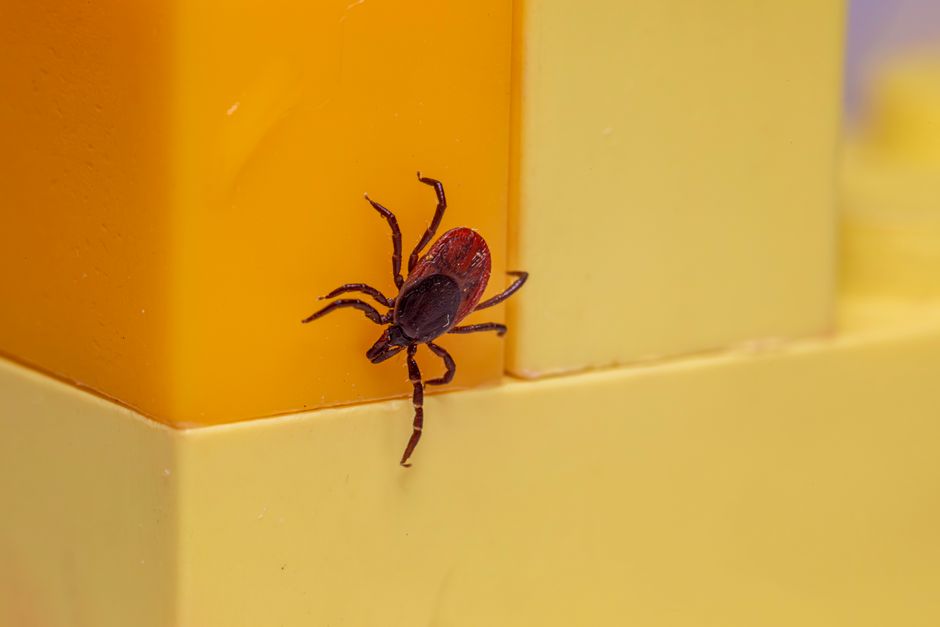
Yes, DEET repels ticks. It is one of a small number of chemicals that public health agencies and medical entomologists consistently recommend for tick bite prevention. DEET does not kill ticks. It interferes with the sensory receptors ticks use to find a host, so they lose the signal that tells them a person is nearby.
That distinction matters. A tick that never finds you cannot bite you. A tick that lands on treated skin often leaves without attaching. This is why DEET-based repellents remain a first-line tool against the ticks that carry Lyme disease and other infections.
How Does DEET Actually Repel Ticks?
DEET works by disrupting the tick’s ability to detect you. Ticks hunt by sensing carbon dioxide, body heat, and lactic acid from sweat. DEET molecules block the receptors ticks use to pick up these cues. The tick loses the trail.
This is different from how DEET affects mosquitoes. With mosquitoes, DEET also interferes with odor detection, but mosquitoes may still land on treated skin before flying off. Ticks behave similarly. They often crawl onto treated clothing or skin, then disengage and drop away without biting.
DEET is not an insecticide. It does not poison ticks. It also does not kill bacteria. If a tick bites you before it encounters DEET, the repellent does nothing to prevent infection. Timing and coverage matter more than the product itself.
One practical point people miss: DEET evaporates. Its protection window is limited, and it shortens further with sweating, swimming, or heavy rain. Reapplication is not optional on long outdoor days.
Does DEET Repel All Tick Species?
DEET is effective against the tick species that matter most for human disease in the United States. That includes the blacklegged tick (the deer tick that transmits Lyme disease), the lone star tick, and the American dog tick.
Effectiveness is not identical across species or life stages. Larval ticks, sometimes called seed ticks, are tiny and can be harder to repel simply because they are difficult to see and easy to miss during a skin check. Nymphs, which are about the size of a poppy seed, are responsible for most Lyme disease cases in the U.S. because they feed in spring and summer and are easily overlooked.
No repellent eliminates all tick bites. DEET reduces the odds. It does not replace a full-body tick check after time outdoors.
What Concentration of DEET Works Against Ticks?
Concentration affects how long DEET works, not how well it works at the moment of application. A 10 percent product and a 30 percent product repel ticks at similar strength initially. The higher concentration simply lasts longer before it evaporates.
- 10 to 30 percent DEET: reasonable protection for a few hours of outdoor activity
- 30 to 50 percent DEET: longer duration, useful for full-day hikes or heavy sweating
- Above 50 percent: no meaningful added benefit for most people, and more skin irritation
The Centers for Disease Control and Prevention notes that DEET concentrations above 50 percent do not provide additional protection. Products in the 20 to 50 percent range are widely available and adequate for most situations. Lower concentrations are reasonable for short outings, especially for people who prefer to reapply rather than use a stronger product.
No clinical guidelines currently exist for a universal “correct” DEET concentration for children. The American Academy of Pediatrics considers DEET safe for children over two months of age, and recommends concentrations of 10 to 30 percent for that age group. Products should not be applied to infants under two months.





How Should You Apply DEET to Prevent Tick Bites?
Application method determines whether DEET works. A poorly applied repellent leaves gaps, and ticks crawl. They do not fly. They move upward from the ground or drop from vegetation, so the lower body and waistband are common entry points.
Apply DEET to exposed skin and to clothing where the label permits. Do not apply it under clothing. Do not apply it to the face directly — spray it on your hands first, then wipe it on. Keep it away from the eyes, mouth, and any broken skin.
Treat the areas ticks reach first:
- Socks and the tops of shoes
- Lower legs and behind the knees
- Waistband and belt line
- Neck, hairline, and ears
DEET can damage some synthetic fabrics, plastics, and watch crystals. Permethrin, a different chemical, is used to treat clothing and gear rather than skin, and it kills ticks on contact. Many outdoor experts suggest combining DEET on skin with permethrin-treated clothing for the strongest protection. That combination is widely recommended but has not been tested in large head-to-head human trials comparing it to DEET alone.
After coming indoors, wash treated skin with soap and water and wash clothing before wearing it again.
Is DEET Safe, and What Are the Real Risks?
DEET has been used by the public since the 1950s and has a long safety record when applied as directed. Serious reactions are rare. Most reported problems are skin irritation, redness, or a burning sensation at the application site.
Rare neurological effects have been reported, mostly in cases involving heavy or prolonged exposure, misuse, or ingestion. The evidence does not support the idea that normal use of DEET causes neurological harm in healthy adults or children. That said, the safety data for infants under two months is essentially absent, and no clinical guidelines exist for DEET use in that group.
Common myths about DEET are worth correcting directly:
- DEET does not cause cancer. No credible evidence supports this.
- DEET is not a neurotoxin at normal exposure levels. The label directions exist for a reason, but they are not a warning about routine use.
- DEET does not need to be avoided in favor of “natural” alternatives. Some plant-based repellents have evidence behind them, but most have shorter effective windows than DEET.
Pregnant women can use DEET. The evidence does not indicate harm, and the risk of a tick-borne infection during pregnancy is a real concern. Anyone with a specific medical question should ask a clinician.
Is DEET Better Than Other Tick Repellents?
DEET and picaridin are the two skin repellents with the strongest evidence for repelling ticks. Picaridin is a synthetic compound developed as an alternative to DEET. It performs similarly against ticks, has less odor, and does not damage plastics or fabrics the way DEET can.
Some studies suggest picaridin may be slightly less effective than DEET against certain tick species, but the difference in real-world use is small. Both are reasonable choices. The best repellent is the one you will actually apply and reapply.
Other options have weaker or more limited evidence:
- Permethrin: applied to clothing, not skin, and kills ticks on contact. Strong evidence for this use.
- Oil of lemon eucalyptus: has some evidence against ticks, but a shorter protection window than DEET.
- Essential oils (citronella, cedar, geranium): limited and inconsistent evidence. Not reliable as a primary defense against ticks.
No repellent replaces the basics. Wear light-colored clothing so ticks are easier to spot. Tuck pants into socks. Stay on trails and avoid tall grass and leaf litter. Do a full-body tick check within a few hours of coming inside, paying attention to the scalp, ears, armpits, groin, and behind the knees. Showering soon after outdoor activity can help wash off unattached ticks.
If you find an attached tick, remove it promptly with fine-tipped tweezers, pulling straight up with steady pressure. The risk of Lyme disease transmission rises the longer a tick stays attached, so removal speed matters. DEET reduces your chance of a bite. It does not change what to do once a bite has happened.
Frequently Asked Questions
Does DEET repel ticks or kill them?
DEET repels ticks by blocking the receptors they use to detect a host. It does not kill ticks or the bacteria they carry.
What percentage of DEET is best for ticks?
Concentrations between 20 and 50 percent provide adequate protection for most activities. Concentrations above 50 percent do not add meaningful protection and increase the risk of skin irritation.
Can I use DEET on children to prevent tick bites?
The American Academy of Pediatrics considers DEET safe for children over two months of age, at concentrations of 10 to 30 percent. It should not be used on infants under two months.
Is picaridin as good as DEET for ticks?
Picaridin performs similarly to DEET against ticks and is a reasonable alternative, especially for people who dislike DEET’s odor or its effect on plastics. Some studies suggest it may be slightly less effective against certain tick species.
