
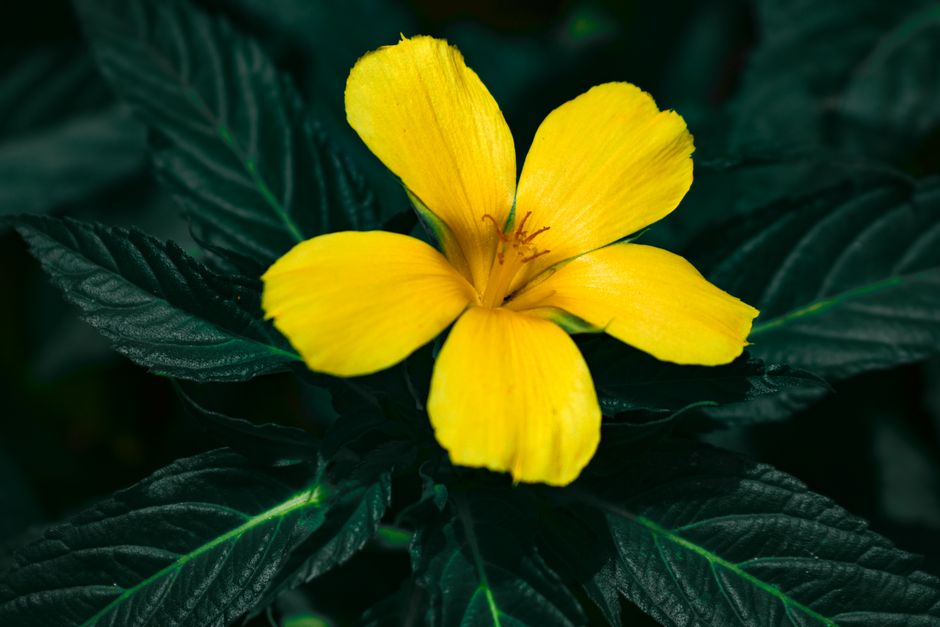
Damiana is a shrub native to Mexico, Central America, and parts of South America, and its leaves have a long history of use as a folk remedy for low libido and low energy. The question of whether it raises or lowers estrogen comes up often, and the honest answer is that the evidence does not clearly support either claim in humans. Most of what circulates online comes from lab studies, animal research, or traditional use rather than controlled human trials.
Does Damiana Increase Estrogen Or Lower It?
There is no reliable human evidence that damiana meaningfully raises or lowers estrogen levels. The few studies that exist were done in test tubes or animals, and their results do not translate cleanly to people.
Some lab research has looked at whether damiana compounds bind to estrogen receptors. Receptor binding in a petri dish is not the same as changing circulating hormone levels in a living human body. A substance can interact with a receptor in a lab and still have little measurable effect on blood estrogen in a person.
What complicates the picture further is that damiana contains a mix of plant compounds, including flavonoids and other phytochemicals. Some plant compounds in this broad category are classified as phytoestrogens, meaning they can weakly mimic estrogen. But “can weakly mimic” is not the same as “raises estrogen levels.” Many factors determine whether a plant compound has any noticeable hormonal effect, including dose, how it is absorbed, and individual biology.
The bottom line: claims that damiana boosts estrogen, or that it lowers it, are not supported by solid human data. If you see a confident statement either way, it is usually based on extrapolation, not direct evidence.
What Does Research Actually Show About Damiana and Hormones?
The research on damiana and hormones is thin and mostly preliminary. This matters because the gap between preliminary findings and established fact is where most misinformation lives.
Most studies on damiana have focused on other questions entirely, such as its traditional use for mood, anxiety, or sexual function. Hormone effects have typically been a side observation or a lab-based finding, not the main focus of well-designed human trials.
Animal studies have looked at damiana’s effect on sexual behavior and, in some cases, reproductive markers. Results have been inconsistent, and animal reproductive physiology differs from human physiology in important ways. A finding in rats or mice does not automatically apply to people.
There is also the matter of how damiana products are made. Supplements vary widely in how they are prepared, what plant part is used, and how concentrated the final product is. Two bottles labeled “damiana” can contain very different amounts of active compounds. This makes it hard to compare studies or draw firm conclusions about real-world effects.
No large, well-controlled human trial has established that damiana changes estrogen levels in either direction. That is the accurate state of the evidence.
Why Do People Think Damiana Affects Estrogen?
The belief that damiana affects estrogen comes from a few overlapping sources, and understanding them helps explain why the claim persists despite weak evidence.
First, damiana contains flavonoids and related plant compounds. Flavonoids are a large, diverse group found in many plants, and some members of this group have shown weak estrogen-like activity in lab settings. This has led to the assumption that any plant with flavonoids must affect estrogen. That assumption is not reliable. Most flavonoids have little to no measurable hormonal effect in humans at typical intake levels.
Second, damiana has traditionally been used for sexual and reproductive concerns. Because estrogen plays a role in sexual function and the menstrual cycle, people have connected the dots and assumed a hormonal mechanism. Traditional use is not evidence of a mechanism, even when the tradition is centuries old.
Third, the supplement industry often markets herbal products with vague references to “hormone balance” without specifying what that means or providing evidence. This language spreads easily and gets repeated as fact.
A related point worth clarifying: “phytoestrogen” is a broad category, not a single effect. Different phytoestrogens behave differently, and some can act in ways that are not simply “more estrogen” or “less estrogen.” Even for well-studied phytoestrogens like those in soy, the effects on human hormones are modest and depend on many factors. Damiana is far less studied than soy.





Is Damiana a Phytoestrogen?
Damiana is sometimes described as a phytoestrogen, but that label is applied loosely and is not well established for this plant. The term gets used for many plants that show any estrogen-related activity in a lab dish, which is a low bar.
Being called a phytoestrogen does not mean a plant will raise estrogen levels in your body. Phytoestrogens are plant compounds that can bind to estrogen receptors, but their effects depend on how strongly they bind, how the body processes them, and what else is going on hormonally.
Some phytoestrogens act more like weak estrogens. Others can partly block estrogen’s effects in certain tissues. The net effect in a living person is often small and hard to predict. For damiana specifically, there is not enough human research to say which category it falls into, or whether it has any meaningful hormonal effect at all.
If a product label calls damiana a phytoestrogen, treat that as a marketing description rather than a confirmed biological fact.
What Should You Know Before Using Damiana?
Damiana is generally sold as a dietary supplement, which means it is not held to the same safety and effectiveness standards as prescription drugs in the United States. Supplements are not required to prove they work before being sold.
Safety information on damiana is limited. There is no strong body of human data establishing a safe dose, long-term safety, or how it interacts with medications. Because of this, anyone considering damiana should be cautious, especially in situations where hormone effects could matter.
People who should be particularly careful include:
- Anyone who is pregnant or breastfeeding — no clinical guidelines establish a safe dose for these groups, and hormonal effects on a developing baby or nursing infant are not well studied.
- People with hormone-sensitive conditions, such as certain breast, uterine, or ovarian conditions, where any estrogen-like activity could be a concern. This is a precaution based on the possibility of hormonal activity, not confirmed harm.
- People taking medications, especially hormonal medications, because interactions have not been well studied.
- Children and adolescents — no clinical guidelines exist for damiana use in these groups.
There is also the practical issue of product quality. Independent testing has repeatedly found that herbal supplements sometimes contain ingredients not listed on the label, or amounts that differ from what is claimed. This is a general problem in the supplement market, not unique to damiana.
If you are considering damiana for a specific health concern, the most useful step is to talk with a clinician who knows your history. This is not a suggestion to avoid the conversation — it is because the evidence is too limited to give blanket guidance.
How Does Damiana Compare to Other Herbal Hormone Aids?
Damiana is often grouped with other herbs marketed for hormonal or sexual health, but the evidence base varies a lot from one herb to another. Grouping them together can be misleading.
Some herbs have been studied more thoroughly in humans than damiana. Others have even less evidence. The table below gives a general sense of how the evidence stacks up, but keep in mind that “more studied” does not automatically mean “effective” or “safe.”
| Herb | Commonly Marketed For | Human Evidence on Hormones |
|---|---|---|
| Damiana | Libido, energy, mood | Very limited; mostly lab and animal studies |
| Soy isoflavones | Menopausal symptoms | Extensively studied; effects on hormones are modest |
| Red clover | Menopausal symptoms | Studied in humans; results mixed |
| Black cohosh | Menopausal symptoms | Studied in humans; hormone effects unclear |
The key takeaway is not that one herb is better than another. It is that damiana sits near the bottom of the list when it comes to human evidence, so confident claims about its hormonal effects are not justified.
What Is the Bottom Line on Damiana and Estrogen?
The honest answer is that we do not know whether damiana raises or lowers estrogen in humans, because the research needed to answer that question has not been done. Lab and animal findings hint at possible hormonal activity, but they do not establish what happens in people.
If you are looking for something to change your estrogen levels, damiana is not a well-supported choice. If you are simply curious about the plant, the accurate position is that its hormonal effects are unproven and its safety profile is not well characterized.
Be skeptical of any source that states damiana’s effect on estrogen as settled fact. The evidence does not support that level of confidence in either direction. When the science is genuinely unclear, the most honest thing anyone can tell you is that it is unclear.
Frequently Asked Questions
Does damiana increase estrogen?
No reliable human evidence shows that damiana increases estrogen levels. Lab studies hint at possible weak hormonal activity, but this has not been confirmed in people.
Does damiana lower estrogen?
There is no solid human evidence that damiana lowers estrogen either. Claims in both directions are based on preliminary or indirect findings, not controlled human trials.
Is damiana safe to take?
Safety data on damiana is limited, and no established safe dose exists for most groups, including pregnant and breastfeeding women. Talk with a clinician before using it, especially if you take medications or have a hormone-sensitive condition.
Is damiana a phytoestrogen?
It is sometimes labeled a phytoestrogen, but that term is applied loosely and is not well established for this plant. Even true phytoestrogens often have only small, unpredictable effects on human hormone levels.
