

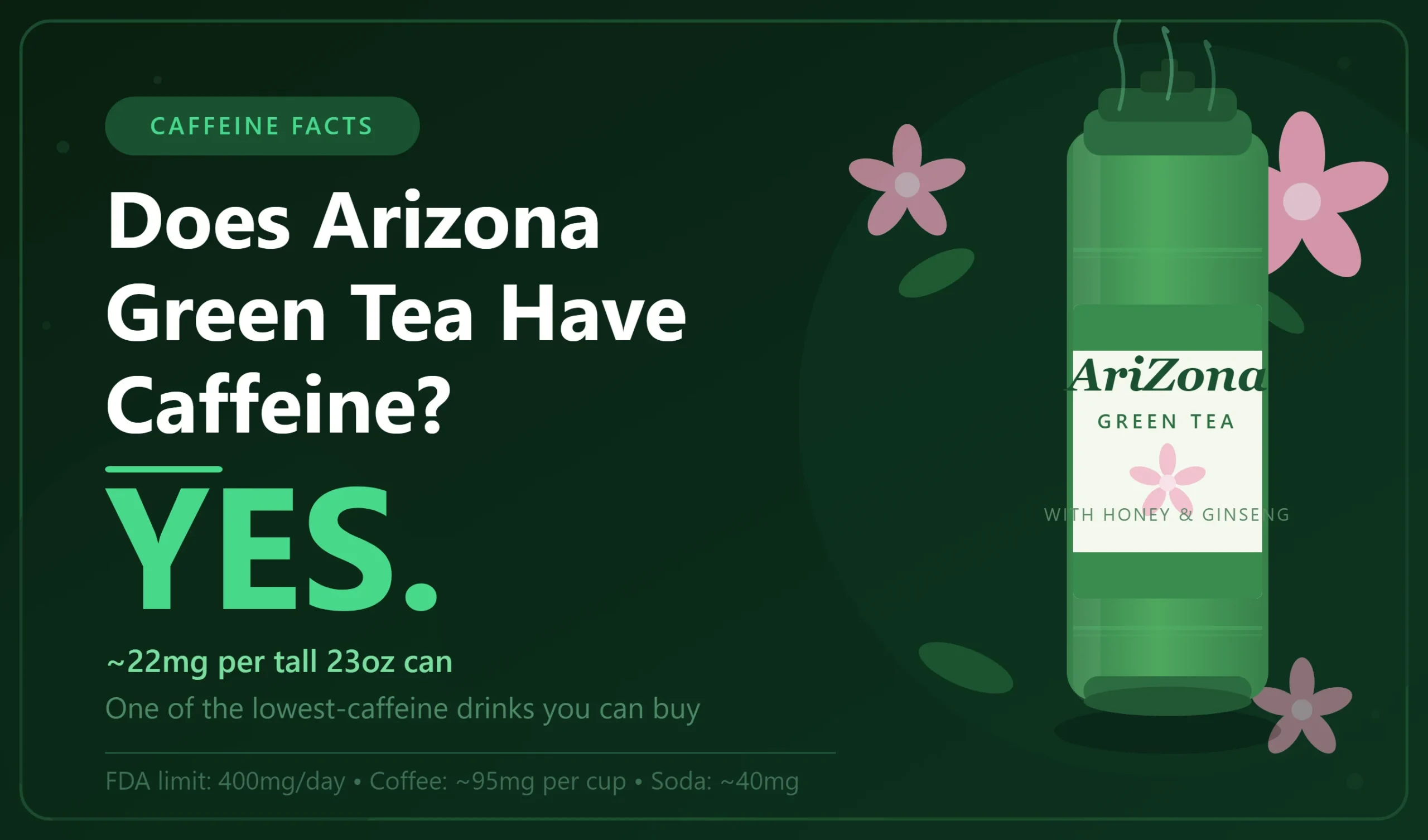
Does Arizona Green Tea Have Caffeine?
Yes — but only a small amount. Arizona Green Tea contains about 7.5 mg of caffeine per 8 oz, according to the brand’s own figures. A standard 23 oz tall can has roughly 22 mg total. That is far less than coffee, black tea, or even a can of soda. For most people, it is a very low-caffeine drink.
You just cracked open a can of Arizona Green Tea — that familiar tall can with the pink flowers — and you’re wondering: does Arizona Green Tea actually have caffeine in it?
The short answer is yes, it does. But the amount is so small that most people never feel a thing from it. It is nothing like a cup of coffee. It is not even close to a soda.
Arizona Green Tea is made from real green tea leaves, which naturally contain a small amount of caffeine. But the way it is brewed and diluted brings that number way down. What you end up with is one of the lightest caffeinated drinks on the market.
This article gives you the exact numbers by can size, tells you how it stacks up against other drinks, and explains who might still want to pay attention to even that small amount.
How Much Caffeine Is In Arizona Green Tea
The first thing most people want to know is a simple number. Here it is, broken down by every size Arizona sells.
Arizona officially states that their green tea contains 7.5 mg of caffeine per 8 oz serving. Everything else is just math from that base rate. The table below does it for you.
| Can / Bottle Size | Total Caffeine (approx.) | Coffee Equivalent |
|---|---|---|
| 8 fl oz (1 label serving) | ~7.5 mg | Less than 1/10 cup of coffee |
| 12 fl oz can | ~8–10 mg | About 1/10 cup of coffee |
| 16 fl oz bottle | ~15 mg | About 1/6 cup of coffee |
| 20 fl oz bottle | ~19 mg | About 1/5 cup of coffee |
| 22 fl oz can | ~15–18 mg | About 1/6 cup of coffee |
| 23 fl oz tall can (most common) | ~22 mg | About 1/4 cup of coffee |
Source: AriZona Beverages’ official figures — 7.5 mg per 8 fl oz serving. The 12 oz and 22 oz figures are from the brand’s own published data. All other sizes are calculated from the same base rate.1Portion, package, or tableware size for changing selection and consumption of food, alcohol, and tobacco, PubMed Central.↓
To put that in plain terms: even if you drink the biggest 23 oz tall can from start to finish, you are getting about 22 mg of caffeine. That is roughly what you’d find in a small piece of dark chocolate. It is a very modest amount.
One thing worth knowing: the label on most Arizona Green Tea cans lists two servings per container. So when you see “7.5 mg per serving” on the nutrition facts, the full can has double that. Many people miss this and think the caffeine is even lower than it already is.
Why Does Arizona Green Tea Have So Little Caffeine?
This is the question most articles skip. The numbers are low — but why?
If you brew a regular cup of green tea at home and steep it for a few minutes, you get somewhere around 28 to 35 mg of caffeine per 8 oz. That is three to four times more than what Arizona Green Tea gives you in the same amount.
Same type of tea. Very different caffeine levels. Here is why.
Arizona Green Tea is made using a liquid concentrate, not freshly steeped leaves. That concentrate is then diluted heavily with water before it goes into the can. By the time it reaches you, the tea has been thinned down significantly — and so has the caffeine.
On top of that, the drink contains added sweeteners (honey and high fructose corn syrup), water, and other ingredients. The actual brewed tea is a smaller portion of what is in that can than most people assume.
Think of it like making a juice drink: if you mix a little bit of orange juice with a lot of water and sugar, the final drink is lighter than pure orange juice. Arizona Green Tea works the same way.
This is not a criticism — it is just how ready-to-drink teas are made. The result is a refreshing, lightly caffeinated drink that sits far below coffee, black tea, and even most sodas on the caffeine scale.
One more thing: Arizona Green Tea also contains a small amount of ginseng. Ginseng is an herbal ingredient, and it does not contribute any caffeine. It is added for a mild energizing feel, but it works through a completely different mechanism than caffeine does.
So if Arizona Green Tea gives you a slight lift, it is not because of a caffeine spike. It is a combination of that low caffeine dose and the gentle effect of ginseng — which is why the experience feels nothing like coffee.
How It Compares to Other Drinks
Numbers mean more when you have something to compare them to. Here is where Arizona Green Tea sits against the drinks most people reach for every day.
| Drink | Typical Serving | Caffeine | Caffeine Level |
|---|---|---|---|
| Arizona Green Tea | 23 oz tall can | ~22 mg | |
| Brewed Green Tea | 8 oz cup | ~28–35 mg | |
| Cola Soda | 12 oz can | ~35–45 mg | |
| Brewed Black Tea | 8 oz cup | ~47 mg | |
| Drip Coffee | 8 oz cup | ~95 mg | |
| Energy Drink | 16 oz can | ~80–160 mg | |
| Espresso | 1 oz shot | ~63 mg |
The gap is striking. A single shot of espresso — just one ounce — has nearly three times more caffeine than an entire 23 oz can of Arizona Green Tea. A standard energy drink can have up to seven times more.
Even a regular soda has more caffeine than a full tall can of Arizona Green Tea.
The FDA considers up to 400 mg of caffeine per day safe for most healthy adults.2Spilling the Beans: How Much Caffeine is Too Much?, FDA.GOV ↓At just 22 mg per tall can, you would need to drink 18 cans of Arizona Green Tea to reach that limit. For the overwhelming majority of people, this drink is a non-issue from a caffeine standpoint.
Why the Energy Feels Different — The L-Theanine Effect
Here is something most people notice but cannot explain. Arizona Green Tea gives you a calm, easy feeling — not the jittery buzz you get from coffee. That is not your imagination. There is a real reason for it.
Green tea leaves naturally contain an amino acid called L-theanine. It is not caffeine, but it interestingly works alongside caffeine. L-theanine helps your brain produce alpha waves — the same kind of relaxed-but-focused state you feel during light meditation or a quiet walk.
When a small amount of caffeine pairs with L-theanine, the result feels smoother. The caffeine lifts your alertness gently. The L-theanine takes the edge off. No spike. No crash. Just a mild, easy lift.
This combination is unique to tea. You do not get it from coffee, soda, or energy drinks. It is one reason why tea drinkers often describe the feeling as “clean” compared to other caffeinated drinks.
Arizona Green Tea is made from real green tea extract, so it does carry some L-theanine. The exact amount is not printed on the label — the brand does not publish that number. But given how diluted the drink is, the L-theanine content is also modest, just like the caffeine.
Still, even a small amount of L-theanine can shape the experience. It is a big part of why Arizona Green Tea feels like a refreshing drink rather than a stimulant. If you have ever switched from coffee to green tea and felt calmer without feeling less alert, this is the science behind that shift.
Who Should Still Pay Attention to That Caffeine
For most people, 22 mg of caffeine is nothing to think about. But a small group of people genuinely need to watch even low amounts. Here is who that includes.
Pregnant women
For women who are pregnant or trying to become pregnant, the recommended limit is around 200 mg of caffeine per day. A single can of Arizona Green Tea is well under that. But if you are already drinking coffee, tea, or soda throughout the day, every milligram adds up. It is worth counting all your sources together, not just this one drink.
Children and teenagers
Currently, there are no established safe caffeine guidelines for adolescents. Most health organizations advise children to avoid caffeine altogether when possible. Arizona Green Tea is not marketed for kids, but it is a popular drink at schools and family gatherings. If you are buying it for a child, it is worth knowing there is caffeine in it — even if the amount is small.
People sensitive to caffeine
Some people feel caffeine strongly even at low doses. If you notice anxiety, a faster heartbeat, or trouble sleeping after just a small amount of coffee or tea, you likely fall into this group. For you, even 15 to 22 mg per can could matter — especially if you drink more than one.
People on certain medications
Caffeine can have effects on medicines or supplements you take. It may also increase symptoms of some conditions, such as anxiety disorders or certain heart conditions. If you take prescription medication regularly, it is a good idea to ask your doctor whether caffeine — even at low levels — is something to watch.
For everyone else — healthy adults who are not pregnant and do not have a caffeine sensitivity — Arizona Green Tea sits so far below the daily safe limit that it is simply not a concern.
Is Arizona Green Tea Safe to Drink Every Day?
From a caffeine standpoint, yes — drinking one can of Arizona Green Tea every day is completely fine for most healthy adults. The caffeine level is so low it barely registers against the daily safe limit. That part is easy.
But here is something most articles on this topic do not tell you: the bigger question is not the caffeine. It is the sugar.
A standard 23 oz tall can of Arizona Green Tea contains roughly 51 grams of sugar. That comes from the honey and high fructose corn syrup used to sweeten it. The drink may feel light and natural, but the sugar content is anything but small.
To put that in context — the American Heart Association recommends no more than 25 grams of added sugar per day for women and 36 grams for men. One tall can of Arizona Green Tea puts you well past that limit on its own.
Over time, regularly consuming that much added sugar — from any source — is linked to weight gain, blood sugar issues, and increased risk of heart disease. This has nothing to do with the caffeine. The tea itself and the small amount of ginseng are not the problem.
If you enjoy Arizona Green Tea regularly, a few simple choices help:
- Stick to smaller sizes — an 8 oz or 12 oz serving keeps both caffeine and sugar at a reasonable level.
- Try the Diet version — Arizona offers a diet green tea that uses sugar substitutes and dramatically cuts the sugar content.
- Treat it like a sweet drink — think of it the way you would a juice or flavored soda, not a plain cup of tea.
The drink is not unhealthy in moderation. But drinking a full tall can every day — while believing it is as clean as a simple cup of green tea — is a gap worth knowing about.
Frequently Asked Questions
Does Arizona Green Tea have caffeine?
Yes. Arizona Green Tea contains about 7.5 mg of caffeine per 8 oz serving. A full 23 oz tall can has roughly 22 mg total — a very low amount compared to most other drinks.
How much caffeine is in a 23 oz can of Arizona Green Tea?
About 22 mg. That is based on Arizona's official figure of 7.5 mg per 8 oz serving. Even drinking the whole can puts you far below the FDA's 400 mg daily safe limit for adults.
Is Arizona Green Tea caffeine-free?
No. It does contain caffeine, but only a small amount. If you need a truly caffeine-free option, Arizona's Red Tea or herbal varieties are naturally caffeine-free.
Can pregnant women drink Arizona Green Tea?
The caffeine in one can is well below the 200 mg daily limit recommended during pregnancy. However, the high sugar content is a bigger concern. Talk to your doctor about what works best for you.
Does Arizona Green Tea have more or less caffeine than coffee?
Far less. A single 8 oz cup of drip coffee has about 95 mg of caffeine. A full 23 oz can of Arizona Green Tea has about 22 mg. Coffee has roughly four times more caffeine per ounce.
Is Arizona Green Tea safe for people sensitive to caffeine?
It is one of the lowest-caffeine drinks available, but caffeine-sensitive people can still react to small amounts. If coffee or regular tea bothers you, start with a small serving and see how you feel.
Can kids drink Arizona Green Tea?
It is not recommended. There is no established safe caffeine limit for children, and the high sugar content makes it a poor everyday choice for kids regardless of the caffeine.
Scientific References
- 1Portion, package, or tableware size for changing selection and consumption of food, alcohol, and tobacco, PubMed Central. ↩︎
- 2
