
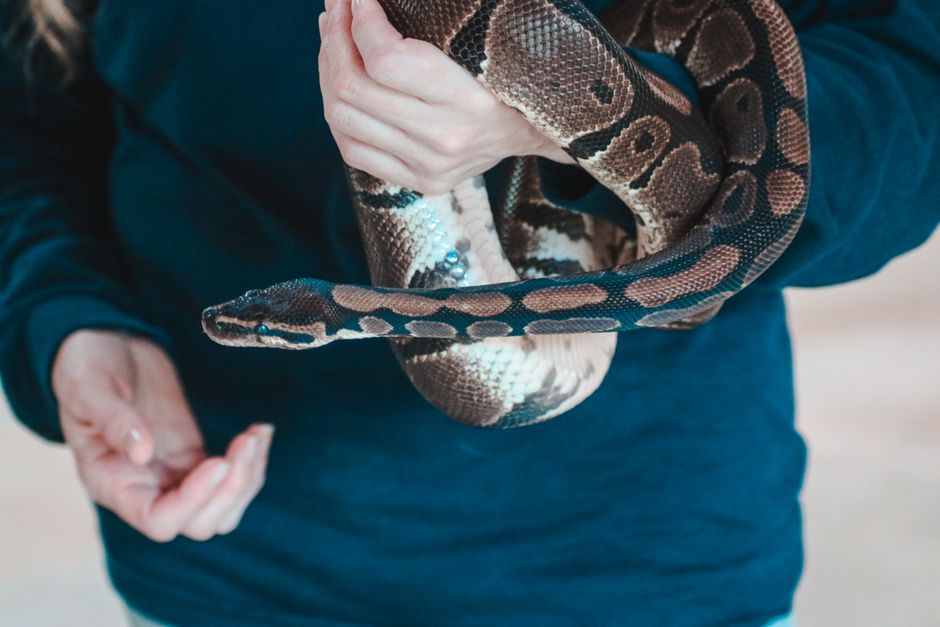
Yes, royal pythons have teeth. They are not fangs, and they do not deliver venom. A royal python’s mouth is lined with dozens of small, sharp, backward-curving teeth, and those teeth serve a very specific purpose that has nothing to do with chewing.
Royal pythons are non-venomous constrictors. Their teeth are built to grab and hold prey, not to kill it with a bite. Understanding what those teeth can and cannot do clears up a lot of confusion about handling, feeding, and bite risk.
Do Royal Pythons Have Teeth or Just Fangs?
Royal pythons have teeth. They do not have fangs in the way most people picture them, meaning large hollow teeth that inject venom. What they have instead is a set of many small, solid teeth arranged in rows along both the upper and lower jaws.
The upper jaw also contains two rows of teeth on a bone called the palatine and pterygoid region, which sits along the roof of the mouth. That gives a royal python several rows of teeth working together rather than a single row like most mammals. This arrangement is common across pythons and many other non-venomous snakes.
It helps to separate two ideas that often get blended together:
- Fangs are enlarged teeth, usually hollow or grooved, connected to venom glands. Venomous snakes have them.
- Teeth are smaller, solid, and used for gripping. Non-venomous snakes like royal pythons have these.
So the accurate answer is that a royal python has teeth but no fangs. It has no venom glands and no venom delivery system at all.
What Do Royal Python Teeth Look Like?
Royal python teeth are small, thin, and curved backward toward the throat. They are easy to miss because they sit low in the mouth and the snake usually keeps its mouth closed.
The backward curve is the key feature. It works like a one-way grip. Once prey is caught, the curve points inward toward the throat, so forward movement of the prey pushes it deeper into the mouth rather than letting it slip out. This is the same basic principle seen in many fish-hooking and gripping structures in nature.
Because the teeth are fine and angled, they are not designed to tear or slice large pieces of flesh. A royal python is not built to chew. It swallows prey whole, and the teeth simply help start that process and keep the prey from escaping.
Teeth are also replaced throughout the snake’s life. Like other snakes, a royal python continually sheds and regrows teeth, so a lost or broken tooth is not a permanent problem the way it would be for a mammal.
Why Do Royal Pythons Have Teeth If They Constrict?
Constriction is how a royal python kills. The teeth are how it holds on long enough to constrict. Both jobs matter, and they happen in sequence.
When a royal python strikes, it does not bite to kill. It bites to grab and anchor. The teeth sink in and hold the prey in place. The snake then wraps its body around the prey and tightens. Constriction works by preventing the prey from breathing and by cutting off blood flow, which is what actually causes death. The teeth are not the lethal part of the process.
This is worth stating clearly because it corrects a common misunderstanding. People sometimes assume that a snake bite is what subdues prey. For royal pythons, the bite is a grip. The body coil does the rest.
In captivity, this sequence matters for feeding. A royal python that grabs a rodent and coils is behaving normally. The teeth are doing exactly what they are supposed to do, which is holding the prey steady until constriction finishes the job.





Can a Royal Python Bite Hurt You?
A royal python bite can hurt, but it is rarely serious. The teeth are small and the snake is not venomous, so the main concerns are puncture marks, minor bleeding, and the surprise of the strike itself.
Royal pythons are known for being one of the more docile and manageable python species kept as pets. They are generally reluctant to bite compared to many other snakes. That said, any snake with a mouth can bite under the right conditions. Common triggers include:
- Feeding mistakes, such as a hand smelling like a rodent
- Feeling threatened or cornered
- Being handled roughly or grabbed suddenly
- Stress during shedding or after a stressful move
The most common bite scenario in captivity is a feeding response. A royal python that is in feeding mode may strike at a warm hand that enters the enclosure, mistaking it for prey. This is a case of mistaken identity, not aggression.
If a bite happens, the teeth may catch on the skin. Because they curve backward, pulling straight away can tear the skin or break teeth. The safer approach is to stay calm, let the snake release on its own, and avoid yanking. If a tooth is left behind in the skin, it should be removed carefully, and the wound should be cleaned and monitored. Anyone who is unsure how to handle a retained tooth or a wound that will not stop bleeding should seek medical care.
How Do You Avoid Getting Bitten by a Royal Python?
Most royal python bites are preventable, and the fixes are practical rather than complicated. The goal is to keep the snake from confusing your hand with food and to reduce situations where it feels threatened.
Feeding with tongs is the single most effective habit. It keeps your hand out of the strike zone and helps the snake associate the tongs, not your fingers, with food. Feeding in the enclosure is common and fine for many keepers, but the key is what enters the space and how.
Washing your hands before handling can also help. If your hands carry the scent of rodents or other prey animals, a royal python may read that as a feeding cue. Handling at a calm, unhurried pace and supporting the snake’s body rather than grabbing it reduces stress.
Reading body language matters too. A royal python that is coiled tightly, hissing, or holding its head in a striking position is telling you it is not in the mood to be handled. Respecting that signal prevents most defensive bites.
It is also worth knowing that royal pythons can go off food for periods, and this is often normal rather than a sign of illness. A snake that is not eating may still strike at a hand out of a feeding response. Handling during those times calls for extra care.
Do Royal Python Teeth Pose Any Health Risk to Humans?
The teeth themselves are not venomous, so the direct risk is limited to the wound. The bigger consideration is infection, which applies to any animal bite that breaks the skin.
A snake’s mouth carries bacteria, as do human skin and the environment. A bite that punctures the skin creates a small open wound where bacteria can enter. For that reason, cleaning a bite promptly and watching for signs of infection is sensible. Signs that warrant medical attention include increasing redness, swelling, warmth, pus, or fever.
People with weakened immune systems, diabetes, or poor circulation should take any bite more seriously and consider having it looked at. This is general wound-care guidance that applies to animal bites broadly, not something unique to royal pythons.
There is no evidence that royal python teeth carry venom or that a bite from one causes envenomation. That concern simply does not apply to this species.
Do Royal Python Teeth Grow Back?
Royal python teeth grow back. Snakes replace their teeth continuously throughout their lives, so a tooth lost during a bite or feeding is typically regrown over time.
This is one reason a broken tooth during a bite is not a lasting injury for the snake. The replacement process is ongoing, similar to how snakes shed their skin on a regular cycle. It is a normal part of their biology rather than a repair that requires intervention.
For the keeper, the practical takeaway is simple. If a bite leaves a tooth behind, that tooth will be replaced by the snake, and the priority is caring for the wound on your own skin rather than worrying about the snake’s mouth.
Frequently Asked Questions
Do royal pythons have teeth?
Yes, royal pythons have many small, sharp, backward-curving teeth in both jaws. They have no fangs and no venom.
Are royal python bites dangerous?
Royal python bites are rarely serious because the snake is not venomous and its teeth are small. The main risks are minor puncture wounds and possible infection, so cleaning the wound matters.
Do royal pythons have fangs?
No, royal pythons do not have fangs. Fangs are enlarged venom-delivering teeth found in venomous snakes, and royal pythons have neither fangs nor venom glands.
How do you get a royal python to let go when it bites?
Stay calm and let the snake release on its own rather than pulling away, since the backward-curving teeth can tear skin or break if you yank. Seek medical care if bleeding will not stop or a tooth is stuck in the skin.
