
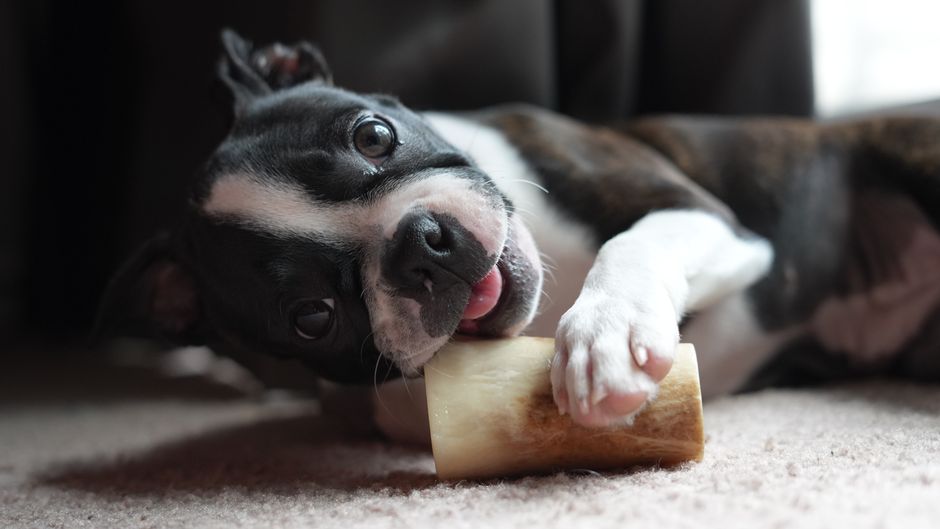
Dogs do not digest bones the way they digest meat or kibble. A dog’s stomach can break down some soft bone and absorb the minerals inside it, but hard bone fragments often pass through the gut largely intact or lodge somewhere along the way. That difference matters, because “dogs can eat bones” and “dogs can digest bones” are two very different claims.
This article explains what actually happens to a bone after a dog swallows it, which bones pose the greatest risk, and why veterinarians treat bone ingestion as a genuine medical concern rather than a natural part of a dog’s diet.
What Happens to a Bone After a Dog Swallows It?
Digestion of bone begins with mechanical breakdown in the mouth, and most dogs do very little of it. Dogs gulp more than they chew, so a swallowed bone often reaches the stomach as a sharp-edged piece rather than a ground-up paste.
In the stomach, strong acid and enzymes go to work. Gastric acid is powerful enough to soften and partially dissolve small, thin pieces of bone over time. This is why some raw-fed dogs pass soft bone fragments that are barely visible in the stool. The minerals — mostly calcium and phosphorus — can be released and absorbed in the small intestine if the bone has been broken down enough by that point.
The problem is timing and size. A large or dense fragment may leave the stomach before acid has done much to it. From there it travels through the small intestine, where the gut cannot grind it down further. Whatever survives that journey either passes out in the stool or gets stuck.
Size and type matter more than anything else
- Thin, soft, raw bones break down far more readily than cooked ones
- Cooked bones become brittle and splinter into sharp shards
- Large weight-bearing bones from big animals resist digestion almost entirely
- Small round bones can lodge in the throat or windpipe
The single most important fact here is that cooking changes bone structure. Heat makes bone hard and brittle. A raw chicken wing bone bends and crushes; a cooked one shatters. This is the basis for the widely repeated warning against feeding cooked bones.
Why Are Cooked Bones More Dangerous Than Raw Bones?
Cooked bones splinter. That is the core issue, and it is well established in veterinary practice.
When bone is heated, the collagen matrix that gives it flexibility breaks down. What remains is a rigid, brittle structure that cracks into sharp fragments under pressure. Those fragments can scrape or puncture the lining of the mouth, esophagus, stomach, or intestine.
Raw bones are softer and tend to crush or bend rather than shatter. That does not make them safe in every case. Raw bones can still cause choking, blockages, and tooth fractures. The risk profile is different, not absent.
Some owners believe a dog’s wild ancestors ate bones without issue, so bones must be fine. This reasoning has limits. Wild canids also died from things we now prevent, and their bones were often from smaller prey and consumed differently. A modern dog chewing a large cooked marrow bone in a living room is not the same scenario.
Can Bones Cause a Blockage or Tear in a Dog’s Gut?
Yes. Bone fragments are a recognized cause of intestinal obstruction and perforation in dogs, and both are emergencies.
An obstruction happens when a fragment or a cluster of fragments is too large to move through the intestines. The gut tries to push it along with strong contractions. This can cause the tissue to swell, lose blood supply, and eventually die. Signs often include repeated vomiting, loss of appetite, abdominal pain, and a lack of bowel movements.
A perforation is worse. A sharp fragment cuts through the intestinal wall, letting gut contents leak into the abdomen. This causes severe infection and can be fatal within a short time without surgery.
Some warning signs that warrant immediate veterinary care include:
- Repeated vomiting or retching
- Blood in the stool or a black, tarry stool
- Straining to defecate with little or nothing coming out
- A hard or painful belly when touched
- Sudden weakness, collapse, or heavy drooling
- Pawing at the mouth or gagging, which can signal a bone stuck in the throat
Do not wait to see if a dog “passes it on its own.” A suspected blockage or perforation is a time-sensitive problem. Call a veterinarian or an emergency clinic right away.




Does a Dog’s Stomach Acid Actually Dissolve Bone?
Partially, and only under the right conditions. This is where a lot of confusion lives.
Gastric acid is strong, and it can demineralize small pieces of bone. Given enough time and a small enough fragment, the stomach can soften bone significantly. This is a real process, not a myth.
But the stomach is not a slow cooker. Food and bone move through it at different rates depending on the meal, the dog, and the size of the pieces. A big chunk may not stay long enough for acid to do meaningful work. And once a fragment leaves the stomach, the intestines do not have the same acid environment. The small intestine is where absorption happens, but it is not built to dissolve hard material.
The practical takeaway: a dog’s digestive system can handle some bone, but it is not designed to safely process large, hard, or sharp pieces. The ability to dissolve bone is real but limited, and it is not a safety guarantee.
Are Bone Broth and Ground Bone the Same as Feeding Bones?
No, and the distinction matters for anyone worried about the risks above.
Bone broth is made by simmering bones in water. The bones themselves are strained out and discarded. What remains is liquid with some dissolved minerals, collagen breakdown products, and flavor. There is no hard fragment left to cause a blockage, which makes broth a very different product from a bone.
Claims about bone broth are often broader than the evidence supports. It contains some nutrients, but it is not a proven treatment for joint disease, gut healing, or anything else in dogs. No large controlled trials in dogs confirm those benefits. If you want to offer broth as a topper or for hydration, that is a reasonable choice for many dogs, but keep expectations realistic.
Ground bone, sometimes sold as bone meal, is another category. It is powdered and mixed into food. Because it is already broken down into fine particles, it does not carry the same choking or perforation risk as a whole bone. The bigger concern with bone meal is nutritional balance, especially calcium and phosphorus. Adding it on top of a complete commercial diet can unbalance the diet over time.
What Should You Do If Your Dog Swallows a Bone?
Stay calm, remove access to any remaining bones, and call your veterinarian or a pet poison helpline for guidance. How urgent it is depends on the bone.
A small, soft, raw fragment in a large dog is often watched at home. A cooked bone, a large bone, or any bone in a small dog is a bigger concern and usually warrants a call right away.
Watch for the warning signs listed earlier. Vomiting, gagging, abdominal pain, or changes in bowel movements are reasons to seek care promptly rather than wait.
Do not try to make your dog vomit unless a veterinarian tells you to. Inducing vomiting can cause a sharp bone to injure the esophagus on the way back up. Do not pull a bone out of your dog’s mouth or throat with your fingers either. That is a common way for people to get bitten, and it can push the bone deeper.
Your veterinarian may recommend imaging such as X-rays to look for a blockage, and treatment can range from monitoring to endoscopy to surgery depending on what they find.
Can Any Bone Be Considered Safe for Dogs?
No bone is risk-free, and no major veterinary organization endorses feeding bones without qualification. Some veterinarians and owners accept certain raw bones as a calculated risk; others advise against all bones.
The evidence points in a clear direction on cooked bones: they are the highest-risk category and are widely discouraged. Raw bones are lower risk but still carry the potential for choking, blockages, tooth fractures, and bacterial contamination from raw meat.
If you are considering bones for your dog, talk to your veterinarian about your dog’s size, chewing style, and health history. Dogs who gulp, dogs with a history of gastrointestinal problems, and small breeds face higher risk. There is no universally safe bone, and any decision here is a trade-off rather than a guarantee.
Frequently Asked Questions
Do bones digest in dogs?
Dogs can partially break down small, soft bone fragments with stomach acid and absorb some of the minerals. Large, hard, or cooked bone pieces often pass through largely intact or get stuck, which is why they are a real medical risk.
Why are cooked bones bad for dogs?
Cooking makes bone brittle, so it splinters into sharp shards that can cut the mouth, throat, stomach, or intestines. Raw bones bend and crush instead of shattering, though they still carry risks like choking and blockages.
How long does it take for a dog to pass a bone?
There is no reliable timeline, because it depends on the size and type of bone and the individual dog. If your dog has swallowed a bone and shows vomiting, gagging, or abdominal pain, contact a veterinarian right away rather than waiting.
What should I do if my dog ate a cooked bone?
Call your veterinarian or an emergency clinic for advice and watch closely for vomiting, gagging, or pain. Do not try to make your dog vomit or pull the bone out yourself, since that can cause more harm.
