
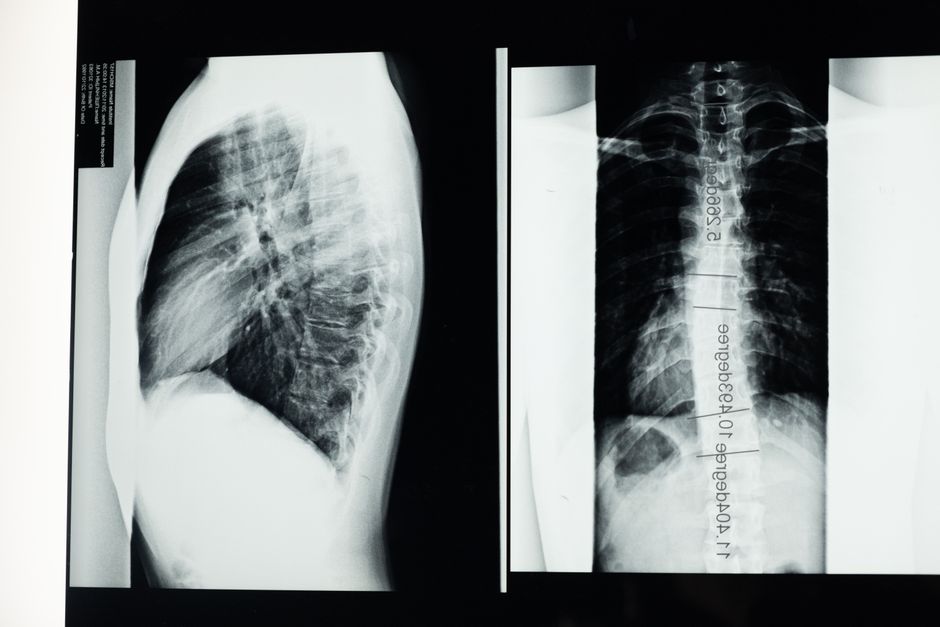
Scoliosis cannot be cured in the traditional sense of the word. There is no treatment that can completely straighten a scoliotic spine back to its original alignment. However, the condition can be effectively managed. Treatment focuses on preventing the curve from progressing, relieving pain, and maintaining a normal, active life. For many people, scoliosis requires no treatment at all, and for others, bracing or surgery provides excellent long-term outcomes.
What Exactly Is Scoliosis?
Scoliosis is a sideways curvature of the spine that measures 10 degrees or more on an X-ray. A normal spine curves gently from front to back. Scoliosis causes the spine to curve from side to side, often looking like a “C” or an “S” shape. The spine can also twist or rotate, which is why one shoulder or hip may sit higher than the other.
This is not a condition that develops because of poor posture, carrying heavy backpacks, or lack of exercise. The cause of most scoliosis cases is unknown. This type is called idiopathic scoliosis, and it most commonly appears during the growth spurt just before puberty.
What Causes Scoliosis?
Most cases of scoliosis are idiopathic, meaning the cause is unknown. This is the most common form and typically appears in children aged 10 to 15. It affects both sexes, but girls are more likely to have curves that worsen and require treatment.
Other types of scoliosis have known causes:
- Congenital scoliosis occurs when the spine does not form correctly before birth.
- Neuromuscular scoliosis is linked to conditions like cerebral palsy or muscular dystrophy that weaken the muscles supporting the spine.
- Degenerative scoliosis develops in adults as the discs and joints of the spine wear down with age.
In adults, scoliosis can also be the result of an untreated childhood curve that continues to progress slowly, or it may develop anew due to spinal degeneration. The cause matters because it influences how the condition is managed.
Can Scoliosis Be Cured Without Surgery?
No non-surgical treatment cures scoliosis. This is a hard truth that contradicts much of what you see online. Chiropractic adjustments, physical therapy, and specialized exercise programs do not straighten a scoliotic spine. Research consistently shows that these approaches do not reduce the degree of the curve.
That does not mean they are useless. Physical therapy and exercise can improve muscle strength, reduce back pain, and improve posture. These benefits are real and valuable. But they are management tools, not cures. Some clinicians recommend these approaches to help patients feel better and function better, and that is a legitimate goal.
Be cautious of any clinic or practitioner claiming they can “reverse” or “correct” scoliosis without surgery. No large clinical trials have confirmed that any brace, exercise program, or manual therapy eliminates a structural spinal curve. Claims like these are marketing, not medicine.





Does Bracing Cure Scoliosis?
Bracing does not cure scoliosis, but it can stop a curve from getting worse. This distinction matters. A brace cannot straighten a spine that is already curved. Instead, it applies pressure to the torso to guide spinal growth in a straighter direction.
Bracing is only effective in children and adolescents whose bones are still growing. The goal is to prevent a curve from reaching the surgical threshold. For a brace to work, it must be worn consistently, often 16 to 20 hours per day, until the child stops growing. Once growth stops, the brace no longer serves a purpose.
Bracing is not offered to adults. Once the skeleton is mature, a brace cannot change the structure of the spine. An adult might use a brace for temporary pain relief, but it will not alter the curve itself.
When Is Surgery Considered?
Surgery is reserved for curves that are severe or rapidly progressing. In children, surgery is typically considered when the curve reaches 45 to 50 degrees despite bracing. In adults, surgery may be recommended for curves greater than 50 degrees, particularly if the curve is causing significant pain, or if it is compressing nerves or organs.
Not every large curve needs surgery. Many adults live well with curves above 50 degrees. The decision to operate depends on symptoms, not just the number on an X-ray. If a curve is stable, painless, and not affecting organ function, observation may be the right choice.
The most common surgical procedure is spinal fusion. During this operation, the curved vertebrae are joined together with bone grafts and metal rods. The rods hold the spine in a corrected position while the bones fuse into a single solid unit. This does not result in a perfectly straight spine, but it significantly reduces the curve and prevents further progression.
Spinal fusion is major surgery. Recovery takes months, and the procedure permanently limits flexibility in the fused section of the spine. It is not a decision made lightly. Surgery is an option when the risks of the curve itself outweigh the risks of the operation.
What Happens If Scoliosis Is Left Untreated?
Most curves, especially small ones, never cause problems. The majority of people diagnosed with scoliosis live normal lives without treatment. For curves under 30 degrees, the risk of progression in adulthood is low. Regular monitoring is often all that is needed.
Larger curves behave differently. Curves above 50 degrees can continue to progress slowly throughout adulthood, typically increasing by about 0.5 to 1 degree per year. Over decades, this can add up. Large curves can cause back pain, reduced lung capacity, and in rare cases, affect heart function.
It is important to understand that scoliosis itself is rarely dangerous. The danger comes from extreme curves that compress internal organs. A curve of 100 degrees or more can significantly restrict lung function. This is why large curves are monitored closely, even in patients who feel fine.
Can Adults with Scoliosis Live Normally?
Yes. Most adults with scoliosis live full, active lives without significant limitations. The condition may cause some back pain, but this is manageable with exercise, physical therapy, and over-the-counter pain relief when needed.
Exercise is safe and encouraged for people with scoliosis. There is no evidence that physical activity makes a curve worse. In fact, staying active strengthens the muscles that support the spine and can reduce pain. Activities like swimming, walking, and strength training are all appropriate.
Pregnancy is also safe for women with scoliosis. The curve does not typically worsen during pregnancy, and most women deliver without complication. Some women with very large curves may have reduced lung capacity, which an obstetrician should monitor, but this is uncommon.
What Treatments Are Proven to Help?
While there is no cure, several treatments are proven to improve quality of life for people with scoliosis:
- Physical therapy reduces pain and improves strength and mobility.
- Bracing prevents curve progression in growing children and adolescents.
- Surgery corrects severe curves and prevents progression in adults.
- Pain management using nonsteroidal anti-inflammatory drugs (NSAIDs) helps with discomfort.
- Observation is appropriate for small curves that are not progressing.
The evidence for other treatments is limited. Acupuncture, massage, and chiropractic care may provide temporary pain relief, but no study has confirmed they change the structure of the spine. Some people find these therapies helpful for symptom management, and that is a reasonable use. Just do not expect them to cure the condition.
What Is the Long-Term Outlook?
The outlook for people with scoliosis is generally excellent. Most people with the condition never need treatment. Those who do need treatment usually respond well to bracing or surgery.
Untreated curves under 30 degrees rarely progress in adulthood. Curves between 30 and 50 degrees may progress slowly, and curves above 50 degrees are more likely to worsen over time. Regular check-ups with a doctor can catch progression early.
The key takeaway is this: scoliosis is a structural condition that cannot be cured, but it can be managed effectively. With appropriate monitoring and treatment, people with scoliosis have normal life expectancies and normal quality of life. The goal is not to achieve a perfectly straight spine. The goal is to live well with the spine you have.
Frequently Asked Questions
Can scoliosis go away on its own?
No, scoliosis does not go away on its own. A structural curve is permanent, but small curves often remain stable and never cause problems.
Can exercise fix scoliosis?
Exercise cannot straighten a scoliotic spine, but it strengthens the muscles around the spine and can reduce pain. No exercise program has been proven to eliminate a structural curve.
At what age does scoliosis stop progressing?
Curves typically stop progressing when bone growth stops, usually around age 16 to 18. However, curves above 50 degrees can continue to progress slowly in adulthood.
Is scoliosis a disability?
Most cases of scoliosis are not disabling. Severe curves that cause significant pain or limit organ function may qualify as a disability, but this is uncommon.
