
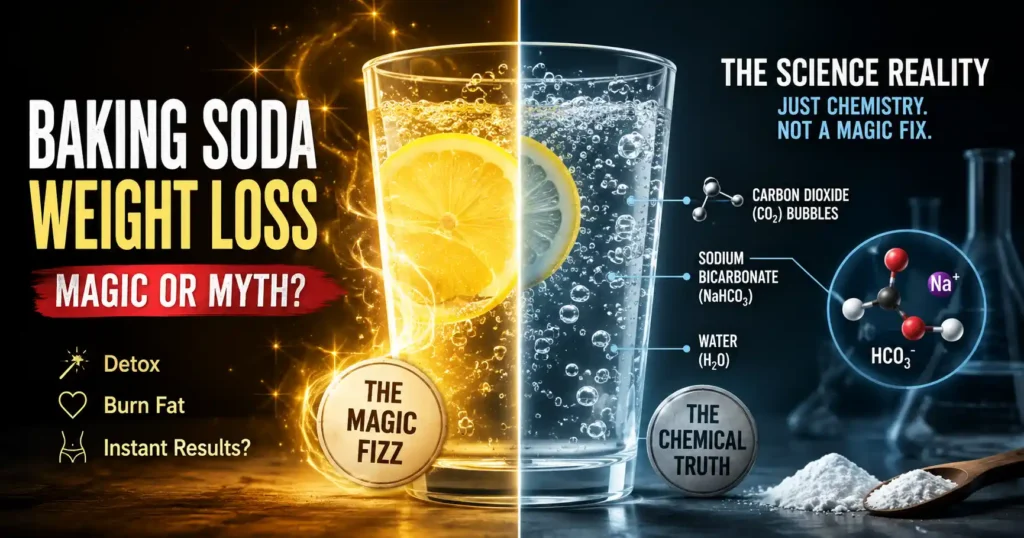
Short Answer: No. There is no clinical evidence that baking soda and lemon juice cause weight loss or fat burning. Any drop on the scale is water weight, not fat. Regular use can also cause serious side effects, including dangerous electrolyte imbalances.
What Is the Baking Soda and Lemon Juice Trend?
This is a viral drink. People mix baking soda with lemon juice and water. They drink it in the morning on an empty stomach. Creators on TikTok and Instagram claim it burns fat, flattens the belly, and “detoxes” the body.
The trend has millions of views. But views are not proof. Let’s look at what happens in your body when you drink this mix.
Does It Actually Work for Weight Loss?
No randomized controlled trial has ever shown that this drink causes fat loss. That is the most important fact in this article.
Healthline spoke to registered dietitians about this exact trend. Every dietitian they interviewed said the same thing. There is no reliable research to support baking soda helping with weight loss, according to registered dietitian Destini Moody, RD, CSSD, LD, in an interview with Healthline.
Moody also pointed out that the only way baking soda could reduce appetite is by causing so much stomach upset that a person stops wanting to eat. That is not a weight loss method. That is a symptom of harm.
The Real Science Behind the Fizz
Here is what actually happens when baking soda meets lemon juice.
- Baking soda is a base. Chemists call it sodium bicarbonate.
- Lemon juice is an acid. It contains citric acid.
- When they meet, they react. This makes carbon dioxide gas, water, and sodium citrate.
- The fizz you see is just gas escaping. It is a simple kitchen chemistry reaction. It is not a fat-burning reaction.
By the time you drink the mixture, much of the original baking soda has already changed form. You are mostly drinking mild, fizzy, citrus-flavored salt water.
Why the “Alkaline Body” Claim Is False
Many videos claim baking soda “alkalizes” your body and creates an environment where fat “can’t survive.” This is not how the human body works.
Your body tightly controls its own blood pH. It does this automatically, using your lungs and kidneys. Food and drinks do not change your blood pH in any meaningful way. If they did, you would be in a medical emergency, not on a diet.
This is confirmed by peer-reviewed medical literature on acid-base balance. Case studies published in the National Library of Medicine show that when people do manage to shift their body’s pH through excess baking soda, the result is not fat loss. The result is a dangerous condition called metabolic alkalosis.
Does Sodium Bicarbonate Have Any Real Effect on the Body?
Yes, but not for fat loss. Sodium bicarbonate is a proven antacid. It neutralizes stomach acid. That’s why it’s an active ingredient in some heartburn medications.
Athletes also use sodium bicarbonate before intense, short workouts. It can buffer lactic acid buildup. A 2013 clinical study published in the International Journal of Sport Nutrition and Exercise Metabolism found that sodium bicarbonate ingestion increased fat utilization during exercise compared to a placebo drink, but the doses used were medically measured and the effect was tied to exercise performance, not everyday fat loss.
This detail matters. Sports researchers are not saying “drink this to lose weight.” They are studying a completely different question: exercise performance in trained athletes, using precise, monitored doses. That is not the same as a viral morning drink.




The Recipe People Use
This is the standard version people share online. We are not recommending you make this, but here is the exact recipe for transparency.
- Squeeze the juice of half a lemon into a glass of water.
- Add 1/4 to 1/2 teaspoon of baking soda.
- Stir until it stops fizzing.
- Drink it, usually on an empty stomach in the morning.
Some versions swap the lemon for apple cider vinegar. Others add honey or ginger. None of these changes affect the core problem: there is still no proof that any version burns fat.
How People Use It (And Why That’s a Warning Sign)
Most people drink this first thing in the morning, before breakfast. Some drink it daily. Others drink it before workouts.
Daily use is the biggest concern. Doctors who study sodium bicarbonate toxicity have repeatedly warned that regular, high-dose use is what leads to hospital visits. A person who drank baking soda daily for two months, escalating to a large dose, developed severe metabolic alkalosis and dangerously high sodium levels, according to a case report and literature review of sodium bicarbonate toxicity.
Researchers in that same report specifically flagged the danger of this trend, noting that health misinformation spreading on social media increases the risk of people trying dangerous self-treatment.
Claimed Benefits vs. Real Benefits
| What Videos Claim | What Evidence Actually Shows |
|---|---|
| Burns belly fat overnight | No clinical trial supports this |
| “Alkalizes” the body for weight loss | Blood pH is tightly regulated; drinks don’t change it |
| Detoxes the body | Your liver and kidneys already do this; no added detox effect |
| Flattens your stomach | Possible temporary bloating relief from the antacid effect, but not fat loss |
| Boosts metabolism | No human trial shows a metabolism increase from this drink |
The one real, evidence-backed benefit is short-term relief from heartburn or acid indigestion. That’s it. That’s an antacid effect, and it has nothing to do with body fat.
Side Effects and Health Risks
This is the part most viral posts skip. Baking soda is not a harmless kitchen item when you drink it regularly. Medical case reports describe real harm from this exact habit.
- Metabolic alkalosis. This is a serious disturbance in your body’s acid-base balance. It can cause confusion, muscle twitching, and in severe cases, seizures or cardiac arrest. A documented case involved a patient who had daily sodium bicarbonate use for twenty years, ending in cardiac arrest, as reported in a peer-reviewed case study.
- High sodium intake. Baking soda is a sodium compound. Regular use adds unnecessary sodium to your diet, which can raise blood pressure over time.
- Electrolyte imbalances. Case reports describe patients developing low potassium, low chloride, and high sodium levels from excess intake, as documented in a 2025 case study on sodium bicarbonate toxicity.
- Digestive upset. Nausea, gas, and stomach cramping are common with regular use.
- Kidney strain. People with existing kidney issues face a higher risk from the sodium and pH load.
One case even linked chronic low-level exposure, from using baking soda in toothpaste to metabolic alkalosis in an elderly patient, according to a 2020 report in BMC Nephrology. The point isn’t that toothpaste is dangerous. The point is that this compound adds up in your body faster than people expect.
If you have high blood pressure, kidney disease, or heart problems, talk to your doctor before trying this drink.
What “Results” Really Means
People searching for “before and after” results are usually seeing one thing: water weight changes.
Here’s why the scale can move:
- Baking soda has a mild diuretic-like effect tied to its sodium and fluid shifts.
- Any bloating relief from the antacid effect can make your stomach look and feel flatter for a few hours.
- None of this is fat loss. Fat loss requires burning more energy than you take in, over time.
A pound lost this way typically returns within a day or two, once your body’s fluid balance resets. That’s why people who try this often feel discouraged when the number on the scale bounces back.
What Reddit and Reviews Actually Say
Search Reddit threads on this topic, and you’ll find a repeating pattern. Some users report short-term bloating relief. Very few report lasting weight loss. Many report stomach discomfort, a strange metallic taste, or no effect at all.
This lines up exactly with the clinical picture: mild, short-term digestive effects, no measurable fat loss, and real risk with repeated use.
What Actually Helps You Lose Weight
Weight loss that lasts comes from a calorie deficit over time. That means burning slightly more energy than you eat, consistently, for weeks and months.
Evidence-backed habits that support this include:
- Eating enough protein and fiber to feel full
- Strength training two or more times a week
- Regular walking or cardio
- Consistent sleep
- Working with a registered dietitian for a personalized plan
None of these gives overnight results. All of them are backed by real, repeated clinical evidence, unlike a fizzy morning drink.
Frequently Asked Questions
Do baking soda and lemon juice burn belly fat?
No. No clinical trial has shown that this drink burns fat anywhere on the body, including the belly.
Is baking soda and lemon water safe to drink every day?
Daily use is not recommended. Case reports link daily, long-term use to serious sodium and electrolyte problems, including life-threatening metabolic alkalosis.
Why do people lose weight on the scale after drinking it?
The change is water weight, not fat. It comes from fluid shifts and mild bloating relief, not from burning stored fat.
What do registered dietitians say about this trend?
Registered dietitians interviewed by Healthline say there is no reliable research supporting baking soda for weight loss, and that any appetite suppression would come from harmful stomach upset, not a healthy mechanism.
Is there any real benefit to this drink?
The only proven benefit is short-term relief from heartburn and acid indigestion, since sodium bicarbonate is a recognized antacid.
This article is for informational purposes only and is not medical advice. Talk to your doctor or a registered dietitian before changing your diet, especially if you have high blood pressure, kidney disease, or heart conditions.
