
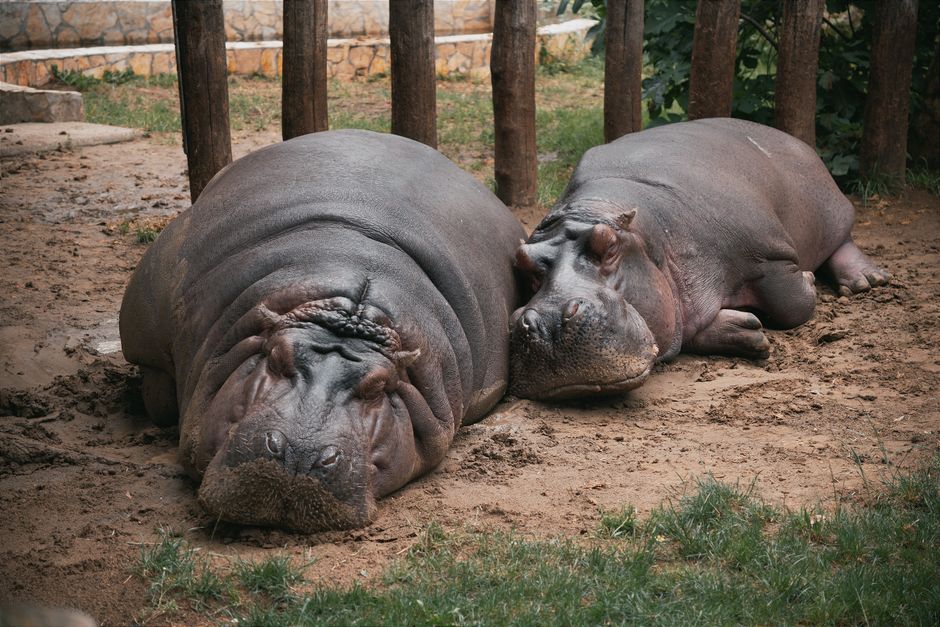
Hippos look fat, but they are not fat in the way humans think of fat. Their massive size comes from dense muscle, thick bones, and a layer of skin that can weigh more than a small car. The blubbery appearance is mostly a thick, heavy hide and powerful muscle mass, not excess body fat. A hippo’s bulk is a survival tool, built for fighting, swimming, and supporting an animal that can weigh over 3,000 pounds.
What Is a Hippo’s Body Actually Made Of?
A hippo’s body is engineered for power, not for storing energy. The bulky shape that looks like fat is mostly skeletal muscle. Hippos have massive muscle groups around their necks, jaws, and torsos that they use for fighting and defending their territory.
Their skin is also incredibly heavy. A hippo’s hide can be up to 2 inches thick and can weigh around 1,000 pounds on a large adult. This skin is dense and tough, not soft and fatty. Underneath that hide is a layer of connective tissue and muscle, with very little subcutaneous fat compared to what you would see in a truly obese animal.
Hippos do carry some fat, but it is not the main contributor to their size. Their heavy bones and water-adapted body structure account for most of their mass. When a hippo walks on land, it is carrying a body built for buoyancy, which makes its movements look heavy and lumbering.
Are Hippos Fat or Just Big-Boned?
Hippos are genuinely large animals, and that size is mostly bone and muscle. A male hippo can weigh between 3,500 and 4,000 pounds. Females are smaller but still weigh around 3,000 pounds. Their skeleton is dense and robust, designed to support that enormous weight both in water and on land.
Muscle makes up a large portion of their body mass. Hippos do not have the thick layer of insulating blubber that marine mammals like whales have. Instead, they have a dense, heavy body that allows them to walk along the bottom of rivers and lakes. Their body composition is closer to that of a rhinoceros or an elephant than to a fat-storing animal.
The visual impression of fat comes from their rounded torsos and short legs. But those proportions are about stability and power, not excess fat. A hippo’s body is built low to the ground so it can move through water easily and maintain balance on land.
How Much Fat Does a Hippo Actually Have?
There is no widely published clinical data on the exact body fat percentage of wild hippos. However, studies of hippo anatomy show that their fat stores are modest compared to their overall mass. Their subcutaneous fat layer is thin relative to their skin thickness and muscle mass.
Hippos do store some internal fat, particularly around their organs. This is normal for any large mammal and provides a small energy reserve. But it is not the primary component of their bulk. If you removed the skin, muscle, and bones from a hippo, the remaining fat would be a small fraction of the total weight.
This matters because it changes how we understand hippo behavior. A truly fat animal would struggle to move and would overheat easily. Hippos are active, aggressive, and capable of running at speeds up to 19 miles per hour on land. That kind of speed requires lean muscle, not heavy fat stores.





Why Do Hippos Look So Round?
The round shape of a hippo comes from its body structure, not from fat. Their ribcage is barrel-shaped, which supports large lungs and digestive organs. This shape helps with buoyancy in water and provides a wide base for their powerful legs.
Hippos also have a thick layer of skin that hangs loosely in some areas. This skin is dense and heavy, and it can make the animal look softer than it actually is. The skin is so thick that it is nearly impossible to penetrate with most animal bites, which is a key defense against predators like lions and crocodiles.
Another factor is their posture. Hippos have short legs and a long, heavy torso. This gives them a low center of gravity, which is useful for walking on riverbeds. The visual result is an animal that looks like it is carrying extra weight, even though its body composition is mostly muscle and bone.
Are Hippos Fat Compared to Other Large Animals?
Compared to animals that genuinely store large amounts of fat, hippos are lean. Whales, seals, and polar bears have thick blubber layers that can make up a significant percentage of their body weight. Hippos do not have this adaptation because they do not need to survive long periods without food in cold environments.
Instead, hippos have a body plan more similar to elephants and rhinos. These animals are large and heavy but not fat in the clinical sense. Their mass comes from bone, muscle, and thick skin. This is a key distinction because it affects how we think about their diet and metabolism.
Hippos eat mostly grass and can consume up to 80 pounds of vegetation in a single night. Despite this large intake, they do not gain excessive fat because their metabolism is built for maintaining a massive body, not for storing energy. A hippo’s size is a survival advantage, not a sign of poor health.
Does Hippo Skin Weigh More Than Fat?
Yes, hippo skin is remarkably heavy. The hide of a large adult hippo can weigh around 1,000 pounds on its own. This skin is thick, tough, and filled with dense connective tissue. It acts as armor and also helps the animal retain moisture when it is out of the water.
This heavy skin is one of the main reasons hippos appear so bulky. When you see a hippo on land, you are looking at an animal carrying hundreds of pounds of skin, muscle, and bone. The fat layer underneath is relatively thin and does not contribute much to the overall silhouette.
Hippo skin also produces a natural sunscreen. It secretes a reddish oily substance that protects the animal from the sun. This substance is not blood, despite what some myths claim. It is a protective secretion that keeps the skin moist and prevents sunburn.
Are There Health Risks Associated With Hippo Size?
Hippos face some health challenges related to their size, but obesity is not a common problem in the wild. Their diet is low in calories, and they spend a significant amount of time in water, which reduces stress on their joints. Wild hippos generally maintain a healthy body composition.
In captivity, hippos can gain excess weight if they are overfed. Zoos carefully monitor hippo diets to prevent obesity, which can lead to joint problems and heart issues. This is a management issue, not a natural condition. Wild hippos do not typically become overweight.
The main health risks for hippos come from their aggressive behavior and environmental factors, not from their weight. Hippos are responsible for more human deaths in Africa than lions, elephants, or crocodiles. Their size and speed make them dangerous, but their body composition is not a health concern for the animal itself.
What Is the Truth About Hippo Bulk?
The truth is that hippos are not fat in the way people usually mean. Their bulk is a combination of dense muscle, thick skin, and heavy bones. These features evolved for survival, not for storing energy. A hippo’s size is functional, giving it power in water and on land.
Calling a hippo fat is a misunderstanding of its anatomy. The animal is built for strength and defense, not for insulation or energy storage. Its round shape is an illusion created by thick hide and a barrel-shaped ribcage.
So when you look at a hippo, you are not looking at an overweight animal. You are looking at one of the most powerfully built creatures on Earth. Its bulk is muscle, armor, and bone — a body designed to dominate its environment.
Frequently Asked Questions
Are hippos actually fat or is it muscle?
Hippos are mostly muscle, bone, and thick skin, not fat. Their bulky appearance comes from dense muscle mass and a hide that can weigh around 1,000 pounds.
How much fat does a hippo have?
There is no exact published figure for hippo body fat percentage. Their fat layer is thin compared to their muscle and skin, and it is not the main source of their size.
Why do hippos look so round and heavy?
Their round shape comes from a barrel-shaped ribcage, short legs, and very thick heavy skin. This structure supports buoyancy in water and provides stability on land.
Can hippos get obese?
Wild hippos rarely become obese because their diet is low in calories. Captive hippos can gain excess weight if overfed, so zoos carefully control their diets.
