
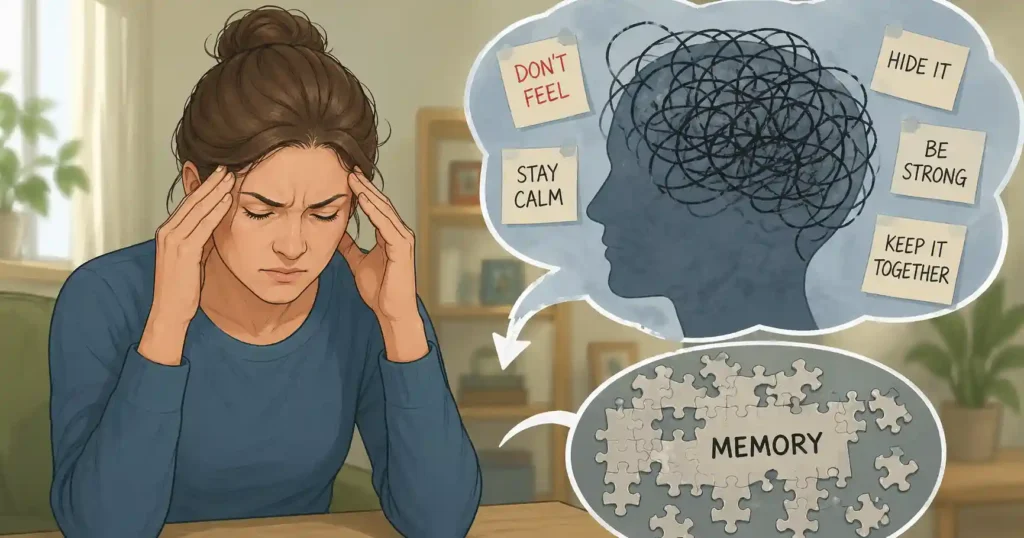
Suppressing emotions does not directly cause permanent memory loss, but it can reduce how well your brain stores and recalls information. It works by increasing mental load and stress, which interfere with attention and memory processing. Over time, chronic suppression may lead to noticeable forgetfulness or poor recall.
Key Takeaways
- Suppressing emotions affects memory recall, not permanent memory loss
- Working memory is impacted first, leading to mental fog and forgetfulness
- Chronic suppression increases stress and disrupts memory processing
- Short-term suppression is normal and often necessary
- Most issues come from cognitive overload, not brain damage
What happens in your brain when you suppress emotions?
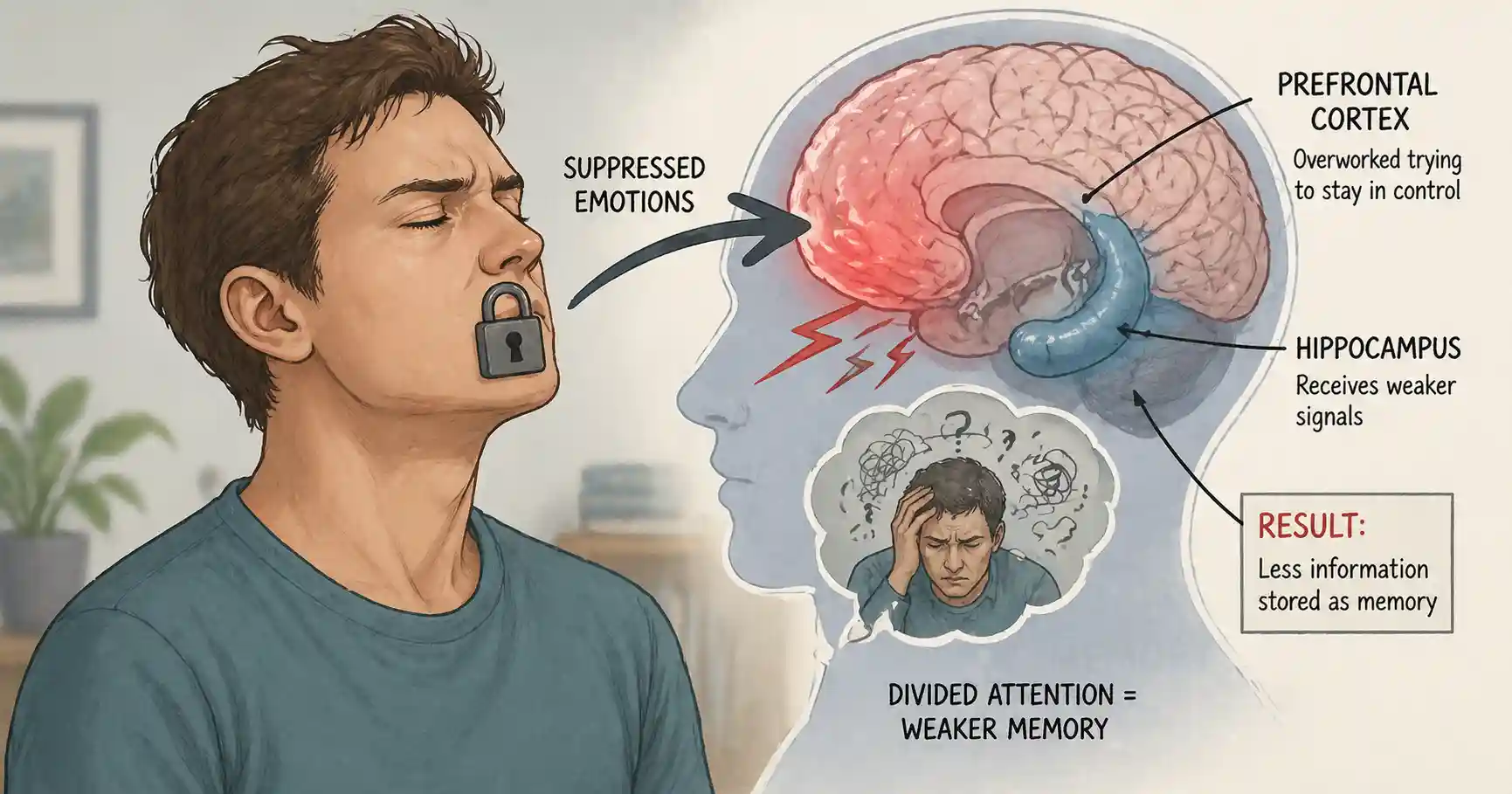
When you suppress emotions, your brain splits attention between two tasks:
- Handling the situation and
- Hiding your internal response.
That sounds harmless, but it isn’t. Memory depends heavily on attention. If your focus is divided, your brain encodes less information.
This is where things start to break down. The prefrontal cortex (which manages control and decision-making) gets overworked trying to keep emotions in check. At the same time, the hippocampus (which forms memories) receives weaker signals. The result is simple: less information gets stored.
Research published in the Journal of Experimental Psychology (2011) found that people who actively suppressed emotions remembered fewer details from events compared to those who processed emotions normally. The effect wasn’t subtle — recall accuracy dropped significantly in controlled settings.
Quick Takeaway: Suppressing emotions reduces attention, and weaker attention leads to weaker memory formation.
Does suppressing emotions actually cause memory loss or just affect recall?
It mostly affects recall, not permanent memory loss.
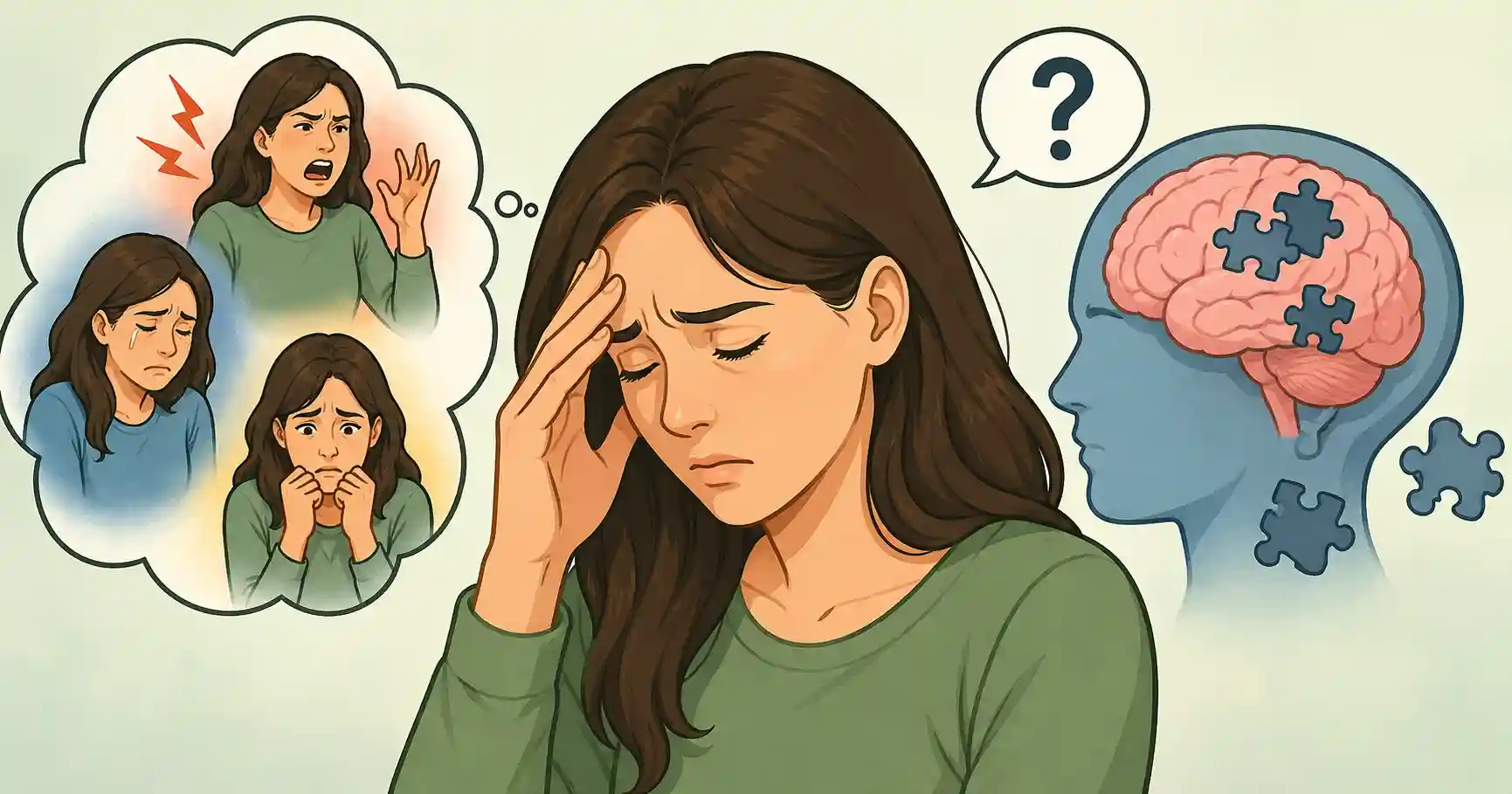
There’s a big difference:
- Memory loss = information is gone or damaged
- Poor recall = information exists but is hard to access
Emotional suppression mainly creates the second problem.
When stress levels rise, your body releases cortisol. Short bursts of cortisol can sharpen memory. But chronic stress — the kind linked with ongoing emotional suppression — does the opposite. It disrupts communication in the hippocampus.
Studies from Harvard Medical School (2021) show that prolonged elevated cortisol levels are linked with reduced memory performance, especially in recall tasks.
So what you experience is:
- Forgetting conversations
- Struggling to find words
- Losing track of thoughts
That’s not your memory “failing.” It’s your brain struggling to retrieve what wasn’t stored well in the first place.
Quick Takeaway: Emotional suppression rarely deletes memory, but it makes recall unreliable.
What types of memory are affected by emotional suppression?
Not all memory is affected equally. The biggest impact is on working memory and short-term recall.
| Memory Type | What It Does | Impact of Emotional Suppression |
|---|---|---|
| Working Memory | Holds information temporarily (e.g., conversations) | Strongly affected — reduced focus |
| Short-Term Memory | Stores recent information | Moderately affected |
| Long-Term Memory | Stores past events and knowledge | Indirect impact over time |
Here’s the non-obvious part: Working memory takes the biggest hit first. This is why people feel “mentally foggy” or distracted.
Long-term memory only starts suffering if suppression becomes chronic. That’s when repeated poor encoding adds up.
Quick Takeaway: Emotional suppression hits your short-term thinking first, not your long-term memory.
What are the early signs that your memory is being affected?
Most people don’t connect these signs to emotional suppression. They assume stress, aging, or distraction.
Look for patterns like:
- Forgetting recent conversations
- Losing track mid-sentence
- Re-reading the same thing multiple times
- Trouble recalling names or simple details
- Feeling mentally “blank” in conversations
Here’s what’s actually happening: your brain is overloaded. Emotional control is consuming resources that should go toward memory.
One detail that stands out — people often report this happening more in social or emotionally tense situations. That’s not random. Suppression spikes exactly when emotions rise.
Quick Takeaway: If your memory feels worse during stress or social pressure, suppression may be the cause.
Why do strong or unprocessed emotions interfere with memory?
Strong emotions don’t just distract you — they change how your brain processes information.
The key player is cortisol again. High emotional stress signals the brain that something important (or threatening) is happening. The brain prioritizes survival, not detailed memory storage.
According to the American Psychological Association, chronic stress can impair hippocampal function, which directly affects memory formation.
Here’s the catch:
- Processed emotions can strengthen memory (you remember meaningful events better)
- Suppressed emotions create noise without resolution
That unresolved tension keeps your brain busy in the background, reducing clarity and recall.
Quick Takeaway: Emotions aren’t the problem — unprocessed emotions are.
Is suppressing emotions always bad for memory?
No. Short-term suppression is sometimes necessary.
In real life, you can’t react emotionally to everything. Temporary control helps you function in:
- Work situations
- Social conflicts
- High-pressure environments
The problem starts when suppression becomes a default habit.
Here’s the distinction:
- Short-term suppression → minimal impact
- Chronic suppression → cognitive fatigue + memory issues
Most articles skip this nuance and make it sound like suppression is always harmful. That’s inaccurate.
What actually matters is duration and frequency.
Quick Takeaway: Occasional suppression is normal. Chronic suppression is where memory problems begin.
What affects memory recall besides emotions?
If you blame everything on emotions, you’ll miss the bigger picture. Memory is influenced by multiple factors:
- Sleep quality (one of the strongest predictors)
- Stress levels
- Attention span
- Nutrition (especially B vitamins)
- Age-related changes
Here’s the reality: emotional suppression is rarely the only cause. It usually stacks with other factors.
That’s why some people suppress emotions but don’t notice memory issues — their sleep, focus, and lifestyle compensate.
Quick Takeaway: Emotional suppression is one piece of the puzzle, not the whole picture.
What is the difference between suppression, repression, and avoidance?
Most articles mix these up. That’s a mistake.
- Suppression → conscious effort to hide emotions
- Repression → unconscious blocking of emotions
- Avoidance → staying away from emotional triggers
Why this matters: Suppression is active and mentally demanding. Repression is automatic. Avoidance changes behavior.
From a memory standpoint:
- Suppression = highest cognitive load
- Repression = less immediate load, but long-term complexity
- Avoidance = indirect impact
If you’re feeling mentally drained and forgetful, suppression is usually the culprit.
Quick Takeaway: Suppression affects memory more directly than repression or avoidance.
Can suppressing emotions cause memory loss in adults or animals?
In adults, the effect is well-documented: it affects recall and focus, especially under stress.
In animals, the evidence is weaker. Studies on dogs and cats focus more on stress behavior than memory recall. There’s no strong proof that emotional suppression causes memory loss in pets the same way it does in humans.
That said, chronic stress in animals can still affect learning and behavior.
Quick Takeaway: The memory effect is clear in humans, less established in animals.
How can you reduce memory issues linked to emotional suppression?
You don’t need extreme changes. You need better emotional processing, not constant expression.
Practical steps:
- Label emotions briefly (this reduces cognitive load)
- Write things down after stressful events
- Take short mental breaks during emotional strain
- Improve sleep consistency
- Avoid multitasking during stress-heavy situations
One thing people get wrong: They think they need to “express everything.” That’s not realistic.
What works is reducing internal pressure, not eliminating control.
Quick Takeaway: You don’t need to stop suppressing emotions — you need to stop overloading your brain.
FAQs
Does suppressing emotions cause memory loss in adults?
Suppressing emotions in adults can affect memory recall, especially in stressful situations. It increases mental load and reduces attention, which weakens how memories are formed. Over time, chronic suppression may lead to noticeable forgetfulness, but it does not typically cause permanent memory damage.
Can suppressing emotions cause long-term memory loss?
Long-term emotional suppression can contribute to ongoing memory issues, mainly by increasing stress and reducing memory efficiency. Research suggests that chronic stress may affect brain areas involved in memory, but the effect is usually gradual and related to recall, not permanent memory loss.
Does repressing emotions affect memory differently?
Repressing emotions is unconscious, while suppression is intentional. Suppression creates more immediate cognitive strain, which can impact memory performance more directly. Repression may have indirect effects over time, but it does not typically interfere with memory in the same immediate way.
Why do I forget things when I feel stressed or emotional?
Stress increases cortisol levels, which can interfere with how the brain encodes and retrieves information. When emotions are intense or suppressed, your attention is divided, making it harder to store details properly. This leads to forgetfulness or difficulty recalling information later.
What are the early signs of memory problems from stress?
Early signs include forgetting recent conversations, losing track of thoughts, needing to reread information, and struggling to recall simple details. These signs often appear during or after stressful situations and are linked to reduced attention and mental overload.
Final Thoughts
So, does suppressing emotions cause memory loss? Not in the way most people think. It doesn’t erase memory, but it makes your brain worse at storing and retrieving information, especially when it becomes a habit.
Fix the overload, and the memory usually improves. Ignore it, and the problem compounds quietly.

Recent Posts