
The Quick Answer
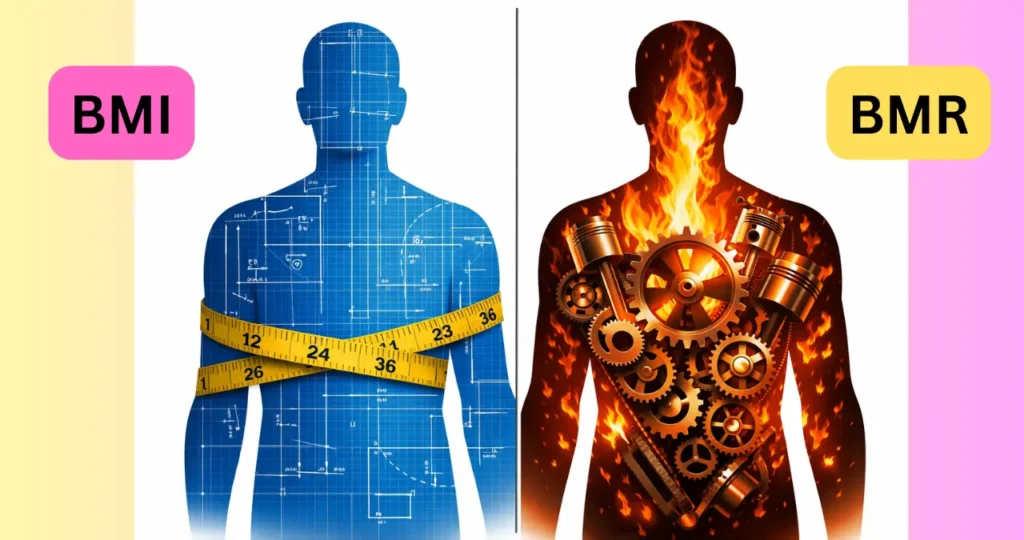
BMI vs BMR: BMI is your body’s “size label”. BMI compares your weight to your height. BMR is your body’s “idle engine”; the calories you burn just staying alive. For weight loss, BMR matters more because it tells you how much fuel your body actually needs each day.
Introduction
You’ve seen those letters plastered all over the place. BMI vs BMR Yeah, they look a whole lot alike. Both start with a “B,” and both have to do with your body.
But here’s what you need to know. They’re measuring two completely different things. And if you get them mixed up, you might be running around trying to hit a totally irrelevant number.
Alright, let’s take a step back and break this down with a simple example.
Think of your body like a house. Your B.M.I. is what the realtor would list on Zillow. It’s the size of the house, the square footage. It’s useful to know, right? But it doesn’t tell you a thing about the actual cost of owning the place.
Your B.M.R. is that electricity bill that shows up every month. It’s the base level of power your house needs to just keep the lights on, the fridge running, and the thermostat not freezing your butt off – even when nobody’s home.
Now here’s the question everyone really wants the answer to:
Which number should you actually care about if you want to lose weight?
Spoiler: It’s not the one your doctor is probably going to bring up first.
Alright, let’s get into this. We’ll explain both numbers, lay them out side by side, and show you how to use them in a real way. No doctor-speak, no fancy formulas – just the facts.
What is BMI?
Body Mass Index – the Label For Your Body’s Size
BMI – short for Body Mass Index – is basically your weight divided by your height. That’s it, a simple math problem.
Doctors use it as a quick way to categorize folks into skinny, normal, a bit chunky, or seriously obese.
Because it only looks at weight, BMI can’t tell the difference between someone who is chunky but muscular and someone who is a wee bit scrawny with very little muscle.
A bodybuilder might weigh a whopping 220 pounds and have a “high BMI” but next to no body fat, while a couch potato might weigh a very respectable 150 pounds and still have a “normal” BMI but hardly any muscle.
BMI is as good as a rough guide, but it’s a starting point, nothing more.
What is BMR?
Your Body’s Engine Running at Low Revs
BMR stands for Basal Metabolic Rate. It’s the number of calories your body goes through just to hang in there and keep on functioning.
Think of the things you do without even realising: breathing, pumping blood, blinking, growing hair, and keeping your body temperature steady at 98.6 degrees.
If you stayed in bed for 24 hours straight without moving a muscle, you would still burn those same BMR calories.
Why should this matter to you?
BMR accounts for around 60-70% of the total calories you burn in a day. It’s the lion’s share of your energy expenditure.
Unlike BMI, which is just a label, BMR is a bit more dynamic. It changes based on three pretty key factors:
BMI vs BMR: The Key Differences
It’s easy to get these mixed up, so let’s look at them side-by-side. Remember the house? BMI is the Zillow listing (Size). BMR is the monthly bill (Energy).
Here is exactly how they stack up against each other:
| Feature | BMI (Body Mass Index) | BMR (Basal Metabolic Rate) |
|---|---|---|
| What It Is | A “Size Label” for your body type. | An “Energy Score” for your metabolism. |
| The Math | Weight divided by Height. | A complex formula using age, weight, height, and gender. |
| The Analogy | The square footage of a house. | The electricity is needed to keep the lights on. |
| Main Use | Screening for health risks. | Calculating calorie needs. |
| Accuracy | Low (ignores muscle vs. fat). | High (gives a specific calorie target). |
| Use for Dieting | Tells you if you need to lose weight. | Tells you how much to eat to lose weight. |
How to Use These Numbers for Weight Loss
Okay, you know the definitions. Now, how do you actually use this stuff to change your body?
Most people guess. They pick a random number like “1,200 calories” and hope for the best. That is a recipe for disaster.
Here is the 4-step system to do it right.
Step 1: Check Your BMI (The Reality Check)
Use an online calculator to find your BMI. If the number is over 25, you are in the “Overweight” category. If it’s over 30, you are in the “Obese” category.
Takeaway: This just confirms if you need to make a change. Once you know that, you can pretty much ignore BMI for the rest of the process.
Step 2: Calculate Your BMR (The “Do Not Cross” Line)
Use an online BMR calculator (like the Mifflin-St Jeor equation). Let’s say your BMR is 1,500 calories.
This is important: Do NOT eat fewer calories than your BMR. If you eat less than your BMR, your body thinks it’s starving. It freaks out. It slows down your metabolism to save energy. You might lose weight fast at first, but you will crash, burn out, and likely gain it all back.
Treat your BMR as your calorie floor. Never go below it.
Step 3: Find Your TDEE (The Real Burn)
We have one more acronym for you. TDEE stands for Total Daily Energy Expenditure.
- BMR = Gas burned while the car idles in the driveway.
- TDEE = Gas burned while actually driving the car around town.
To get your TDEE, you multiply your BMR by an activity factor (usually between 1.2 and 1.9).
If your BMR is 1,500, your TDEE might be 2,000. This means you burn 2,000 calories a day just living your life.
Use our free TDEE Calculator to calculate.
Step 4: Create the Deficit (The Sweet Spot)
To lose fat, you need to eat less than your TDEE but more than your BMR.
- TDEE (Burn): 2,000 calories
- BMR (Floor): 1,500 calories
- Target Intake: 1,750 calories
By eating 1,750 calories, you are “under-eating” by 250 calories a day. Over time, your body fills that gap by burning stored fat.
That is the secret. It’s not magic. It’s math.

Recent Posts