
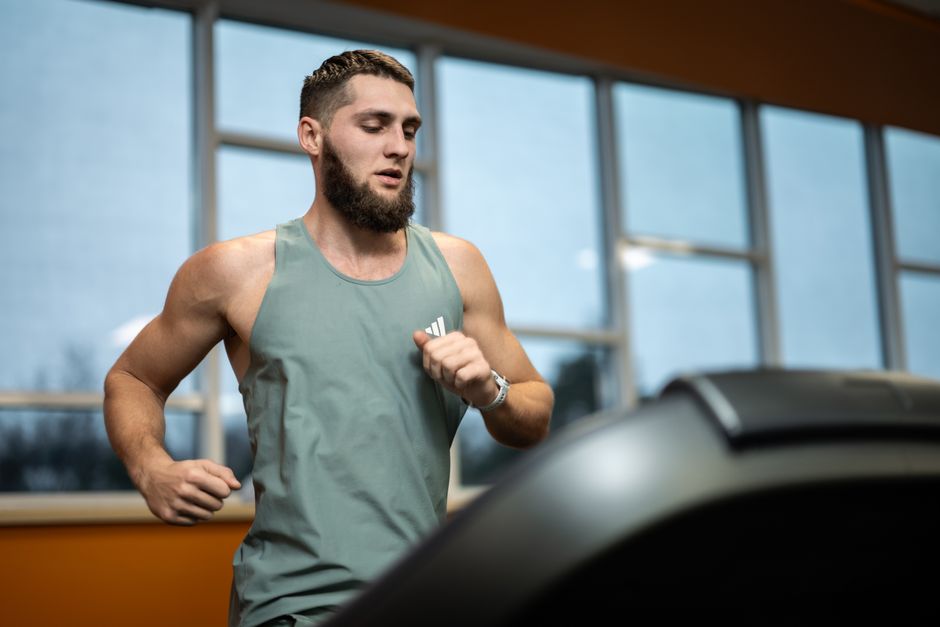
Running builds muscle, but not the kind most people picture when they think about getting stronger. It builds endurance in the legs and a leaner, more fatigue-resistant muscle profile. It does not build the large, powerful muscles that heavy resistance training produces. So if your goal is visible size or maximal strength, running alone will not get you there. If your goal is muscular endurance and a fitter lower body, it will.
The confusion comes from mixing up two different questions. Can running change your muscles? Yes, clearly. Can running make you muscular in the bodybuilding sense? No, not on its own. Those are separate answers, and keeping them separate makes everything else about running and muscle easier to understand.
Does running build muscle or just burn fat?
Running does both, and the muscle-building part is real but specific. When you run, your leg muscles — the calves, the quadriceps, the hamstrings, and the glutes — repeatedly contract against resistance and manage your body weight over many steps. That repeated load is a genuine training stimulus. The muscles adapt by becoming better at producing force over and over without tiring.
What running does not do is create the kind of mechanical tension that drives large increases in muscle size. Muscle growth in size, called hypertrophy, depends heavily on high-force contractions, often against heavy loads, performed for relatively few repetitions. Running is the opposite: moderate force, thousands of repetitions. The body responds to that pattern with endurance adaptations, not bulk.
There is also a common claim that running “burns muscle” or that cardio eats away your gains. That is overstated. In people eating enough food and training sensibly, running does not strip away muscle. The problem arises mainly when running is combined with a large calorie deficit or very high volumes of endurance training without enough protein and resistance work. In that situation, the body can break down muscle for energy. It is the overall context — food intake, total training load, protein — that determines whether muscle is lost, not running by itself.
What actually happens inside your muscles when you run?
Your muscles adapt to running in ways that are measurable and well established. The most consistent change is an increase in the number and size of mitochondria, the structures inside muscle cells that produce energy. This makes the muscle more efficient at using oxygen and fat. Capillaries — the tiny blood vessels feeding muscle — also increase, improving delivery of oxygen and removal of waste.
At the fiber level, skeletal muscle contains different fiber types. Type I fibers are slow-twitch and built for endurance. Type II fibers are fast-twitch and built for quick, powerful efforts. Endurance running preferentially trains and develops Type I fibers. It can also shift some Type II fibers toward a more fatigue-resistant profile. What it does not do is convert your muscle into a dramatically larger, stronger version of itself.
Here is a detail worth knowing: the muscle changes from running are mostly about quality and endurance, not quantity. A runner’s leg muscle may not look much bigger, but it can sustain work far longer and recover faster. That is a real adaptation even if the tape measure does not move.
Will running build muscle in your legs and glutes?
Yes, running develops the lower-body muscles, but the effect is modest and depends on the terrain and intensity. Flat, easy running uses the calves, quads, hamstrings, and glutes in a steady, low-force pattern. Hills and faster intervals increase the force involved and can produce more noticeable strengthening.
New runners often notice their legs feel firmer and more capable within weeks, even before any visible change. That early improvement is largely neurological — your nervous system gets better at coordinating the movement and recruiting muscle. Visible size changes, if they happen at all from running, take much longer and are usually small.
For people who are currently inactive, starting to run can produce a genuine increase in leg muscle and strength simply because they are going from very little activity to regular loading. For someone already lifting weights, adding running is unlikely to add much leg size and may slightly interfere with it if the running volume is very high.
Why doesn’t running build big upper-body muscle?
Running does almost nothing for the upper body because it places very little load on those muscles. Your arms swing, your shoulders and core stabilize, but the force is small and repetitive. That is not enough to drive meaningful growth in the chest, back, shoulders, or arms.
This is a simple matter of specificity. Muscles grow in response to the demand placed on them. If a muscle is never asked to produce high force, it has little reason to get bigger. Running asks the legs for endurance and the upper body for little more than balance. If upper-body strength or size matters to you, running will not substitute for resistance training.
Can you build muscle by running and lifting weights together?
Yes, and this is where running becomes genuinely useful for muscle. Combining running with resistance training gives you the endurance benefits of cardio and the size and strength benefits of lifting. For most people this combination is more effective for overall fitness than either alone.
There is one well-documented catch. Doing a lot of endurance training alongside strength training can blunt strength and size gains somewhat, a phenomenon researchers call the interference effect. It is real but often overstated. The interference tends to matter most at high running volumes and when the two types of training are crammed together without recovery. Practical steps that reduce it:
- Separate hard running and heavy lifting by several hours, or put them on different days.
- Keep easy runs genuinely easy so they do not add to your recovery burden.
- Prioritize protein and total calories so your body has what it needs to build and repair muscle.
- Lift with real effort — the strength work needs to be challenging to drive growth.
For general health, the established guidance is to get both aerobic activity and muscle-strengthening activity each week. Running covers the aerobic side well. It does not replace the strengthening side.
Does running help you lose weight and look more muscular?
Running can help with weight loss by burning calories, and losing fat can make existing muscle more visible. That visible “toned” look people chase is usually a combination of muscle you already have plus less fat covering it. Running contributes to the fat-loss side. It does not add much muscle to reveal.
This is why some runners look lean but not especially muscular. They have trained their endurance system and reduced body fat, but they have not given their muscles a strong enough growth signal. If a more muscular look is the goal, running plus resistance training plus adequate protein is the combination that delivers it. Running alone mostly delivers the lean part.
One honest caution: weight loss from running depends heavily on diet. Exercise alone, without attention to food intake, often produces less weight loss than people expect. The body can compensate in various ways. Running is a useful tool, not a guarantee.
How much running does it take to see muscle changes?
There is no single number, and anyone who gives you an exact timeline is guessing. What is well established is the direction: consistent running improves muscular endurance in the legs over weeks to months, with early gains coming mostly from the nervous system and later gains from deeper changes in the muscle itself.
Beginners tend to see the fastest improvements because they have the most room to adapt. Experienced runners see smaller, slower changes. Visible muscle size from running is unpredictable and generally minor. No clinical guideline sets a running volume specifically for building muscle, because running is not primarily a muscle-building activity. If muscle growth is your goal, the evidence supports resistance training as the main driver, with running as a complement.
What is the bottom line on running and muscle?
Running builds muscular endurance, especially in the legs, and it improves how your muscles use energy. It does not build large muscles or major strength on its own. The muscle you gain from running is real but modest, and mostly about stamina rather than size.
If you want to be fitter and more fatigue-resistant, running delivers. If you want to be visibly more muscular or stronger, you need resistance training, and running works best as a partner to it rather than a replacement. The two together, backed by enough food and protein, cover far more ground than either one alone.
Frequently Asked Questions
Will running build muscle without weights?
Running builds muscular endurance in your legs but produces only modest muscle size and strength on its own. For noticeable muscle growth, resistance training is the stronger stimulus.
Does running burn muscle?
Running does not strip away muscle in people who eat enough and train sensibly. Muscle loss is more likely with large calorie deficits or very high training volumes without enough protein.
Can running give you big legs?
Running can firm and strengthen your legs, especially with hills and intervals, but it rarely produces large increases in leg size. Sprinting and heavy resistance training build leg size far more effectively.
Is running enough exercise to build muscle?
No, running alone is not enough to build substantial muscle. Established guidance recommends both aerobic activity and muscle-strengthening activity each week for overall health.
