
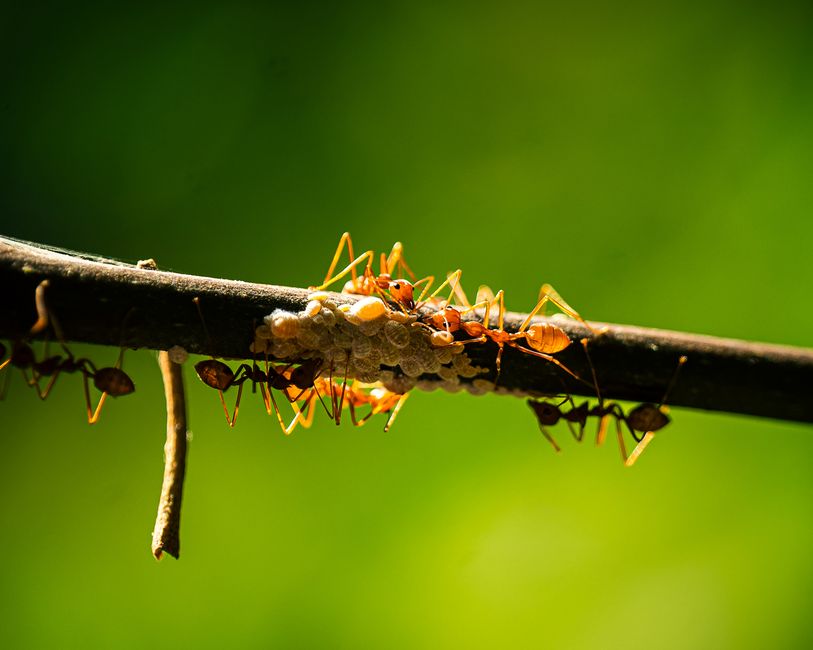
No. Grits do not get rid of ants. The idea that ants eat dry grits, drink water, and then swell up and die is a myth with no scientific support. Ants are not built to burst from eating grain, and dry grits provide them with nothing they need. If you have an ant problem, grits will waste your time while the colony keeps growing.
This is one of those home remedies that sounds clever and spreads easily. It deserves a clear, honest answer rather than a maybe. Here is what the evidence actually shows, why the myth persists, and what does work.
Where Did the Grits and Ants Myth Come From?
The myth likely grew from a simple misunderstanding of ant biology. The story goes that ants carry dry grits back to the nest, eat them, drink water, and expand until they die. It sounds plausible if you picture a grain of corn swelling in water.
But ants do not work that way. Their digestive systems are not sealed bags that rupture when contents expand. An ant’s body regulates what passes through it. Eating a dry grain of corn and then drinking water does not cause the ant to burst.
There is also a practical problem. Dry grits are hard, bland, and offer no nutritional value to a foraging ant. Ants are drawn to fats, sugars, and proteins. A plain grain of dried corn sits far down that list. Most ants will walk right past it.
Some versions of the myth claim grits are taken back to the queen and fed to her, killing the colony. No research supports this. Ants do share food through a process called trophallaxis, but they do not treat dry grits as food worth carrying home.
Do Ants Actually Eat Grits?
Ants can physically move small particles, but that does not mean they eat them. A foraging ant may investigate a grit, pick it up, and drop it. That is curiosity, not feeding.
Ant diets vary widely by species. Many common household ants feed on sweets, greasy foods, and other insects. Some species eat seeds and grains, but even those prefer whole seeds with nutritional value. Processed, dried corn grits offer little.
There is a related myth worth clearing up. Some people believe instant grits work better than regular grits because they absorb water faster. This is not supported by any evidence either. The texture of the grits does not change how an ant’s body works. The whole premise is flawed.
If you put grits out and later see fewer ants, something else likely explains it. Ant traffic changes with temperature, moisture, and food availability. A drop in activity is not proof the grits worked.
Will Grits Get Rid Of Ants in the House?
Grits will not get rid of ants in the house. There is no clinical or pest management evidence that they reduce ant populations. Using grits as a treatment means the colony continues to grow and forage while you wait for a result that will not come.
This matters because ant problems get worse over time. A few foraging ants are workers from a colony that may be large and hidden. Killing the ones you see does nothing to the nest. That is true whether you use grits, soapy water, or any surface spray.
The trap many people fall into is treating the symptom. Visible ants are the symptom. The colony is the problem. Grits do not address either one.
There is one more consideration. Scattering food particles like grits around your kitchen can attract other pests. You may end up with more activity rather than less.
What Actually Gets Rid Of Ants?
Bait is the most effective approach for most household ant problems. The principle is straightforward. Ants carry bait back to the nest and share it with the colony, including the queen. This targets the source rather than the workers you see.
Different ant species respond to different baits. Some prefer sweet baits. Others prefer protein or fat based baits. Matching the bait to the species you have increases your chances. If one bait type sits untouched, try another.
Here is what pest management professionals generally recommend:
- Identify the ant species if you can. Behavior and food preference differ by species.
- Use sealed bait stations rather than loose bait, especially around children and pets.
- Place bait near trails, not directly on them, so ants find it while foraging.
- Leave bait stations undisturbed for as long as the product label directs.
- Avoid spraying repellent insecticides along trails you are also baiting. Repellents can disrupt foraging and keep ants away from the bait.
For severe or persistent infestations, a licensed pest control professional is the practical choice. Some species, like carpenter ants, can damage wood and need targeted treatment.
Prevention matters too. Wipe counters, store food in sealed containers, fix leaks, and seal cracks where ants enter. These steps reduce the conditions ants are looking for. They do not replace treatment if a colony is already established inside.
Are Home Ant Remedies Worth Trying?
Some home remedies have partial support. Others are pure folklore. The evidence varies widely, and it is worth knowing which is which.
Diatomaceous earth is sometimes recommended. It works by damaging the waxy outer layer of an insect’s body, causing it to dry out. This mechanism is real. But results depend on using the right product and applying it correctly, and the evidence for it controlling indoor ant infestations specifically is limited. It also works best when dry, which limits its use in damp areas.
Vinegar, lemon juice, and similar liquids are often described as ant repellents. They may disrupt scent trails temporarily. They do not kill ants or reach the colony. Any effect is short lived.
Cinnamon, cayenne pepper, coffee grounds, and cucumber peels are common folk remedies. No reliable evidence shows these control ant infestations. At best they might redirect a trail briefly. They do not solve the problem.
Boiling water poured into an outdoor nest can kill ants, but it is only practical for nests you can locate and reach safely. It is not a solution for indoor infestations. Use caution, since boiling water can cause serious burns.
The pattern here is consistent. Remedies that only affect the ants you can see do not address the colony. Bait does. That is the core difference.
When Should You Call a Professional?
Call a professional when the infestation keeps coming back, when you cannot find the nest, or when you see ants that cause structural damage. Carpenter ants are the main concern indoors in many parts of the US. They tunnel into wood and can weaken structures over time.
Signs that point to carpenter ants include large black or reddish ants, sawdust like material near wood, and faint rustling sounds inside walls. If you notice any of these, get an inspection rather than experimenting with home remedies.
Some people have allergic reactions to ant stings or bites. Fire ants are the most common concern in the southern US. Reactions range from mild local swelling to serious systemic reactions. Anyone with a known allergy should treat ant exposure as a medical issue, not just a household nuisance.
The bottom line is simple. Grits are a myth. Bait, prevention, and professional help when needed are the approaches that hold up.
Frequently Asked Questions
Will grits kill ants?
No. There is no scientific evidence that grits kill ants. The idea that ants eat dry grits, drink water, and burst is a myth that does not match how ant digestion works.
Do ants eat dry grits?
Most ants will not eat plain dry grits because they offer no nutritional value. Some may pick up a particle, but that is not the same as feeding on it.
What is the fastest way to get rid of ants in the house?
Bait stations are generally the most effective approach because ants carry the bait back to the colony. Matching the bait type to the ant species you have improves results.
Does instant grits work better than regular grits for ants?
No. Instant grits have no advantage over regular grits because neither one kills ants. The texture of the grits does not change the outcome.
