
Yes, bananas raise blood sugar. That is what any food containing carbohydrate does. But whether a banana causes a meaningful spike depends on the banana’s ripeness, how much you eat, and what you eat with it. For most people, a banana eaten whole and in normal portions produces a moderate, gradual rise — not the sharp surge people fear.
The confusion comes from mixing up two different questions. Does a food raise blood sugar at all? And does it raise it in a way that matters for health? Those are not the same thing, and the answer to the second is far more reassuring than the answer to the first.
What Happens to Your Blood Sugar When You Eat a Banana?
Digestion breaks the banana’s carbohydrate into glucose, which enters your bloodstream. That is normal physiology, not a problem. The body releases insulin, and cells take up the glucose. Within roughly an hour to two hours, blood sugar returns toward baseline in people without diabetes.
What makes a banana different from a candy bar is the package it arrives in. A medium banana contains about 3 grams of fiber and provides potassium, vitamin B6, vitamin C, and magnesium. The fiber slows how quickly the sugars are absorbed. The fruit’s structure — its cell walls and resistant starch — also affects digestion speed.
That combination means the rise is usually gradual rather than abrupt. It is a real rise, but it is not the same as drinking a sugary soda on an empty stomach.
Does Banana Ripeness Change Blood Sugar Impact?
Ripeness changes the carbohydrate profile of a banana in a way that affects blood sugar. A green, underripe banana contains more resistant starch — a type of carbohydrate your small intestine cannot fully digest. It passes to the large intestine, where gut bacteria ferment it. Because it is not absorbed as glucose, it contributes less to blood sugar.
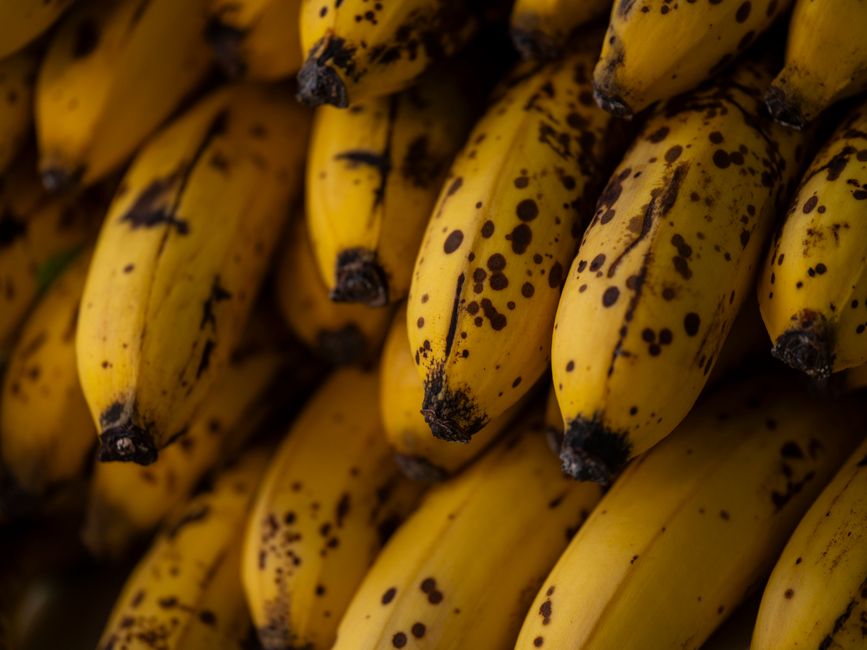
As the banana ripens and turns yellow, enzymes convert that resistant starch into regular starch and then into simple sugars. A very ripe, spotted banana is sweeter because it contains more free sugars and less resistant starch. The same banana at two stages of ripeness will produce different blood sugar responses.
This is a real effect, though its size varies between individuals. If you are watching your blood sugar, a slightly less ripe banana is a reasonable choice. It is not a dramatic difference, but it is a genuine one.
How Many Carbs Are in a Banana?
The amount of carbohydrate depends on size. USDA data for raw bananas shows a medium banana of about 118 grams contains roughly 27 grams of total carbohydrate, including about 3 grams of fiber. A small banana has less. A large one has more.
| Banana size | Approximate total carbs | Approximate fiber |
|---|---|---|
| Small (about 100 g) | 23 g | 2.6 g |
| Medium (about 118 g) | 27 g | 3.1 g |
| Large (about 136 g) | 31 g | 3.5 g |
Portion size matters more than most people realize. Two bananas are not one banana. If you eat a large banana, you are consuming carbohydrate roughly equal to a slice of bread plus a small piece of fruit. That is not a reason to avoid bananas — it is a reason to count them accurately if you are tracking carbohydrate intake.
Will Bananas Raise Blood Sugar If You Have Diabetes?
Bananas raise blood sugar in people with diabetes, just as they do in anyone else. The difference is how the body handles that rise. In type 1 diabetes, the body does not produce enough insulin. In type 2, cells respond poorly to insulin. Either way, the same carbohydrate load can produce a higher and longer-lasting rise.
That does not mean bananas are off-limits. Many diabetes education programs include fruit as part of a balanced eating pattern. The practical approach most clinicians take is to eat bananas in moderate portions, pair them with protein or fat, and monitor your own glucose response.
Individual responses vary widely. Two people with type 2 diabetes can eat the same banana and see different glucose curves. Continuous glucose monitoring has made this visible in a way it never was before. This is why general rules about “safe” fruits are less useful than knowing your own response.
If you take insulin and are counting carbohydrates, a banana’s carbohydrate content needs to be factored into your dose. That is a conversation to have with your care team, not something to estimate from a general article.
What Is the Glycemic Index of a Banana?
The glycemic index (GI) is a scale that ranks carbohydrate foods by how quickly they raise blood sugar compared with a reference food. Bananas generally fall in the low-to-medium range, though the exact value varies with ripeness and the specific variety tested.
The glycemic index has real limitations. It was developed using specific test conditions and average responses across groups of people. Your personal response may differ. It also does not account for how much you eat — a concept called glycemic load, which multiplies the GI by the carbohydrate content of a realistic portion.
Glycemic load is often more useful than GI alone because it reflects portion size. A medium banana has a moderate glycemic load. That is a more honest picture than a single GI number suggests.
Does Eating a Banana With Other Foods Change the Effect?
Yes, and this is one of the most practical things you can do. Eating a banana with protein, fat, or fiber slows gastric emptying and blunts the blood sugar rise. A banana alone on an empty stomach produces a different response than the same banana eaten with peanut butter, yogurt, or nuts.
Food order may also matter. Some research suggests that eating protein or vegetables before carbohydrate-rich foods can reduce the post-meal glucose rise. The effect appears modest but consistent across several studies. It is not a substitute for medication or carbohydrate counting, but it is a low-cost adjustment worth knowing about.
Ripe banana in a smoothie is a different situation. Blending breaks down the fruit’s cell structure, which can speed digestion and produce a faster rise than eating the whole fruit. The fiber is still there, but its physical form has changed. This is one reason whole fruit and fruit smoothies are not nutritionally identical even when the ingredients match.
Are Bananas Good for Blood Sugar or Bad?
For most people, bananas are a reasonable part of a balanced diet. They provide potassium, fiber, and vitamins, and they are portable, affordable, and satisfying. The evidence does not support avoiding them for blood sugar reasons in the general population.
Whole fruit intake, including bananas, is consistently associated with lower risk of chronic disease in large observational studies. That does not prove bananas lower blood sugar — they do not. It means that eating fruit as part of an overall pattern is not the blood sugar problem it is sometimes made out to be.
The framing matters. A banana is not a “blood sugar food” to be feared or a “superfood” to be celebrated. It is a carbohydrate-containing fruit with real nutritional value. How it fits depends on your overall diet, your portion size, and your individual glucose response.
For people with diabetes or prediabetes, the useful question is not “can I eat bananas?” but “how does my body respond to this banana, in this amount, eaten this way?” That is a question only your own monitoring can answer.
Frequently Asked Questions
Will bananas raise blood sugar?
Yes, bananas raise blood sugar because they contain carbohydrate that digests into glucose. The rise is usually moderate and gradual in most people, especially when the banana is eaten whole and paired with protein or fat.
Are bananas bad for diabetics?
No, bananas are not automatically off-limits for people with diabetes. Portion size, ripeness, and what you eat with them all affect the glucose response, and individual responses vary enough that monitoring your own reaction matters more than general rules.
Which is better for blood sugar, a ripe or green banana?
A greener banana contains more resistant starch and less free sugar, so it tends to produce a smaller blood sugar rise. The difference is real but modest, and it varies between individuals.
How many carbs are in a medium banana?
A medium banana of about 118 grams contains roughly 27 grams of total carbohydrate, including about 3 grams of fiber, according to USDA data. A large banana contains more, and a small one contains less.
