
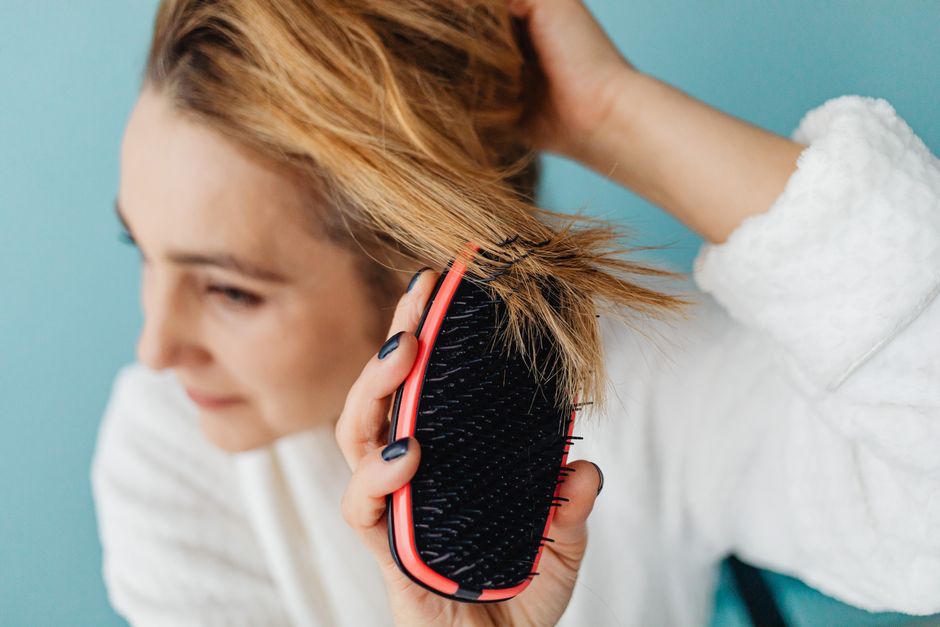
Finding strands of hair in your brush is normal. On average, people shed between 50 and 100 hairs every day as part of the natural hair growth cycle. Brushing collects the hairs that have already detached from the follicle but are still sitting loose in your hair. So in most cases, what you see in the brush is accumulation, not sudden loss. The question worth asking is whether the amount has changed — and if so, why.
Why Is My Hair Falling Out When I Brush It?
Hair shedding is a built-in feature of how hair grows, not a sign that something is wrong by itself.
Each hair follicle cycles through three main phases. The anagen phase is active growth and lasts for years. The catagen phase is a short transition period of a few weeks. The telogen phase is a resting period of roughly three months, after which the hair detaches and falls out. At any given time, most of your hair is in the growth phase, while a minority is in the resting phase.
When you brush, you are mechanically removing hairs that have already completed the telogen phase and are ready to shed. Without brushing or washing, those loose hairs stay tangled in the rest of your hair and come out all at once later — which can look alarming but represents the same daily shedding.
The key distinction is between shedding and hair loss. Shedding is the normal release of hairs at the end of their cycle. Hair loss, or alopecia, means something is disrupting the follicle itself — reducing how much hair grows back. Shedding can be temporary and reversible. Some forms of hair loss are progressive.
If you are noticing more hair in your brush than usual, the next sections cover the most common reasons why.
How Much Hair Loss When Brushing Is Normal?
Shedding 50 to 100 hairs per day is considered typical for most adults. That range comes from established dermatology references and reflects the normal turnover of the hair cycle.
Brushing can concentrate a day’s worth of shedding into a single moment. If you brush once in the morning after sleeping, you may see 30 to 50 hairs in the brush at once. That does not mean you are losing 50 hairs every time you brush — it means you are seeing the hairs that shed overnight plus those loosened by the brushing itself.
Several factors make normal shedding look heavier than it is:
- Not brushing or washing for a few days, then brushing — loose hairs accumulate and release together
- Brushing with a fine-tooth comb or dense bristle brush, which pulls more loose hairs free
- Having long hair, which makes individual strands more visible and makes a small number of hairs look like more
- Brushing wet hair, when strands are more elastic and more likely to stretch and snap
What matters more than the number on any given day is the trend. If the amount has been steadily increasing over weeks, or if you can see thinning at the part line or temples, that points toward something beyond normal shedding.
What Causes Sudden Increase in Hair Shedding?
A noticeable jump in shedding usually has a trigger, and the timing of that trigger matters.
The most common cause of sudden, diffuse shedding is a condition called telogen effluvium. In telogen effluvium, a stressor pushes a larger-than-normal percentage of hair follicles into the resting phase at the same time. Because the resting phase lasts about three months, the shedding typically begins roughly two to three months after the trigger — not immediately.
Common triggers include:
- Physical stress: surgery, serious illness, high fever, or significant injury
- Emotional stress: major life events, grief, or prolonged anxiety
- Rapid weight loss: especially from very low-calorie diets or bariatric surgery
- Nutritional deficiencies: low iron stores, low vitamin D, or inadequate protein intake
- Thyroid disorders: both hypothyroidism and hyperthyroidism can disrupt the hair cycle
- Medications: certain drugs including some antidepressants, blood thinners, and retinoids
- Childbirth: shedding commonly peaks around three to six months after delivery
Telogen effluvium is generally temporary. Once the trigger resolves, hair typically returns to its normal growth pattern. But recovery takes time — often several months — because the follicles need to cycle back into active growth.
It is also worth knowing that COVID-19 infection has been associated with increased shedding in some people, following the same telogen effluvium pattern. Some studies suggest this shedding typically begins around two to three months after infection and is usually temporary.





Could It Be Pattern Hair Loss Instead of Shedding?
Pattern hair loss looks different from shedding, and the distinction matters for what you do next.
Androgenetic alopecia — commonly called male-pattern or female-pattern hair loss — is a gradual thinning driven by genetics and hormones. It does not cause hairs to fall out in large numbers. Instead, it causes individual follicles to produce thinner, shorter hairs over time until they eventually stop producing visible hair.
The pattern differs between men and women:
- Men: thinning typically starts at the temples and crown, often progressing to a receding hairline
- Women: thinning is usually diffuse across the top of the scalp, with widening of the part line and sparing of the frontal hairline
If you are seeing more hairs in your brush and noticing that your hair is getting thinner in specific areas over months, you may be dealing with both — pattern hair loss plus a shedding episode on top of it. That combination is common.
Pattern hair loss is not reversible without treatment, but it can often be slowed or partially regrown with medical treatment. A doctor or dermatologist can evaluate whether this is what you are experiencing.
When Should You See a Doctor About Hair Shedding?
See a doctor if the shedding has been ongoing for more than a few months, if you can see visible thinning or bald patches, or if you have other symptoms like fatigue, weight changes, or unusual skin changes.
These signs warrant a medical evaluation:
- Shedding that continues for more than six months
- Visible scalp through the hair, or a widening part
- Patchy bald spots, which can indicate alopecia areata — an autoimmune condition
- Scalp pain, itching, redness, or scaling alongside the shedding
- Shedding accompanied by fatigue, cold intolerance, or unexplained weight changes — possible thyroid issues
- Hair loss that started after a new medication
- Eyebrow or body hair loss along with scalp shedding
A doctor will typically ask about your medical history, recent stressors, medications, and diet. Blood tests may check ferritin (iron stores), thyroid function, vitamin D, and sometimes other markers. These tests help identify treatable causes.
Some clinicians recommend checking ferritin levels even when iron is technically within the normal range, because low-normal iron stores have been associated with hair shedding in some studies. This is not a universally agreed threshold, and clinical practice varies.
Does Brushing Cause Hair Loss?
Normal brushing does not cause hair loss. It removes hairs that have already shed. But how you brush can affect how much breakage you see.
Hair breakage is different from shedding. A shed hair comes out with a small white bulb at the root — that is the telogen club hair detaching normally. A broken hair has no bulb and splits or snaps along the shaft. If most of what you see in your brush lacks a white tip, you may be looking at breakage rather than shedding.
Breakage is more likely when:
- You brush wet hair, which is more fragile and stretches before it snaps
- You use a brush with stiff or sharp bristles
- You rip through tangles instead of working them out from the ends up
- Your hair is chemically treated, heat-damaged, or over-processed
To reduce breakage, use a wide-tooth comb or a brush designed for detangling, start from the ends and work upward, and be gentle with wet hair. These steps reduce mechanical damage but will not change how much hair you naturally shed.
Does Shedding More Hair Mean I Am Going Bald?
Not necessarily. Most episodes of increased shedding are temporary and resolve once the underlying trigger is addressed.
Telogen effluvium, the most common cause of sudden diffuse shedding, typically resolves within six to twelve months after the trigger is removed. Hair regrows because the follicles were never permanently damaged — they were just shifted into a resting phase.
However, chronic or repeated shedding can gradually reduce hair density if it goes on long enough or recurs frequently. And if shedding is happening alongside an underlying pattern hair loss condition, the two can compound each other.
The honest position: temporary shedding usually recovers. Ongoing shedding needs investigation. Progressive thinning in a specific pattern usually needs treatment. These are different situations with different outcomes.
What Helps Reduce Hair Shedding?
The most effective step is identifying and addressing the underlying cause. There is no single supplement or shampoo that reliably stops shedding regardless of why it is happening.
What the evidence supports:
- Correcting deficiencies: If blood tests show low iron, vitamin D, or protein intake, correcting those deficiencies can help — but only if a deficiency is actually present
- Treating thyroid disorders: Restoring normal thyroid function often normalizes hair cycling
- Reviewing medications: If a medication is the trigger, a doctor may adjust or switch it
- Managing stress: Since emotional stress is a known trigger, stress reduction may help prevent recurrence, though the evidence for specific stress-reduction techniques directly improving hair shedding is limited
- Gentle hair care: Reduces breakage, which can make hair look fuller even when shedding is unchanged
Be cautious with products that claim to stop hair loss or regrow hair. Many have no clinical evidence behind them. A small number of treatments — including minoxidil and certain prescription medications — have been studied and shown to help with specific types of hair loss, but they are not appropriate for all causes of shedding and should be discussed with a doctor.
No clinical guidelines currently exist for using most over-the-counter hair supplements to treat shedding, because the evidence base is limited and results vary widely.
Frequently Asked Questions
How many hairs a day is normal to lose?
Losing 50 to 100 hairs per day is considered normal for most adults. Brushing can make a day’s worth of shedding visible all at once.
Can brushing too much cause hair loss?
Brushing does not cause hair loss, but rough brushing can cause breakage that looks like loss. Gentle brushing with a wide-tooth comb reduces mechanical damage.
How long does stress-related hair shedding last?
Stress-related shedding usually begins about two to three months after the trigger and typically resolves within six to twelve months. Hair regrows once the trigger resolves.
Should I worry if I see a lot of hair in my brush?
Occasional heavy shedding is usually not a concern, but shedding that continues for months or comes with visible thinning should be evaluated by a doctor. Blood tests can identify treatable causes like low iron or thyroid problems.
