
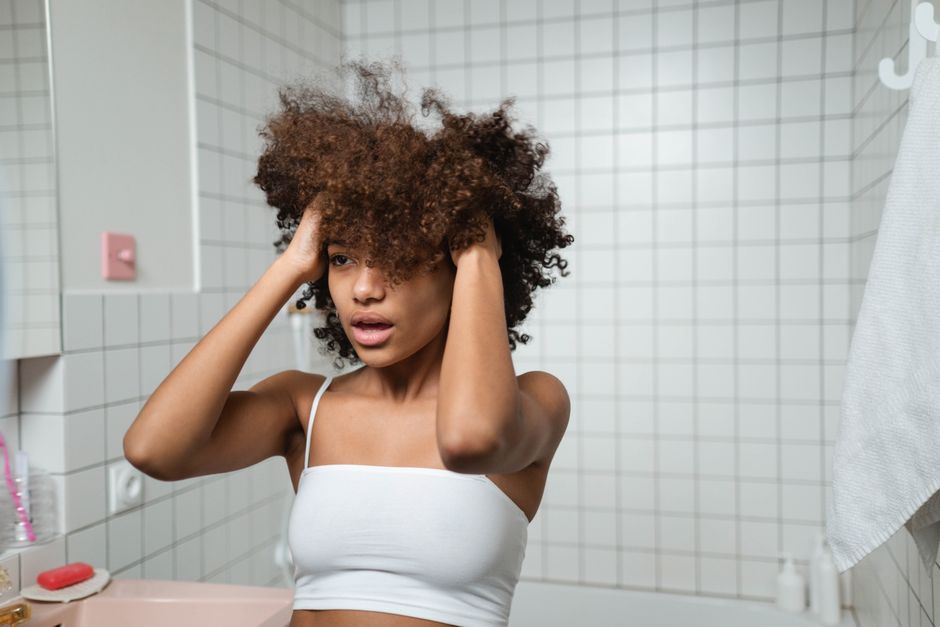
Poofy curly hair happens when dry, damaged or overly brushed curls lose their shape and soak up moisture from the air, swelling outward instead of clumping into defined curls. The fix is not a single product. It is a change in how you handle water, friction and moisture balance. Curly hair is structurally different from straight hair, and most poofiness comes from treating it like straight hair.
Why Is My Curly Hair So Poofy And How To Fix It?
Curly hair has a twisted shape along its length. That twist creates natural weak points in the hair fiber, and it also means the hair’s outer layer — the cuticle — does not lie as flat as it does on straight hair.
The cuticle is the protective outer shell made of overlapping scales. On healthy hair those scales lie flat and smooth. On dry or damaged curly hair they lift. When the cuticle is raised, the hair absorbs water from humid air, swells, and the curl pattern loosens into frizz. That is the poof you see.
There is a second factor people rarely connect to poofiness. Curly hair grows in a helix, so the natural oils produced at the scalp have a harder time traveling down the strand. Straight hair wicks oil down easily. Curly hair tends to be drier along its length as a result. Dry hair is more porous, and more porous hair takes on moisture from the environment more readily.
Poofiness is usually a combination of these two things: raised cuticles and thirsty, unevenly moisturized hair. Sometimes mechanical damage from brushing, heat or rough drying is layered on top.
Does Brushing Curly Hair Make It Poofy?
Yes. Brushing dry curly hair is one of the most direct causes of poofiness.
Curly hair naturally groups into clumps — families of strands that wrap around each other and form the visible curl. When you run a brush through dry curls, you break those clumps apart. Each individual strand separates and the cuticle gets roughened in the process. The result is a cloud of separate fibers rather than defined curls.
This is why the same head of hair can look defined when wet and enormous when brushed dry. Nothing has changed about the hair itself. The clumping has been destroyed.
If you need to detangle, do it in the shower with conditioner in your hair, when it is wet and slippery. Use your fingers or a wide-tooth comb rather than a fine brush. Some people with tighter curl patterns detangle only in the shower and never brush dry at all.
Why Does Humidity Make Curly Hair Frizz?
Hair is hygroscopic, meaning it absorbs water from the air. When humidity is high, porous hair pulls in moisture and swells.
On straight hair this swelling is fairly uniform and does not change the shape much. On curly hair, the swelling is uneven along the twist. Some sections absorb more than others, the fiber expands, and the curl pattern distorts. The cuticle lifts slightly and light scatters off the roughened surface, which reads as frizz.
This is also why hair can look worse on a humid day even if you did nothing different. The environment changed, and porous hair responds to it.
Products marketed as humidity blockers or anti-humidity shields work by coating the hair surface. Some contain film-forming ingredients that temporarily smooth the cuticle. The effect is real but temporary and varies by hair type. No product permanently seals hair against humidity.
How Do You Stop Curly Hair From Getting Poofy?
The core principle is to keep curls clumped, keep the cuticle smooth, and keep hair moisturized without weighing it down. Most of the practical changes fall into a few areas.
Stop brushing dry. Detangle wet with conditioner. This one change reduces poofiness for many people more than any product will.
Apply products to wet hair. Leave-in conditioner, curl cream or gel applied to soaking wet hair helps clumps form before the hair dries. Once the hair dries without clumping, you cannot easily recreate the clumps.
Dry gently. Rubbing hair with a rough towel roughens the cuticle and breaks clumps. Many people with curly hair use a cotton T-shirt or a microfiber towel and squeeze or blot rather than rub. Air drying or diffusing on low heat avoids the heat damage that raises the cuticle over time.
Reduce heat and chemical damage. Flat irons, hot brushes and repeated bleaching or relaxing damage the cuticle and increase porosity. More porous hair frizzes more easily. If you use heat, a heat protectant and lower temperatures reduce the damage, though they do not eliminate it.
Condition more than you shampoo. Curly hair often benefits from a conditioner applied to the mid-lengths and ends, and from shampooing less often or using a gentler cleanser. Shampooing frequency depends on your scalp — some people need to wash more often for scalp health, and that is fine. Scalp health comes first.
Does the Curly Girl Method Actually Work?
The Curly Girl Method is a set of practices — often no shampoo, no silicones, no sulfates, no heat, and plenty of conditioner — that became popular online. Parts of it align with what we know about curly hair. Parts of it are not supported by strong evidence.
The parts that make sense: avoiding rough drying and brushing, keeping hair conditioned, and reducing heat damage. These are consistent with how curly hair behaves.
The parts that are debated: cutting out all sulfates and silicones, and avoiding shampoo entirely. Sulfates are cleansing agents that some people find drying, but not everyone needs to avoid them. Silicones are not inherently damaging — they coat the hair and can reduce frizz. Some people find they build up and weigh curls down. The evidence does not support a blanket rule for everyone.
The honest position is that the Curly Girl Method is a useful framework, not a proven protocol. Some people see clear improvement. Others find that skipping shampoo causes scalp problems or that their hair needs different care. There is no single method that works for all curl types.
What Products Actually Reduce Poofiness?
Products help, but they work best when the handling is already right. A gel on brushed dry hair will not fix poof. A gel on wet, clumped hair can hold definition as it dries.
Here is a rough guide to what different product types do. This is general information, not a recommendation for your specific hair.
- Leave-in conditioner adds moisture and smooths the cuticle. Useful for dry or porous hair.
- Curl cream adds moisture and some hold. Often used under a gel.
- Gel forms a cast that holds clumps as hair dries. Many people scrunch out the crunch once dry.
- Serum or oil can smooth the surface and add shine. Used sparingly, mostly on ends. Too much weighs curls down.
No product permanently changes the structure of your hair. The effect lasts until the next wash. Claims that a product “repairs” damaged hair should be read carefully — some ingredients can temporarily smooth the cuticle or reduce the appearance of damage, but hair is not living tissue and cannot heal itself the way skin can.
Does Diet or Water Affect Curly Hair Poofiness?
Hair is built from protein, and severe nutritional deficiencies can affect hair health. But for most healthy adults eating a normal diet, changing food will not fix poofy curls. There is no strong evidence that specific foods or supplements reduce frizz in people who are not deficient.
Water hardness is a common topic in curly hair communities. Hard water contains higher levels of minerals like calcium and magnesium. Some people report that hard water leaves hair feeling rougher or more prone to frizz. The evidence here is limited and mostly anecdotal. A shower filter may help some people and do nothing for others. It is not a proven fix.
If you have sudden changes in hair texture, thinning, or breakage, that is worth mentioning to a doctor. Hair changes can sometimes reflect thyroid problems, iron deficiency or other health issues. Poofiness alone is not a medical concern, but a sudden change in your hair is worth noting.
Frequently Asked Questions
Why is my curly hair so poofy?
Poofiness usually comes from dry or damaged hair with a raised cuticle that absorbs moisture from the air and swells. Brushing dry curls breaks the natural clumps and separates strands, which makes the poof worse.
How do I stop my curly hair from being frizzy?
Detangle wet with conditioner, apply product to soaking wet hair, and dry gently with a soft towel or diffuser instead of rubbing. Reducing heat and chemical damage also helps over time.
Should I brush curly hair?
Not when it is dry. Brushing dry curls breaks up the clumps that form defined curls and roughens the cuticle. Detangle in the shower with conditioner instead.
Does the Curly Girl Method work for frizzy hair?
Some parts of it are well grounded, like avoiding rough drying and reducing heat. Other rules, like cutting out all sulfates and silicones, are debated and do not work for everyone.
