
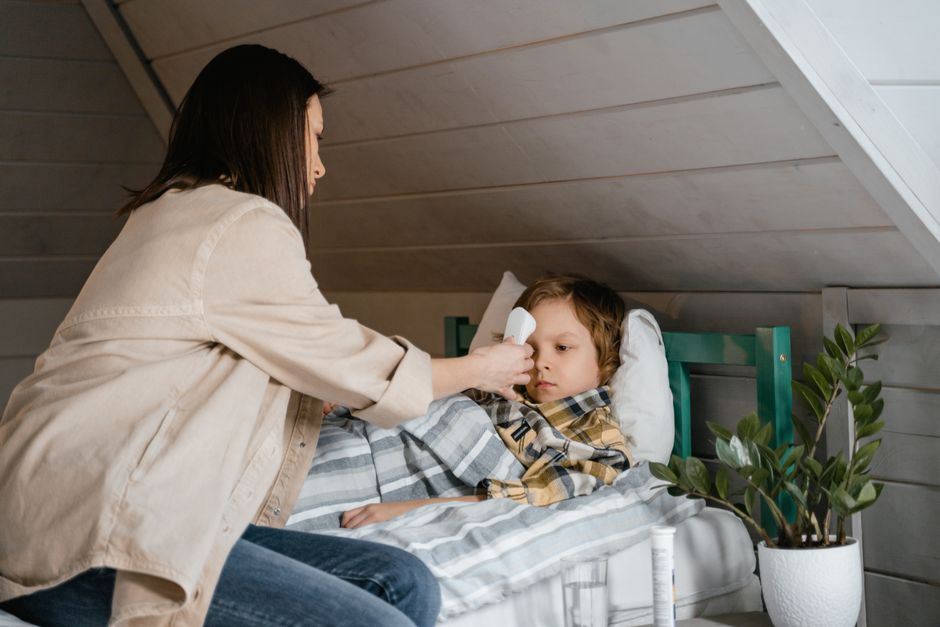
A child who feels hot to the touch but has a normal thermometer reading is a common situation, and it usually has a simple explanation. Body temperature is not one fixed number. It rises and falls through the day, it climbs during active play, and it can feel higher in one spot than another. A normal temperature does not always match what your hand tells you.
Fevers start at 100.4°F (38°C) or higher when measured with a reliable thermometer. Below that, a child can still feel warm for many reasons that have nothing to do with illness. The sections below explain what body temperature actually measures, what commonly drives that warm feeling, and when it deserves a call to a doctor.
What Counts as a Fever?
Medical definitions of fever are based on measurement, not on how warm a child feels. A temperature of 100.4°F (38°C) or higher, taken with a thermometer, is generally considered a fever. Anything below that falls within the normal range.
Normal body temperature sits around 98.6°F (37°C), but that is an average, not a rule. A child’s temperature can normally range from about 97°F to 100.3°F depending on the time of day, their age, and what they have been doing. It tends to be lowest in the early morning and highest in the late afternoon and evening.
This is where the confusion usually starts. A child can feel genuinely hot at 99.5°F, especially to a parent’s hand. That reading is not a fever. It is a normal body doing normal things.
Why Is My Childs Body Hot But No Fever?
A warm-feeling child with a normal temperature is usually responding to something ordinary: activity, a warm environment, recent eating, or the natural daily rise in body temperature. None of these involve infection.
Body heat is a byproduct of the body doing its job. Muscles working, food being digested, and the body’s internal clock all shift temperature up and down. When a child feels hot but the thermometer reads normal, one or more of these factors is usually at work.
It also helps to know that a hand on the forehead is a poor thermometer. Skin temperature and core temperature are not the same thing. A child’s skin can feel hot from warm air, blankets, or a warm bath even when their core temperature has not moved. The reverse is also true: a child with cold hands can still have a fever.
What Causes a Warm Body Without a Fever?
Most causes of a hot-feeling child with a normal temperature are harmless and temporary. The list below covers the ones that come up most often.
- Physical activity. Running, playing, or crying raises body temperature. It settles back down once the child rests.
- A warm environment. A hot room, too many blankets, or heavy clothing can make skin feel hot without raising core temperature much.
- Recent eating. Digestion produces heat. A child can feel warmer for a while after a big meal.
- Time of day. Body temperature naturally peaks in the late afternoon and evening.
- Teething. Some parents notice a slightly warm child during teething. Teething can cause mild temperature changes, but it does not cause true fever. If a fever is present, look for another cause.
- Emotion. Crying, excitement, or stress can briefly raise temperature.
- Hormonal shifts. This matters more in teens, and in girls around the menstrual cycle, than in young children.
If more than one of these is happening at once, a child can feel quite warm and still have a perfectly normal reading.





How Do You Take a Child’s Temperature Correctly?
How you measure matters as much as the number you get. Different methods give different readings, and an inaccurate measurement is a common reason parents get confused.
| Method | Best for | Notes |
|---|---|---|
| Rectal | Infants and young children | Most accurate; considered the standard in this age group |
| Oral | Children old enough to hold it | Reliable when done correctly |
| Axillary (armpit) | Quick screening | Less accurate; tends to read lower |
| Ear (tympanic) | Older infants and children | Accuracy depends on correct placement |
| Forehead (temporal) | Quick screening | Convenient; can be less precise |
Wait at least 15 to 30 minutes after activity, a warm bath, or a hot drink before measuring. Those can push a reading up temporarily. If the first reading seems off, take it again with the same method.
For infants under 3 months, a rectal temperature is the most reliable. This age group needs special care, and any fever in a baby this young should be checked by a doctor right away.
When Should You Call a Doctor?
How a child looks and acts matters more than the exact number on the thermometer. A child who is alert, drinking, and playing is usually fine even if they feel warm. A child who looks unwell needs attention regardless of the reading.
Call a doctor if your child:
- Is under 3 months old and has a temperature of 100.4°F (38°C) or higher
- Has a fever of 100.4°F (38°C) or higher that lasts more than a few days
- Is unusually sleepy, hard to wake, or not responding normally
- Is not drinking, has fewer wet diapers, or shows signs of dehydration
- Has trouble breathing, a stiff neck, a rash that does not fade when pressed, or repeated vomiting
- Has a fever that drops and then returns after being gone for a day or more
Trust your instincts. If something feels wrong, it is reasonable to call, even if the temperature is normal.
What About Teething and Other Common Beliefs?
Teething is often blamed for a warm child, and there is a small grain of truth here, but it is widely overstated. Teething can cause mild discomfort and slight temperature changes. It does not cause a true fever. When a teething baby has a fever of 100.4°F (38°C) or higher, something else is going on, and it should be looked at.
Another common belief is that a hot forehead always means illness. It does not. Skin temperature changes with the room, with clothing, and with activity. A cool forehead does not rule out a fever either. The thermometer is the tool that answers the question, not your hand.
Some parents worry that a warm child without a fever means an illness is “coming on.” That can happen, but it is not reliable. A rising temperature is what signals a fever, not a warm feeling beforehand. Watching your child’s behavior and energy is more useful than checking their forehead every hour.
How Can You Help a Child Who Feels Hot?
If your child has a normal temperature and feels hot, the goal is comfort, not treatment. There is nothing to bring down.
Simple steps help:
- Remove extra layers or blankets if the room is warm
- Offer water or other fluids
- Let them rest if they have been active
- Keep the room at a comfortable temperature
Do not give fever-reducing medicine when there is no fever. These medicines treat fever and discomfort, not a warm feeling. Giving them “just in case” is not helpful and carries its own risks, especially in young children.
If your child does develop a fever later, follow the dosing instructions on the package or from your doctor. Never give aspirin to a child or teenager. It is linked to a rare but serious condition called Reye’s syndrome.
Frequently Asked Questions
Can a child feel hot but not have a fever?
Yes. Activity, a warm room, recent eating, and the natural daily rise in body temperature can all make a child feel hot with a normal reading. A hand on the skin is not a reliable way to detect fever.
What temperature is considered a fever in children?
A temperature of 100.4°F (38°C) or higher, measured with a thermometer, is generally considered a fever. Anything below that is within the normal range.
Does teething cause a fever?
Teething can cause mild temperature changes and discomfort, but it does not cause a true fever of 100.4°F (38°C) or higher. If a fever is present, look for another cause.
When should I worry about a hot child with no fever?
Worry less about the warmth itself and more about how your child looks and acts. Call a doctor if your child is very sleepy, hard to wake, not drinking, breathing oddly, or if they are under 3 months old.
