
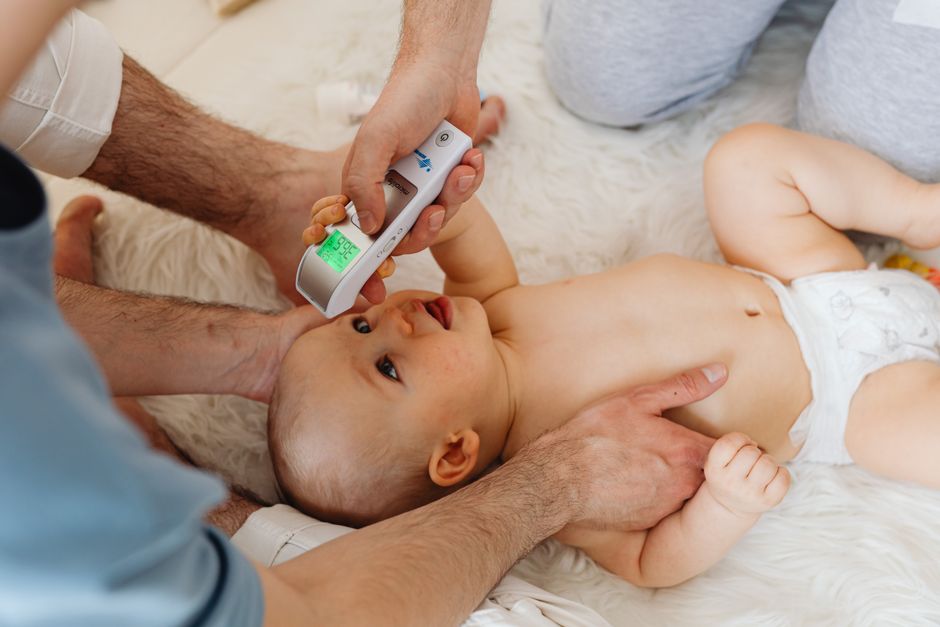
You touch your baby’s skin and it feels warm, even hot. But the thermometer reads normal. You check again. Still normal. This is confusing and worrying for good reason. The simple answer is that babies regulate body temperature differently than adults. Their bodies heat up for many reasons that have nothing to do with illness. A hot body without a fever is common and usually not a sign of danger. Let’s look at what is actually happening.
What Does It Mean When a Baby’s Body Is Hot But No Fever?
A true fever is defined as a rectal temperature of 100.4°F (38°C) or higher. If your baby’s skin feels hot but the thermometer stays below that number, it is not a fever. The skin can feel warm because blood vessels near the surface are expanding. This happens during normal activities like playing, crying, or digesting food. Babies have a larger surface area relative to their body weight. This means they absorb and release heat faster than adults. Their skin can feel hot even when their internal temperature is perfectly fine. The American Academy of Pediatrics states that skin temperature alone is not a reliable measure of fever. You must use a thermometer to know for sure.
Why Is My Baby’s Body Hot But No Fever? Common Reasons
Several everyday situations cause a baby’s body to feel hot without raising their core temperature. Overdressing is the most common cause. Babies cannot sweat efficiently in the first few weeks of life. If you put them in too many layers or a heavy blanket, heat gets trapped against their skin. Their body feels hot but their internal temperature stays normal. A good rule is to dress your baby in one more layer than you are comfortable wearing.
A warm room or car can also do this. Babies heat up faster in warm environments because they cannot cool themselves as well. Crying is another big one. When a baby cries hard for several minutes, their body temperature can rise temporarily. This is from muscle activity and stress hormones. Once they calm down, the heat fades within 10 to 15 minutes. Teething is often blamed for a hot body, but research published in Pediatrics found that teething does not cause a true fever. It can cause slightly warm cheeks and gums from inflammation, but not a core temperature above 100.4°F.
Physical activity like rolling, crawling, or kicking also generates body heat. After a play session, your baby’s skin may feel noticeably warm. This is normal and passes quickly.
How to Tell the Difference Between a Hot Body and a Real Fever
The only reliable method is a thermometer. Do not rely on touching their forehead, neck, or chest. Your hands are not accurate for detecting small temperature changes. A 2017 study in the Journal of Emergency Nursing found that parents who used touch alone missed fevers in 40% of cases. Use a digital rectal thermometer for infants under three months. This is the gold standard. For older babies, a temporal artery thermometer is also accurate.
| Method | Best For | Accuracy |
|——–|———-|———-|
| Rectal thermometer | Infants under 3 months | Most accurate |
| Temporal artery | 3 months and older | Very accurate |
| Ear thermometer | 6 months and older | Good when positioned correctly |
| Armpit thermometer | Any age | Less accurate, use as screening only |
| Touch | None | Not reliable |
Look for other signs of illness. If your baby is eating normally, playing, and acting happy, a hot body without fever is almost certainly nothing to worry about. If they are unusually fussy, lethargic, or refusing food, that matters more than skin temperature. The Centers for Disease Control and Prevention (CDC) advises that you should call your doctor if a baby under three months has any temperature over 100.4°F. For older babies, watch for behavior changes more than the number on the thermometer.





What Research Shows About Baby Body Temperature Regulation
Babies are not miniature adults when it comes to temperature control. Their hypothalamus, the part of the brain that regulates body temperature, is still developing. This makes their temperature less stable. A study in the journal Temperature found that infants’ core temperature can fluctuate by up to 1°F over the course of a normal day. This is twice the fluctuation seen in adults.
Newborns also have a higher metabolic rate. Their bodies produce more heat per pound of body weight than older children or adults. This is necessary for growth but it also means their skin can feel warm even when they are not sick. Brown adipose tissue, or brown fat, is another factor. Babies have more brown fat than adults. This tissue generates heat to keep them warm. It is active even at rest and contributes to the warm feeling you notice.
Some studies suggest that the timing of temperature checks matters. Body temperature naturally peaks in the late afternoon and drops in the early morning. If you check your baby at 4 p.m., their temperature may be 99.5°F and they will feel warm. The same baby at 4 a.m. might be 97.8°F and feel cool. Neither is a fever. This is normal circadian variation.
What to Do When Your Baby’s Body Feels Hot
Start with a thermometer. Do not guess. If the reading is below 100.4°F, take simple steps to cool them down. Remove one layer of clothing. If they are in a warm room, turn on a fan or lower the thermostat. Offer a cool washcloth on their forehead or the back of their neck. Give them extra fluids if they are old enough for water or more frequent breastfeeding. These steps usually resolve the feeling of heat within 20 minutes.
If your baby’s body stays hot for more than an hour after removing layers and cooling the room, check again with a thermometer. Sometimes a fever develops slowly. A hot body that persists without a fever could also mean they are overheated from their environment. In rare cases, it can be a sign of a condition called hyperthermia, where the body absorbs more heat than it can release. This is different from a fever. Hyperthermia happens from external heat, like being in a hot car or too many blankets. Fever is the body’s response to infection. If you suspect overheating, cool your baby immediately and call your doctor.
When to Call the Doctor
Call your pediatrician if your baby is under three months old and has a temperature of 100.4°F or higher. For any age, call if your baby has a hot body along with these signs: difficulty breathing, rash, vomiting, diarrhea, unusual sleepiness, or not waking for feeds. Also call if the hot feeling lasts more than 24 hours without a fever. This could indicate an underlying issue like a urinary tract infection or a viral illness that has not yet caused a temperature spike. Trust your instincts. If something feels wrong even though the thermometer is normal, call. Parents are usually right when they sense something is off.
Common Misconceptions About Baby Heat and Fever
One widespread myth is that teething causes fever. It does not. Research published in the Journal of the American Dental Association reviewed multiple studies and found no link between teething and a core temperature above 100.4°F. Teething can cause slightly warm cheeks and irritability, but a true fever is a separate issue. Another myth is that a warm forehead always means fever. Forehead temperature can be affected by room temperature, sweating, or even a recent nap against a warm surface. Only a thermometer gives you the real answer.
Some parents believe that a hot body means the baby is fighting an infection even without a fever. This is not supported by evidence. The immune system raises body temperature as one defense against pathogens. If the temperature is normal, the body is not mounting that response. A hot feeling skin without a fever is almost always environmental or activity-related. Do not assume illness without other symptoms.
Another misconception is that babies should be kept very warm at all times. Overheating is actually a risk factor for sudden infant death syndrome (SIDS). The American Academy of Pediatrics recommends keeping the room at a comfortable temperature for an adult and dressing the baby in no more than one extra layer. A hot baby is not a healthy baby. Cool is safer.
Frequently Asked Questions
Can a baby have a hot body from teething without a fever?
Yes. Teething can cause slightly warm cheeks and gums from inflammation, but it does not cause a true fever above 100.4°F. If your baby has a fever, look for another cause.
How long does it take for a baby’s body to cool down after overheating?
Most babies cool down within 15 to 20 minutes after removing layers or moving to a cooler room. If the hot feeling lasts longer, check their temperature with a thermometer.
Is it normal for a baby’s head to feel hot but not have a fever?
Yes. A baby’s head has many blood vessels close to the skin and can feel warm from crying, activity, or a warm room. This alone does not mean they have a fever.
Should I give my baby medicine if their body feels hot but no fever?
No. Do not give fever-reducing medicine like acetaminophen or ibuprofen if the temperature is below 100.4°F. These medications have side effects and should only be used for true fevers as directed by your doctor.
