
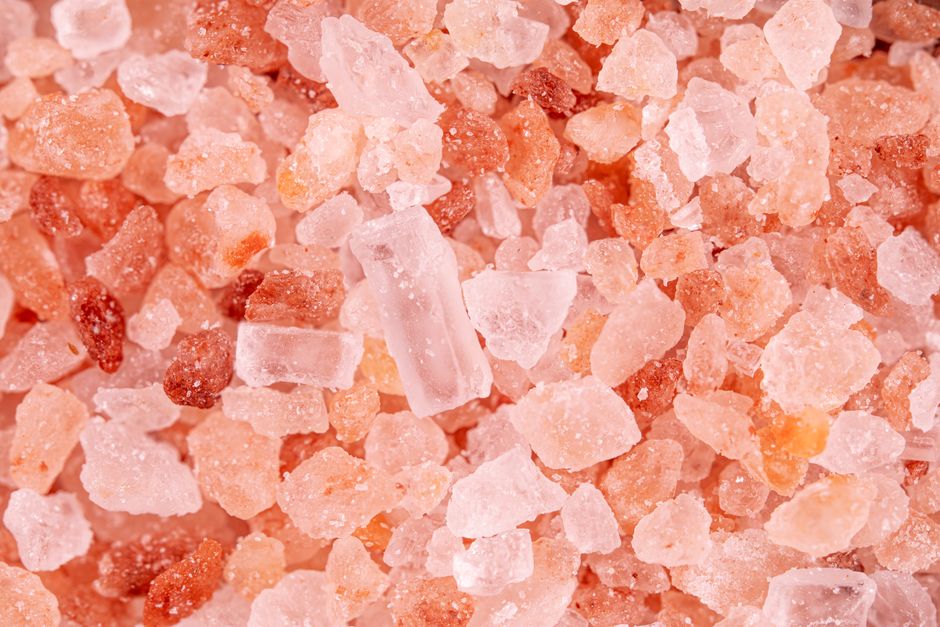
Himalayan salt gets its pink color from trace minerals, especially iron oxide. The salt is mined from the Khewra Salt Mine in Pakistan, and the mineral content trapped inside for millions of years creates the range of pink, red, and orange hues. Unlike table salt, which is heavily processed, Himalayan salt is harvested by hand and minimally washed, leaving those natural minerals intact.
What Makes Himalayan Salt Pink?
The pink color comes from mineral impurities trapped in the salt crystals. Iron oxide — which is basically rust — is the main source of the pink and reddish tones. The salt deposits formed when ancient seabeds evaporated, and the surrounding rock layers added minerals over time.
Research published by the Pakistan Mineral Development Corporation shows that Himalayan salt contains up to 84 different trace minerals. Most of these exist in very tiny amounts. Calcium, potassium, magnesium, and iron are the most common. The specific mineral mix varies by the exact location within the mine, which is why some salt is pale pink and other pieces are deep red.
The darker the pink color, the higher the iron oxide content. White or clear areas in a Himalayan salt block have almost no iron. This is a straightforward chemical fact, not a health claim.
Is Himalayan Salt Healthier Than Regular Salt?
Himalayan salt and regular table salt are both about 98 percent sodium chloride. The difference is the other 2 percent. Table salt often has anticaking agents and added iodine. Himalayan salt has trace minerals instead.
Some people claim those minerals provide significant health benefits. The evidence does not support that. A 2020 study in the Journal of Nutrition and Metabolism found that the mineral levels in Himalayan salt are too low to make a meaningful difference in your diet. You would need to eat dangerous amounts of salt to get enough magnesium or potassium from it.
The American Heart Association states that all salt — including pink salt — should be limited to reduce blood pressure risk. No type of salt is “healthy” in large amounts. The mineral content is a marketing point, not a medical one.
How Does Himalayan Salt Compare to Table Salt?
The main difference is processing and mineral content. Table salt is mined, heated, and bleached white. Anticaking agents are added so it pours freely. Iodine is added to prevent thyroid problems. Himalayan salt is crushed and sold with its mineral impurities still present.
Here is a direct comparison of the two salts:
| Feature | Himalayan Salt | Table Salt |
|---|---|---|
| Sodium content | About 98% | About 99% |
| Trace minerals | Up to 84 minerals present | None naturally |
| Processing | Minimal, hand-mined | Heavily processed |
| Additives | None | Anticaking agents, iodine |
| Color | Pink to red | White |
| Cost per pound | $4–$8 | $0.50–$1 |
The texture also differs. Himalayan salt has larger, coarser crystals. Table salt is fine and uniform. That affects how it dissolves in cooking. The taste difference is subtle — most people cannot tell them apart in blind tests.





Does Himalayan Salt Have Any Proven Benefits?
The most well-established use is for cooking and finishing dishes. Chefs use pink salt blocks for grilling and serving because the salt slowly releases flavor. Salt lamps are popular for ambiance, though no clinical evidence supports health claims about them.
A 2017 review in Nutrition Today looked at all the health claims around Himalayan salt. The researchers found no published studies showing that pink salt improves hydration, balances pH, or treats respiratory problems. These claims come from marketing materials, not clinical research.
Some people report feeling better after switching to Himalayan salt. That could be a placebo effect, or it could be that they are eating less processed food overall. The salt itself is not the likely cause.
What Are the Risks of Using Himalayan Salt?
The main risk is exactly the same as with any salt: too much sodium. The CDC reports that Americans consume about 3,400 mg of sodium daily, well above the recommended limit of 2,300 mg. Pink salt is still salt. It raises blood pressure the same way.
Himalayan salt also lacks iodine. Table salt in the United States has iodine added to prevent thyroid enlargement and cognitive issues. If you switch entirely to pink salt, you need to get iodine from other sources like seafood, dairy, or iodized salt.
There is also the cost factor. Himalayan salt costs five to ten times more than table salt. You are paying for the color and the marketing, not for any proven health advantage.
Common Misconceptions About Himalayan Salt
The most widespread myth is that Himalayan salt contains 84 minerals that your body desperately needs. The truth is that most of those minerals exist in amounts too small to measure reliably. A 2018 analysis by the Australian consumer group Choice found that the mineral content varied widely between brands and that none of them contained enough of any mineral to matter.
Another claim is that salt lamps clean the air by releasing negative ions. This is widely claimed but strong evidence is limited. A 2012 study in the Journal of Applied Physics showed that heated salt crystals release some negative ions, but the amount is negligible compared to what is already in the air. You would need a lamp the size of a car to make a measurable difference.
Bath salts made from Himalayan salt are another popular product. They do not provide any minerals through the skin. The skin is an excellent barrier. Soaking in salt water can be relaxing, but the pink color is cosmetic.
What to Look For When Buying Himalayan Salt
Check the label for where the salt was mined. Authentic Himalayan salt comes from the Khewra region in Pakistan. Some pink salts are dyed or come from other locations. Look for “Khewra Salt Mine” or “Pakistan” on the package.
Grain size matters for cooking. Fine grains dissolve quickly and are good for everyday seasoning. Coarse grains and salt blocks are better for finishing dishes or grilling. The color should range from pale pink to deep reddish-pink. Uniform bright pink could indicate artificial coloring.
Consider these factors when choosing:
- Source: Pakistan is the only verified origin for true Himalayan salt
- Texture: Fine for cooking, coarse for finishing, blocks for grilling
- Color: Natural variation is normal; uniform bright pink is suspicious
- Price: Expect to pay more than table salt, but not more than $10 per pound
- Iodine: If you use pink salt exclusively, eat iodine-rich foods
Store your salt in a dry place. Himalayan salt is hygroscopic, meaning it absorbs moisture from the air. A sealed container keeps it from clumping.
Frequently Asked Questions
Is Himalayan salt actually healthier than regular salt?
No. Both are about 98% sodium chloride, and the trace minerals in Himalayan salt are too low to provide health benefits.
Can Himalayan salt lamps improve your health?
No clinical evidence supports health claims about salt lamps. They are decorative items, not medical devices.
Does Himalayan salt contain enough iodine?
No. Himalayan salt does not contain added iodine, so you need to get iodine from other foods or use iodized table salt.
Why is some Himalayan salt darker than others?
The darker the pink color, the higher the iron oxide content. Color varies naturally based on mineral composition at the mining site.
