
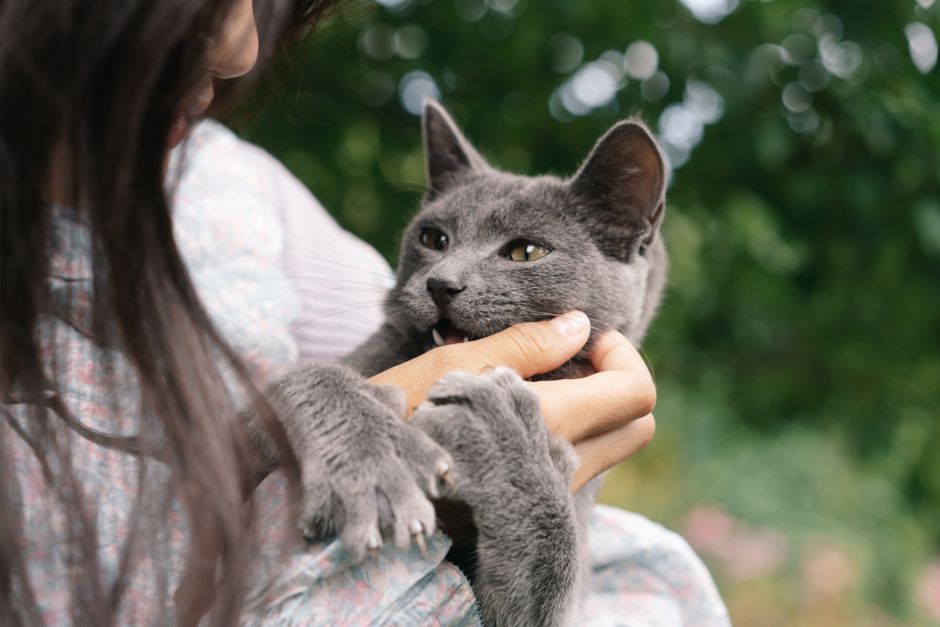
Kittens bite fingers for a simple reason: it is how they play. Their instincts tell them that a moving target is prey, and your fingers are the perfect size and speed to trigger that response. The good news is that this behavior is normal and almost always fixable with consistent training. You can stop finger-biting by redirecting the behavior to appropriate toys, stopping play when teeth touch skin, and never using your hands as playthings.
Why do kittens bite fingers in the first place?
Kittens are born predators. Their brains are wired to chase, pounce, and bite. In the wild, this is how they learn to catch food. In your home, your hand moving across the carpet looks exactly like a mouse darting across the floor.
Between the ages of 2 and 4 months, kittens are in a critical learning window. This is when they normally learn bite inhibition from their mother and littermates. When one kitten bites too hard, the other yelps and stops playing. That feedback teaches them how much pressure is acceptable. Kittens separated from their mothers too early often miss this lesson, which is why some kittens bite harder than others.
Play aggression is the most common cause of finger-biting. It is not anger or malice. The kitten is simply practicing skills it would need to survive on its own.
Is it normal for kittens to bite fingers?
Yes, it is completely normal. Nearly all kittens go through a phase where they bite hands and fingers. The behavior peaks between 3 and 6 months of age, then usually fades as the kitten matures. Adult cats that continue biting fingers often learned as kittens that biting gets attention, even if that attention is negative.
Kittens also bite when they are overstimulated. Petting a kitten for too long can cause what is called petting-induced aggression. The kitten enjoys the attention at first, then suddenly turns and bites. This is not a sign of a bad cat. It is a sign that the kitten has reached its tolerance limit and needs a break.
Teething is another factor. Kittens lose their baby teeth around 3 to 4 months of age. Their gums are sore, and biting helps relieve the pressure. Your fingers are a convenient chewing tool, even if it does not feel convenient for you.
How to stop a kitten from biting your fingers
The most effective method is redirection. Keep a small toy nearby at all times. When the kitten goes for your fingers, immediately offer the toy instead. This teaches the kitten that toys are acceptable to bite and hands are not. Wand toys are especially good because they keep your hands far from the kitten’s mouth.
When the kitten bites you, stop moving your hand. Movement makes the behavior more exciting. Freeze for a moment, then gently pull your hand away. Do not yank it, as fast movement can trigger the chase response again.
Use a sharp, high-pitched “ow!” when the kitten bites. This mimics the yelp a littermate would make. It should startle the kitten and cause it to pause. If the kitten stops, immediately reward it with a treat or a toy. If the kitten continues, end the play session and leave the room for a minute or two.
Never punish a kitten for biting. Hitting, spraying with water, or yelling teaches the kitten to be afraid of you. It does not teach the kitten what to do instead. Fear-based training damages trust and can make biting worse because the kitten learns that hands are threatening.




What not to do when your kitten bites
Do not wiggle your fingers at your kitten to entice it to play. This is one of the most common mistakes new owners make. It seems cute at first, but you are actively training the kitten that fingers are toys. Once that lesson is learned, it is much harder to undo.
Do not play rough with bare hands. Use a toy every time. If you want to wrestle with your kitten, use a thick glove or a stuffed animal toy. The distinction between “hands are off-limits” and “toys are fair game” must be consistent.
Do not ignore the behavior hoping it will go away. It will not. Kittens practice what they learn. If biting gets them attention or entertainment, they will keep doing it. The longer the habit continues, the more entrenched it becomes.
Avoid pulling your hand away quickly. Fast movement triggers the prey drive. The kitten sees a fleeing target and instinctively chases it. This is why many owners report that the kitten bites harder when they try to pull away.
How long does it take to stop kitten biting?
Most kittens show significant improvement within 2 to 4 weeks of consistent training. The key word is consistent. Every person in the household must respond the same way. If one person allows finger play and another does not, the kitten will be confused and the behavior will persist.
Some kittens are more stubborn than others. High-energy breeds like Siamese and Bengals may take longer to learn because their play drive is stronger. That does not mean they cannot learn. It just means you need to be more patient and provide more outlets for their energy.
Play sessions should be short and frequent. A 5-minute session three times a day is better than one 30-minute session. Kittens lose focus quickly, and an overtired kitten is more likely to bite out of overstimulation.
If you have an adult cat that still bites fingers, the same training methods apply. It will take longer because the habit is more established, but adult cats can learn new behaviors. The training process is identical.
When should you worry about kitten biting?
Most kitten biting is normal play behavior. However, there are times when biting signals a real problem. If the kitten’s eyes dilate, its ears flatten against its head, and its tail puffs up, the kitten is frightened or angry, not playing. In this state, the kitten may bite hard and break skin.
If the kitten bites suddenly during petting after being calm, it may have petting-induced aggression. Learn to read the warning signs. A twitching tail, flattened ears, or a sudden stillness often precede a bite. Stop petting at the first sign of these signals.
If biting is accompanied by hissing, growling, or swatting, the kitten may be in pain or feeling threatened. A veterinary check is a reasonable step to rule out medical causes. Pain from dental issues, injuries, or illness can make a kitten irritable and more likely to bite.
If a bite breaks the skin, wash the wound thoroughly with soap and water. Apply an antibiotic ointment and cover it with a bandage. Watch for signs of infection such as redness, swelling, warmth, or red streaks. Cat bites can introduce bacteria deep into tissue, and any bite that becomes painful or swollen should be evaluated by a doctor.
Does neutering or spaying reduce biting?
Yes, in some cases. Hormones influence aggression and roaming behavior. A kitten that is not spayed or neutered may become more territorial and reactive as it reaches sexual maturity around 5 to 6 months of age. Neutering reduces hormone-driven behaviors, which can make training easier.
However, neutering is not a cure for biting. Play biting is a learned behavior, not a hormonal one. A kitten that bites before neutering will likely continue biting after the surgery unless you train it not to. The surgery removes one contributing factor, but it does not replace the need for consistent redirection and training.
Frequently Asked Questions
Why does my kitten bite my fingers when I pet it?
This is usually overstimulation or petting-induced aggression. The kitten enjoys the petting at first but reaches a tolerance limit and bites to signal it wants the interaction to stop.
Is it bad to let my kitten bite my fingers?
Yes, because it teaches the kitten that hands are acceptable toys. This is easy to tolerate when the kitten is small but becomes painful and dangerous as the cat grows and its jaw gets stronger.
How long does it take to train a kitten not to bite?
Most kittens improve within 2 to 4 weeks of consistent training. Every person in the household must use the same redirection and stop-play methods for the training to work.
What should I do if my kitten bites me hard enough to break skin?
Wash the wound immediately with soap and water, apply antibiotic ointment, and cover it with a bandage. See a doctor if the area becomes red, swollen, or painful.
