
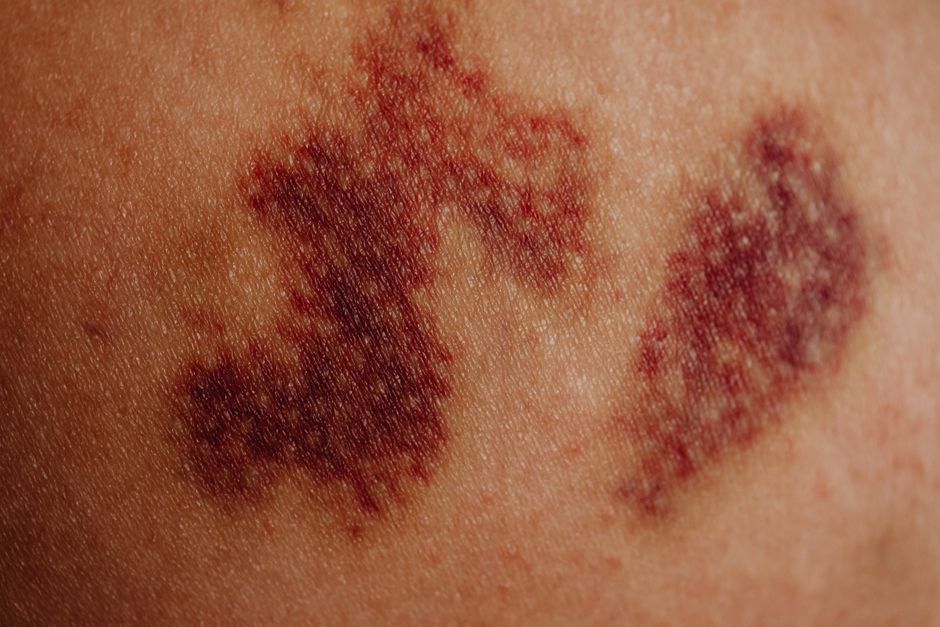
You bump your shin on the coffee table and by evening there’s a dark purple patch blooming under the skin. A few days later it turns green, then yellow, then fades. That color show isn’t random — it’s a chemical timeline happening just beneath the surface, and each shade tells you something about what’s going on inside.
A bruise looks blue or purple because blood has leaked out of damaged vessels into the tissue under your skin, and that pooled blood has lost its oxygen. Oxygen-rich blood is bright red. Once it escapes and sits in tissue without a fresh oxygen supply, the hemoglobin inside red blood cells shifts toward a darker blue-purple color. You’re essentially looking at deoxygenated blood through a layer of skin, which filters the light and deepens the hue further.
Why Does A Bruise Look Blue Or Purple?
Hemoglobin is the protein in red blood cells that carries oxygen, and its color depends entirely on whether oxygen is attached. When oxygen is bound, hemoglobin reflects red light and appears bright red. When oxygen is released, the molecule changes shape and starts absorbing more red light while reflecting blue and violet wavelengths.
This is the same reason veins near the surface look blue even though the blood inside them is red. The skin scatters light in a way that shifts what reaches your eye, and deoxygenated hemoglobin pushes the visible color toward blue-purple.
Two things happen at once inside a bruise:
- Blood leaks from broken capillaries into surrounding tissue, where it is no longer connected to your circulation and cannot pick up fresh oxygen.
- The skin above the pooled blood absorbs and scatters light, filtering out warmer tones and letting cooler blue and violet wavelengths through.
The depth of the blood matters too. Blood sitting deeper under the skin tends to look more blue or gray. Blood closer to the surface looks more purple or red-purple. This is why the same injury can look different depending on where on the body it happens.
What Do the Different Bruise Colors Mean?
Bruise color changes follow a fairly predictable sequence as your body breaks down and clears the leaked blood. The timing varies from person to person and depends on the size and location of the bruise.
Here’s what’s generally happening at each stage:
- Red or pink (right after injury): Fresh blood is still oxygenated and flowing into the tissue.
- Blue, purple, or black (first day or two): Hemoglobin has lost its oxygen and the pooled blood darkens.
- Green or yellow (roughly days 3 to 7): Your body breaks hemoglobin down into other compounds, including biliverdin (greenish) and bilirubin (yellowish).
- Brown or fading (about 1 to 2 weeks): The remaining breakdown products are cleared away and the skin returns to normal.
These timelines are general. A small bruise on your forearm might fade in a few days. A large bruise on your thigh from a fall can take two weeks or longer. Older adults often bruise more easily and heal more slowly because skin thins and blood vessels become more fragile with age.
Why Do Some Bruises Turn Green and Yellow?
The green and yellow stages are a sign that healing is underway. When red blood cells in the bruise break down, the hemoglobin inside them is dismantled in steps.
The first breakdown product is biliverdin, which has a green color. Your body then converts biliverdin into bilirubin, which is yellow. Eventually these compounds are carried away and processed, mostly by the liver, and the discoloration fades.
This is the same bilirubin that gives jaundice its yellow tint. In a bruise, it’s confined to a small area rather than affecting the whole body.
One thing worth knowing: the green and yellow phase doesn’t always appear in a neat sequence. A bruise can look purple in the center and yellow at the edges at the same time, because the breakdown happens faster near the edges where blood is thinner and closer to healthy circulation.
Why Do Some People Bruise More Easily Than Others?
Bruising tendency varies a lot between people, and several factors explain why.
- Age: Skin gets thinner and blood vessel walls weaken over time, so less force is needed to cause a leak.
- Medications: Blood thinners, aspirin, and some anti-inflammatory drugs reduce clotting ability and can make bruises larger and more frequent.
- Nutritional status: Vitamin C and vitamin K both play roles in blood vessel health and clotting. Severe deficiency in either can increase bruising.
- Genetics: Some people simply have more fragile capillaries than others.
- Sun damage: Long-term sun exposure weakens skin and blood vessels.
If you bruise easily and it’s new for you, or if bruises appear without any injury you can recall, that’s worth mentioning to a doctor. Easy bruising can sometimes reflect a platelet problem, a clotting disorder, or another underlying condition. It usually doesn’t, but it’s the kind of change that deserves a professional look rather than a guess.
When Should You Be Concerned About a Bruise?
Most bruises are harmless and heal on their own. A few situations warrant medical attention.
See a doctor if:
- A bruise keeps growing or becomes very swollen and painful.
- You have bruises with no known cause, especially in unusual places like the back or torso.
- You bruise easily along with bleeding gums, frequent nosebleeds, or blood in urine or stool.
- A bruise doesn’t fade after about two weeks.
- You have a bruise after a head injury, especially with confusion, vomiting, or drowsiness.
These signs don’t automatically mean something serious is going on. They’re simply the situations where a medical evaluation can rule out problems that are better caught early.
Does Bruise Color Tell You How Old It Is?
Not reliably. This is one of the more persistent myths about bruises — that a doctor can pinpoint the exact age of a bruise by its color.
Research on bruise aging has found that color is a poor predictor of timing. The same bruise can look different on two people injured at the same moment. Depth, skin tone, location, and how fast someone’s body clears blood all affect what you see. Some studies looking at whether bruise color can estimate age have found wide overlap between different time points.
This matters in forensic settings, where estimating when an injury occurred can have legal weight. The general consensus in the medical literature is that bruise color alone cannot establish a precise timeline.
What color can tell you is roughly where you are in the healing process — fresh versus breaking down versus fading. That’s useful information. It just isn’t a clock.
Does Skin Tone Affect How a Bruise Looks?
Yes, and this is often overlooked. On lighter skin, bruises typically show the classic red-purple-blue progression. On darker skin, the same bruise may look more like a dark brown, black, or deep purple patch, and the green and yellow stages may be harder to see.
This can make bruises easier to miss on darker skin, both by the person who has them and by clinicians assessing for injury. It doesn’t mean the bruise is less real or less significant — only that the visible color signal is different.
If you’re trying to track a bruise on darker skin, paying attention to swelling, tenderness, and changes in texture can be more helpful than color alone.
Frequently Asked Questions
Why does a bruise turn yellow after it was purple?
As your body breaks down the hemoglobin in the pooled blood, it produces bilirubin, which is yellow. This stage usually appears a few days after the injury and signals that the bruise is being cleared away.
Is a bruise always blue or purple?
No. Bruises can look red, purple, blue, black, green, yellow, or brown depending on how old they are and how deep the blood sits. Skin tone also changes how the color appears.
Can you tell how old a bruise is by its color?
Not precisely. Research has found that bruise color overlaps significantly across different time points, so color alone cannot establish an exact age. It can only suggest a general stage of healing.
Why do I bruise so easily?
Age, medications like blood thinners, genetics, and sun damage all affect how easily you bruise. If easy bruising is new for you or happens without injury, it’s worth discussing with a doctor.
