
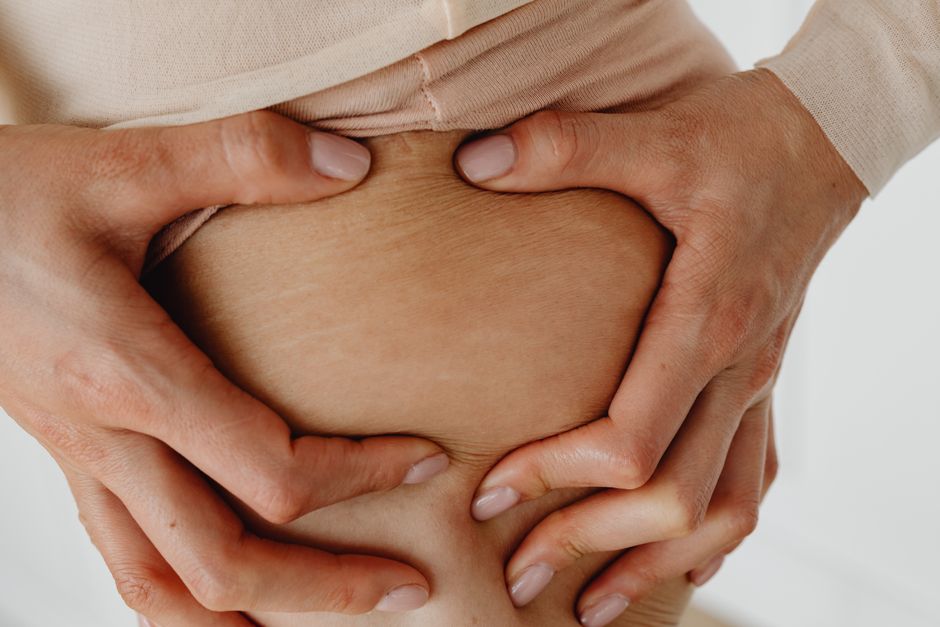
Stretch marks are scars. They form when skin stretches faster than its supporting fibers can adapt, causing tiny tears in the dermis — the middle layer of skin. The body repairs those tears with scar tissue, and that scar tissue is what you see as a line on your skin. They are extremely common, they are not a sign of poor health, and no single product has been proven to erase them.
Why Do You Have Stretch Marks? Root Causes Explained
The direct cause is mechanical: rapid stretching of skin combined with a loss of the structural proteins that keep skin elastic. When the dermis tears, the body fills the gap with scar tissue that lacks the elasticity and pigment of normal skin.
Two proteins matter most here. Collagen gives skin its strength. Elastin gives it the ability to snap back. When skin is pulled faster than these fibers can be rebuilt, they break. That is the whole mechanism, and it is well established in dermatology.
Several things make that breaking point more likely.
- Rapid growth or weight change. Puberty growth spurts, fast weight gain, and pregnancy all stretch skin quickly.
- Hormonal shifts. Cortisol and related hormones can reduce collagen production and weaken the skin’s elastic fibers. This is why stretch marks often appear during puberty and pregnancy, when hormone levels change sharply.
- Genetics. How strong your skin’s supporting structure is partly inherited. Some people get stretch marks from modest stretching; others never get them despite major changes.
- Corticosteroid use. Long-term use of corticosteroid medications, whether oral or applied to the skin, is linked to stretch marks because these drugs can thin skin and interfere with collagen.
- Body composition and skin type. These play a role, though the relationship is not fully understood.
One clarification worth making: stretch marks are not caused by “dry skin” or by not moisturizing enough. Dryness can make existing marks look more noticeable, but it does not create them. The damage happens in the dermis, well below the surface you moisturize.
Who Gets Stretch Marks and When
Most people will develop at least one stretch mark in their lifetime. They are not a minority condition.
The most common periods are puberty, pregnancy, and any time body size changes quickly. During puberty, stretch marks often appear on the thighs, hips, and breasts as the body grows fast. In pregnancy, they most often show up on the abdomen, breasts, and thighs, usually in the later months as the belly expands.
Bodybuilders and people who gain muscle very quickly can get them on the shoulders, chest, and arms. Rapid weight gain from any cause can produce them on the abdomen, hips, and buttocks.
There is a common belief that stretch marks only affect women. That is not accurate. Men get them too, especially during puberty growth spurts and with rapid muscle or weight gain. The pattern and location differ, but the mechanism is identical.
What Do Stretch Marks Actually Look Like?
Stretch marks change over time, and the appearance depends heavily on their age.
New stretch marks — called striae rubrae — are often red, pink, or purple. The color comes from blood vessels showing through the thinned dermis where the tear occurred. These are the marks most likely to respond to treatment, because the tissue is still active.
Over months to years, they fade into striae albae — white or silvery lines that feel slightly different from surrounding skin, sometimes with a faint indentation. This is mature scar tissue. Once a mark has reached this stage, it is much harder to change.
Stretch marks can also itch or feel tender when they first form. That is normal and usually settles.
They are not harmful. They do not signal an underlying disease on their own. In rare cases, widespread stretch marks appearing suddenly without an obvious cause — especially alongside easy bruising or other symptoms — can be worth mentioning to a doctor, because they can occasionally be linked to a medical condition affecting cortisol or connective tissue.





Can You Prevent Stretch Marks?
The honest answer is that prevention is difficult and the evidence for most prevention products is weak.
No cream, oil, or lotion has been reliably shown to prevent stretch marks in large, well-controlled studies. Some research on specific topical ingredients during pregnancy has shown modest results, but the findings are inconsistent and often limited by study design. Moisturizing keeps skin comfortable and may reduce itching, but rubbing oil into your belly does not reach the dermis where the tearing happens.
What genuinely helps is managing the rate of change where you can control it. Gradual weight gain rather than rapid gain gives skin more time to adapt. During pregnancy, following your clinician’s guidance on healthy weight gain is reasonable. Staying hydrated and eating a balanced diet supports skin health generally, though no diet has been proven to prevent stretch marks specifically.
If you take corticosteroid medication, do not stop it on your own. Talk to your prescriber about risks and monitoring.
Do Any Treatments Actually Work?
Some treatments can reduce the appearance of stretch marks, but none remove them completely. This is where marketing runs far ahead of evidence.
For newer, red or purple marks, the evidence is strongest. Topical retinoids — a class of vitamin A-derived medications — have shown benefit in some clinical studies for early stretch marks. These are prescription or over-the-counter products with real active ingredients, and they carry risks, including skin irritation. Retinoids are not recommended during pregnancy or breastfeeding, so anyone who is pregnant or nursing should not use them without medical guidance.
For mature, white marks, results are much more modest. Some clinicians use procedures such as laser therapy, microneedling, or chemical peels, and some studies report partial improvement in appearance. The results vary widely between people, the effects are rarely complete, and these are medical procedures with costs and risks. Evidence for any single approach is not strong enough to call it a reliable fix.
What does not have good evidence: most over-the-counter “stretch mark creams,” cocoa butter, and similar products. They are generally safe and may improve skin moisture, but no large human trials confirm they reduce stretch marks. That is the accurate position, and it is worth saying plainly.
Do Stretch Marks Ever Go Away on Their Own?
They fade, but they rarely disappear completely. Most stretch marks soften and lighten over time, often becoming less noticeable within a year or two, though the timeline varies a lot from person to person.
The color usually fades first. The texture and slight indentation are more persistent. Many people find that mature marks become much less visible against their natural skin tone as they age.
Because the change is gradual, some people assume a product worked when the mark would have faded anyway. That is a common reason anecdotal “success stories” are unreliable.
When Should You See a Doctor?
For most people, stretch marks are a cosmetic concern and nothing more. You do not need medical care for typical stretch marks.
It is worth checking in with a clinician if stretch marks appear suddenly and widely without an obvious cause, if they come with easy bruising, unusual weight change, or other symptoms, or if you are considering prescription treatments and want to weigh the risks. A doctor can also advise on corticosteroid-related skin changes.
Pregnancy is a specific case. If you are pregnant or breastfeeding, check with your clinician before using any topical treatment, including retinoids and medicated creams.
Frequently Asked Questions
Are stretch marks a sign of anything serious?
No, typical stretch marks are harmless scars and not a sign of poor health. Widespread marks that appear suddenly with other symptoms can occasionally point to a medical condition, so those are worth discussing with a doctor.
Can you get rid of stretch marks completely?
No treatment has been shown to remove stretch marks completely. Some options can reduce their appearance, especially when marks are new and still red or purple.
Do stretch mark creams really work?
Most over-the-counter stretch mark creams have not been confirmed in large human trials to reduce stretch marks. They may improve skin moisture, but that is different from changing the scar itself.
Why do some people get stretch marks and others don’t?
Genetics play a large role in how strong your skin’s collagen and elastin are, so some people’s skin tolerates stretching better than others. The speed of stretching and hormonal changes also matter.
