
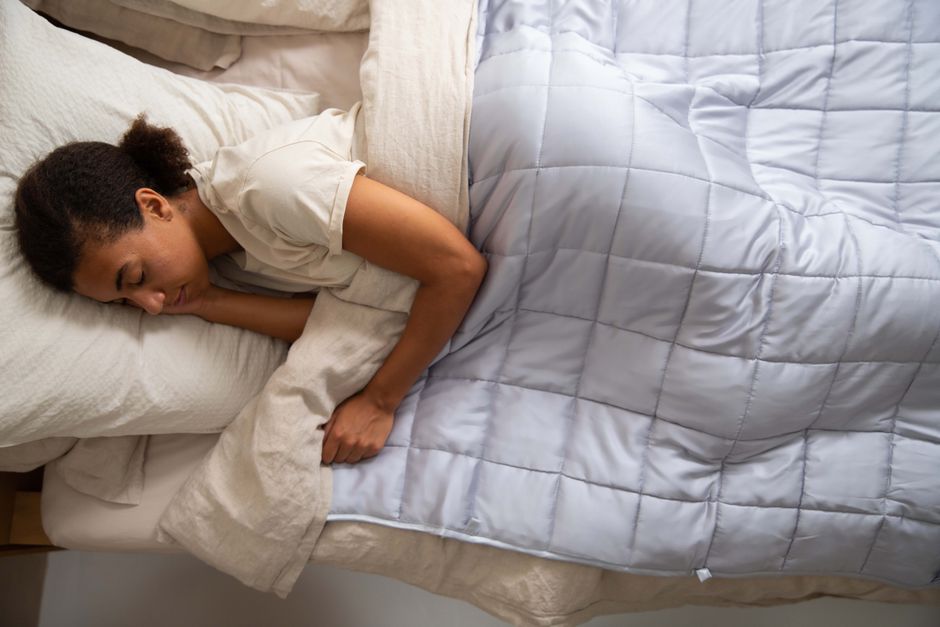
Anxiety does not only live in your thoughts. It also shows up in your body — a racing heart, tight chest, restless legs, a nervous system that will not settle. Weighted blankets work on that physical side of anxiety. They apply gentle, even pressure across the body, and that pressure appears to calm part of the nervous system involved in the body’s stress response.
That is the short answer to why weighted blankets help with anxiety. The longer answer involves how deep pressure affects the nervous system, why anxiety gets triggered in the first place, and what the research actually shows — because the evidence here is real but limited, and it is worth knowing the difference.
Why Do Weighted Blankets Help with Anxiety?
The main idea is something called deep pressure stimulation. A weighted blanket spreads gentle pressure across your body, similar to a firm hug or being tucked in tightly. That pressure appears to influence the autonomic nervous system — the part of your body that controls things you do not think about, like heart rate and breathing.
The autonomic nervous system has two main branches. The sympathetic branch drives the stress response, sometimes called fight-or-flight. The parasympathetic branch supports rest and recovery. Anxiety tends to come with a sympathetic system that is switched on and stays on. Deep pressure is thought to nudge the balance toward the parasympathetic side.
Researchers have proposed a few ways this might happen. Pressure receptors in the skin send signals to the brain. Some theories suggest these signals reduce activity in areas tied to threat detection. Others point to changes in heart rate and skin conductance — physical signs of arousal — during deep pressure. These mechanisms are plausible and are supported by some small studies, but they are not fully settled science.
What is clearer is that the body and mind are not separate systems. When your body feels physically held and still, your mind often follows. That is not a trick. It reflects how closely the nervous system links physical sensation with emotional state.
What Actually Triggers Anxiety?
Anxiety has many triggers, and they fall into a few broad groups. Some are external — a stressful job, a conflict, financial worry, a frightening event. Some are internal — certain thoughts, memories, or physical sensations like a fast heartbeat. Some are biological, including genetics, hormone shifts, and how your brain chemistry is wired.
It helps to separate two ideas that people often blend together. There are triggers, which are the immediate things that set off anxiety in the moment. And there are underlying causes, which make a person more likely to feel anxious in the first place. A cup of coffee might be a trigger. A family history of anxiety might be part of the underlying picture.
Common triggers include:
- Stressful or threatening situations, real or anticipated
- Caffeine and some other stimulants
- Lack of sleep or disrupted sleep
- Certain physical sensations, like a racing heart, that get interpreted as danger
- Major life changes, even positive ones
- Some medical conditions and medications
The last point matters. Anxiety can be a symptom of an underlying medical issue, such as an overactive thyroid, heart rhythm problems, or low blood sugar. It can also be a side effect of certain medications. This is one reason persistent or new anxiety deserves a conversation with a doctor rather than self-treatment alone.
How Does Deep Pressure Affect the Nervous System?
Deep pressure is not a new idea. Occupational therapists have used weighted tools and deep pressure techniques for decades, particularly with children and adults who have sensory processing differences. The goal has generally been to help the nervous system feel organized and calm.
The pressure from a weighted blanket is spread across a large area of the body. Unlike a single touch, it is constant and even. That steady input may be what makes it different from other sensations. The nervous system seems to respond to predictable, gentle pressure in a way that supports settling.
Some studies have measured physical markers during deep pressure, including heart rate and skin conductance, which reflect arousal. Findings have generally pointed toward a calming effect, though sample sizes have often been small. This is an area where the mechanism is reasonable and the early signals are encouraging, but large, high-quality trials are still limited.





What Does the Research Say About Weighted Blankets and Anxiety?
The research is promising but not conclusive. Several small studies have looked at weighted blankets for anxiety, sleep, and stress. Some found improvements in self-reported anxiety or sleep quality. Others found little or no difference compared with a lighter blanket.
A key limitation is that many studies are small and short. Some rely on what people report rather than objective measures. It is also hard to design a truly “blind” study with a blanket — people usually know whether the blanket is heavy. That makes it harder to rule out the placebo effect, which is real and can genuinely help people feel better.
None of this means weighted blankets do not work. It means the evidence is not yet strong enough to call them a proven treatment for anxiety disorders. They are best understood as a comfort tool that some people find helpful, not a replacement for professional care.
One non-obvious point: the placebo effect is not the same as “fake.” If a blanket helps you feel calmer, that benefit is real to you, regardless of how it compares to a heavier blanket in a study. The honest framing is that we do not yet know exactly how much of the benefit comes from the pressure itself.
Who Might Benefit and Who Should Be Careful?
Weighted blankets are generally used by adults who want help feeling calmer or sleeping better. Many people report they find them soothing. Because the evidence is limited, it is fair to think of them as something to try rather than something to rely on.
There are important safety considerations, especially for certain groups:
- Young children should not use weighted blankets without guidance from a pediatrician or occupational therapist. A blanket that is too heavy for a small body can be a safety risk.
- People who cannot easily remove the blanket themselves — including some older adults or people with certain disabilities — may face a risk of being unable to get free, which matters for breathing and safety.
- People with breathing conditions such as sleep apnea should talk to a doctor first, since extra weight on the chest could affect breathing.
- Anyone with a medical condition affecting circulation, breathing, or mobility should check with a clinician before use.
For most healthy adults, using a blanket that feels comfortable and that you can easily push off is a low-risk thing to try. If it feels too heavy, restrictive, or uncomfortable, that is a sign to stop.
Are Weighted Blankets a Treatment for Anxiety?
No. Weighted blankets are not a treatment for anxiety disorders. They are a comfort product. Established treatments for anxiety — such as cognitive behavioral therapy and, in some cases, medication — have far stronger evidence behind them.
That distinction matters. Anxiety disorders are common and treatable, and effective help exists. If anxiety is interfering with your work, relationships, sleep, or daily life, that is a signal to talk to a doctor or mental health professional. A blanket can sit alongside that care. It should not stand in for it.
If you are already in treatment, a weighted blanket may be one small piece of a routine that helps you feel steadier. Think of it as a comfort aid, not a cure. There is no shame in using comfort tools — and no reason to expect them to do the work that therapy or medical care is designed to do.
How to Choose and Use a Weighted Blanket
If you decide to try one, a few practical points can help. Weight is the main consideration. A common guideline is to choose a blanket that feels comfortable to you and that you can remove easily on your own. If a blanket feels hard to move or breathe under, it is too heavy for you.
Material and breathability matter too. Some blankets trap heat, which can disrupt sleep. If you run warm, look for one with breathable fabric or a cooling cover. Size should match how you plan to use it — a smaller throw for a couch, a larger one for a bed.
Give it a fair trial, but do not force it. Some people feel calmer within minutes. Others notice nothing, or find the weight uncomfortable. Both outcomes are normal. If it does not help after a reasonable period, it is fine to stop.
One practical caution: weighted blankets can be warm and hard to wash. Check the care instructions before buying, and consider a removable cover.
Frequently Asked Questions
Do weighted blankets really help with anxiety?
Some people report feeling calmer with a weighted blanket, and small studies show mixed but generally positive signals. The evidence is not strong enough to call them a proven treatment for anxiety disorders.
How heavy should a weighted blanket be?
There is no single official standard, and blanket makers often suggest a range based on body weight. The safest rule is to choose one that feels comfortable and that you can easily push off by yourself.
Can a weighted blanket replace therapy for anxiety?
No. Weighted blankets are a comfort product, not a treatment. Therapy and, in some cases, medication have much stronger evidence for treating anxiety disorders.
Are weighted blankets safe for children?
Not without professional guidance. A blanket that is too heavy for a small child can be a safety risk, so check with a pediatrician or occupational therapist first.
