
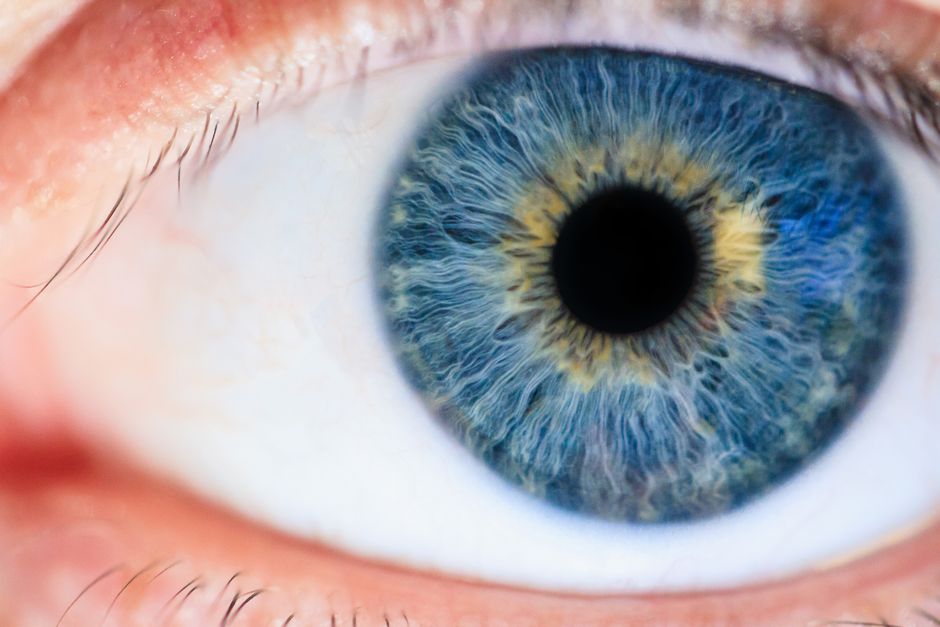
Your eye doctor puts drops in your eyes, and a few minutes later your pupils open wide and stay that way. The drops are called mydriatics, and they work by temporarily paralyzing the tiny muscle that normally keeps your pupil at a set size. That muscle is the iris sphincter, a ring of smooth muscle that tightens to make your pupil smaller. The drops block the signals that tell it to tighten, so the pupil relaxes open instead. Your vision gets blurry up close, bright light feels harsh, and the effect can last for hours. None of this is damage. It is a controlled, temporary chemical relaxation of one small muscle.
Why Do They Dilate Your Eyes During an Exam?
A dilated pupil gives your eye doctor a view of the inside of your eye that no other method provides.
The pupil is the opening that lets light in. When it is small, that opening is only a few millimeters wide. When it is dilated, it can open to roughly 7 to 8 millimeters in many adults. That wider opening lets the doctor see the retina, the optic nerve, and the blood vessels at the back of the eye without the iris blocking the view.
This matters because some of the most serious eye conditions start in the back of the eye and cause no symptoms early on. Diabetic retinopathy, macular degeneration, retinal tears, and optic nerve damage can all be visible during a dilated exam before a person notices anything wrong. A routine undilated exam can miss these. That is the main reason dilation is standard practice rather than an optional extra.
The drops also temporarily stop the pupil from reacting to light. A pupil that keeps changing size as the doctor moves a light around is hard to examine. Holding it open and still makes the exam faster and more accurate.
What Do the Dilation Drops Actually Do?
Most dilation drops are anticholinergic drugs or sympathomimetic drugs. They act on two different muscles in the iris.
The iris has a circular muscle (the sphincter) that constricts the pupil, and a radial muscle (the dilator) that opens it. Anticholinergic drops like tropicamide and cyclopentolate block the sphincter so it cannot constrict. Sympathomimetic drops like phenylephrine stimulate the dilator to pull the pupil open. Some exams use one type; others use both together for a stronger effect.
Cyclopentolate and atropine also relax the ciliary muscle, which controls focusing. That is why close-up vision blurs after certain drops. Tropicamide and phenylephrine mainly affect the pupil, so near vision may stay clearer.
How long the effect lasts depends on which drug is used. Tropicamide wears off in a few hours. Cyclopentolate can last a day or more. Atropine, used less often, can keep the pupil dilated for several days. The specific duration varies between people, so exact timing is hard to predict for any one person.
How Long Does Eye Dilation Last?
Most people find their pupils return to normal within 4 to 6 hours after a standard exam using tropicamide. That is a general range, not a guarantee.
Several things affect how long it takes. Lighter-colored eyes often recover faster than darker eyes, because melanin in the iris can bind some drugs and slow their clearance. The specific drop used matters more than anything else. Age plays a role too, and children sometimes stay dilated longer than adults.
During the recovery window, near vision stays blurry and light sensitivity continues. Driving is often possible once the worst of the blur fades, but many people are told to bring sunglasses and arrange a ride if they are unsure. The safest approach is to ask your doctor how long to expect for the specific drops used.
Why Does Bright Light Bother You After Dilation?
A dilated pupil lets in far more light than usual, and the muscle that normally shrinks the pupil to control that light is temporarily unable to respond.
Normally your pupil adjusts constantly. Step into sunlight and the sphincter tightens within a fraction of a second to protect the retina. After dilation drops, that reflex is blocked. The pupil stays wide open, so bright light pours in unchecked. That is what causes the glare, squinting, and discomfort.
This is also why near vision blurs. The same muscles and pathways involved in pupil control overlap with focusing. When they are relaxed, the eye struggles to shift focus to close objects. Reading, texting, and threading a needle all become difficult until the drops wear off.
Sunglasses help. So does staying out of direct sun and avoiding long stretches of close work until your vision clears.
Are Dilating Eye Drops Safe?
For most people, dilating drops are safe and the effects are temporary. Serious reactions are uncommon.
That said, some people should tell their doctor before receiving them. Anyone with a known allergy to a specific drop, or with certain heart conditions, glaucoma, or a history of angle-closure, should mention it. Angle-closure glaucoma is a rare but real concern, because dilation can trigger a sudden pressure rise in eyes that have a narrow drainage angle. Your doctor screens for this risk before using drops.
Mild side effects are common and expected. They include stinging when the drops go in, a temporary increase in light sensitivity, and blurred near vision. Some people get a brief headache or a flushed feeling. These usually pass as the drug wears off.
Rare but serious symptoms warrant a call to your doctor right away. These include severe eye pain, a sudden drop in vision, seeing halos around lights, or redness and swelling around the eye. These are uncommon, but they are not something to wait out.
What Should You Expect After a Dilated Eye Exam?
Plan for a few hours of altered vision, and the day goes more smoothly.
- Bring sunglasses, even on a cloudy day. They cut the glare.
- Arrange a ride if you are unsure about driving. Blurred vision and light sensitivity can make it unsafe.
- Skip close work like reading or detailed computer tasks until your vision clears.
- Expect your near vision to recover before your light sensitivity does, in many cases.
- Do not rub your eyes. It will not speed up recovery and can irritate the surface.
One detail people often miss: the drops do not wear off evenly. Your pupils may look normal while your focusing is still catching up, or the reverse. Give it the full window your doctor mentions rather than assuming you are back to normal the moment your pupils look smaller.
Do You Always Need Dilation?
No. Not every eye exam requires dilating drops, and the decision depends on your age, symptoms, risk factors, and why you are being seen.
Some clinics use retinal cameras that can photograph the back of the eye through an undilated pupil. These images can be useful for screening, but they do not always replace a dilated exam, especially when the doctor needs a direct, magnified view or when something suspicious needs a closer look. The two approaches are not fully equivalent.
People at higher risk for retinal or optic nerve problems are more likely to need dilation at every visit. That includes people with diabetes, a family history of certain eye diseases, or symptoms like flashes, floaters, or vision changes. For others, the doctor may dilate less often.
If you are unsure whether your exam will include dilation, ask when you schedule. It is a simple question that saves you an unexpected few hours of blurry vision.
Frequently Asked Questions
How long do dilated eyes last?
Most people return to normal within 4 to 6 hours after standard drops like tropicamide, though it varies. Drops such as cyclopentolate or atropine can keep your pupils dilated for a day or longer.
Can I drive after having my eyes dilated?
Many people can drive once the worst of the blur fades, but it is not safe for everyone. If your vision is still blurry or light bothers you, arrange a ride instead.
What makes your pupils dilate besides eye drops?
Dim light, strong emotions, certain medications, and some drugs all cause pupils to widen naturally. A doctor can tell the difference between a normal response and one that needs checking.
Is it bad to have your eyes dilated often?
Routine dilation is generally considered safe, and the effects are temporary. If you have a condition like angle-closure glaucoma risk, your doctor will weigh that before using drops.
