
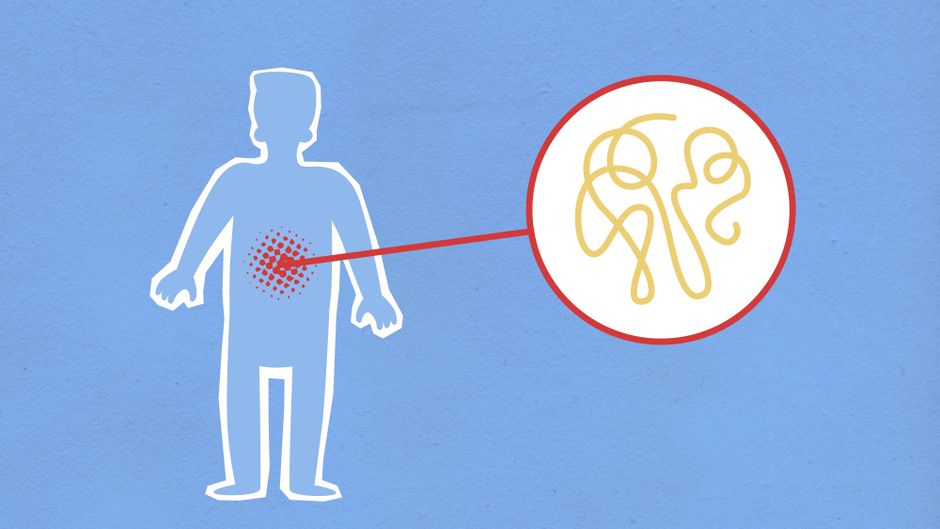
Tapeworms do not have a digestive system because they do not need one. They live inside the small intestine of a host, surrounded by partly digested food, and they absorb nutrients directly through their body surface. Having no gut is not a defect — it is an adaptation that works extremely well for a parasite living in a nutrient bath.
Why Do Tapeworms Not Have a Digested System?
A tapeworm’s environment already contains the products of digestion. The host has done that work. The worm sits in the small intestine, where amino acids, simple sugars, fatty acids, and vitamins are present in a form it can take in without breaking food down itself.
Building and running a digestive tract costs energy and takes up space. For an animal surrounded by ready-to-use nutrients, a gut would add complexity without adding benefit. Tapeworms evolved away from a digestive system because absorption from the surface was enough.
This is a pattern seen in many internal parasites. When a organism lives in a stable, nutrient-rich place, structures that were useful outside that place often shrink or disappear over evolutionary time. In tapeworms, the loss of the gut is one of the clearest examples.
How Do Tapeworms Get Nutrients Without a Gut?
Tapeworms absorb nutrients across their outer covering, a specialized skin called the tegument. This surface is not like human skin. It is a living, metabolically active layer built for taking in food.
The tegument is covered in tiny folds and finger-like projections that increase its surface area. A larger surface means more contact with the nutrient-rich fluid of the intestine, which allows more absorption at once. The worm’s body is essentially one long absorptive surface.
Nutrients cross the tegument and move into the worm’s tissues. Because tapeworms are flat and thin, no nutrient has to travel far to reach any cell. This matters because tapeworms have no circulatory system either. Their flattened shape keeps every part of the body close to the surface, so absorbed nutrients can spread through the tissue without blood vessels to carry them.
That flat, ribbon-like body is not just a shape. It solves two problems at once — it maximizes surface area for absorption and keeps the distance short for nutrient distribution.
What Does a Tapeworm’s Body Look Like Inside?
A tapeworm has a head-like end called the scolex, which attaches to the intestinal wall. Behind the scolex is a neck region where new segments form. The rest of the body is a chain of segments called proglottids.
Each segment contains reproductive organs. As segments mature, they fill with eggs. The oldest, egg-packed segments are at the far end and break off to leave the host in stool. This is why tapeworm infections are often noticed when segments appear in the toilet or in underwear.
What is missing is just as notable as what is present. There is no mouth, no stomach, no intestine, and no anus. There is also no body cavity and no circulatory system. The worm’s internal space is filled with tissue, and its organs sit within that tissue.
The nervous system is simple but present — a small cluster of nerve tissue in the scolex and nerve cords running down the body. Muscles allow the worm to move and to hold its position against the flow of intestinal contents.





How Does a Tapeworm Stay Attached to the Host?
Staying put is a survival problem. The small intestine pushes material along, and a worm that loses its grip is expelled. Tapeworms hold on using the scolex, which is armed with structures suited to their species.
- Some species have suckers that grip the intestinal lining.
- Others have hooks in addition to suckers, which dig into tissue.
- A few have grooves called bothria that clamp onto the gut wall.
This attachment is part of why tapeworms can live in the intestine for a long time. The scolex anchors the worm while its body absorbs nutrients from the surrounding fluid. The worm does not feed on blood or tissue in most cases — it lives off the contents of the gut.
One point worth being clear about: the idea that tapeworms “eat” your food in a way you would notice is not accurate. They absorb nutrients that are already broken down, and many infections cause no obvious symptoms at all.
Do Tapeworms Cause Symptoms Without a Digestive System?
Many tapeworm infections in humans cause no symptoms. When symptoms do occur, they are usually not dramatic. People may notice mild abdominal discomfort, changes in appetite, or the appearance of segments in their stool.
Some species can cause more serious problems, but this depends heavily on the species and where the worm or its larvae end up. A tapeworm living in the intestine behaves very differently from tapeworm larvae that migrate into other tissues.
The most serious human tapeworm disease comes from a species whose larvae can form cysts in organs such as the brain or liver. This condition is not caused by eating the worm itself but by swallowing microscopic eggs. That distinction matters, and it is why the source of infection changes the risk.
Because symptoms are often absent or vague, tapeworm infection is usually confirmed by finding segments or eggs in stool samples or through imaging in specific cases. If you suspect an infection, a healthcare provider can arrange the right test. Do not rely on self-diagnosis.
Why Is Losing a Digestive System an Advantage?
Evolution does not reward complexity for its own sake. It rewards what works in a given environment. For a parasite bathed in predigested nutrients, a simpler body plan is more efficient.
Every organ a tapeworm does not have is energy it does not have to spend building and maintaining. That energy can go into reproduction instead. Tapeworms are remarkably prolific — a single worm can release enormous numbers of eggs over its life.
This is a general principle in parasite biology. When a stable, rich environment provides something for free, organisms often lose the structures that once produced it. Tapeworms lost their gut. Some other parasites have lost other systems for similar reasons.
The trade-off is dependence. A tapeworm cannot survive outside a host. It has no way to digest food on its own, so it must stay where nutrients are already available. Its specialization is also its limitation.
How Do Tapeworms Reproduce Without a Gut?
Reproduction does not depend on having a digestive system. Tapeworms use the nutrients they absorb to build eggs and sperm, and most species can reproduce sexually within a single worm.
Each mature segment has both male and female reproductive organs. Segments can fertilize each other or, in some species, self-fertilize. This means a single tapeworm can potentially produce offspring without a mate.
Egg output is high because the odds of any single egg completing the life cycle are low. A tapeworm’s life cycle usually requires more than one host. Eggs must reach the right environment, be eaten by the right intermediate host, develop into larvae, and then end up in a final host where the adult worm can grow. Most eggs never make it that far.
This is why tapeworms invest so heavily in reproduction rather than in digestion. The body plan is stripped down to what matters most for survival in the gut: attach, absorb, and reproduce.
What This Means for Understanding Tapeworms
The absence of a digestive system is the single clearest fact about tapeworm biology, and it explains much of the rest. No gut means nutrients must come from the surface. Surface absorption works best with a flat, thin body. A flat body needs no circulatory system. And a body free of digestive organs can devote its resources to making eggs.
Each feature connects to the next. The tapeworm is not a simplified animal that lost parts by accident. It is a highly specialized one shaped by where it lives.
For people, the practical takeaway is simple. Tapeworm infections are treatable, and diagnosis is usually straightforward when a provider is involved. If you notice worm segments in your stool or have unexplained digestive symptoms, see a healthcare provider rather than guessing.
Frequently Asked Questions
Why do tapeworms not have a digested system?
They live in the small intestine, surrounded by nutrients the host has already broken down, so they absorb food directly through their surface. A gut would cost energy without adding benefit in that environment.
How do tapeworms absorb nutrients?
They take in nutrients through a specialized outer layer called the tegument, which has many folds to increase surface area. Because the worm is flat and thin, absorbed nutrients can spread through the body without a circulatory system.
Can a tapeworm survive without a host?
No. Tapeworms depend entirely on a host for predigested nutrients and cannot digest food on their own, so they cannot survive outside a host.
Are tapeworm infections always symptomatic?
No. Many infections cause no symptoms at all, and when symptoms appear they are often mild, such as abdominal discomfort or appetite changes. Diagnosis usually requires a stool test or, in some cases, imaging.
