
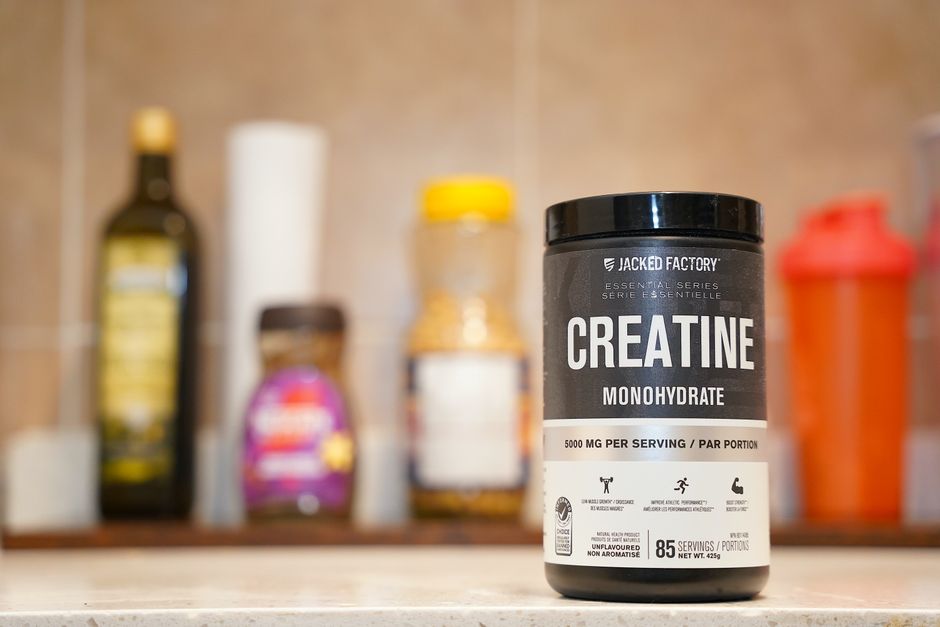
Creatine is one of the most studied sports supplements in the world, and people take it for a short list of practical reasons: to build muscle, gain strength, and improve performance in short bursts of intense activity. It works by helping your muscles regenerate a quick energy source during efforts like sprinting or heavy lifting. Some people also take it hoping for benefits beyond the gym, though the evidence there is thinner.
What makes creatine unusual is how well understood it is. Unlike most supplements on the shelf, its basic biology and its effects on certain types of exercise have been examined in hundreds of studies over decades. That does not mean every claim attached to it holds up. It means the core reasons people take it rest on a firmer footing than most.
Why Do People Take Creatine?
People take creatine primarily to increase muscle strength and power and to support muscle growth when combined with resistance training. The supplement raises the amount of creatine stored in muscle, which feeds the energy system your body uses during short, explosive efforts.
Your muscles use a molecule called ATP for energy. During the first several seconds of intense activity, they rebuild ATP using a compound called phosphocreatine. When you take creatine, you increase the phosphocreatine available in muscle. That gives you a slightly larger buffer for high-intensity work.
That mechanism explains why creatine helps with some activities and not others. It is useful for lifting heavy weights, sprinting, and repeated bursts of power. It does not do much for long-distance running or other endurance work, because those rely on different energy systems.
The second big reason is muscle size. Creatine draws water into muscle cells, which increases muscle volume. Some of the weight gain people notice early on is this water, not new muscle tissue. Over weeks of training, the added capacity for hard work can translate into more muscle growth over time.
A third reason is simplicity. Creatine is cheap, widely available, and does not require cycling on and off or precise timing around workouts. That ease of use keeps it popular.
How Does Creatine Actually Work in the Body?
Creatine is not a drug. It is a compound your body already makes and stores, and you also get some from food. Understanding that helps explain why it works the way it does.
Your body produces creatine mainly in the liver, kidneys, and pancreas, and stores most of it in skeletal muscle. You also get creatine from foods like red meat and fish. Vegetarians and vegans tend to have lower baseline muscle creatine, which is one reason they often respond more noticeably to supplementation.
Once in muscle, creatine gets converted into phosphocreatine. During short, intense efforts, phosphocreatine donates a phosphate group to rebuild ATP, the energy currency your cells run on. This system burns out fast. It powers the first few seconds of a sprint or a heavy lift, then other systems take over.
By loading muscle with more creatine, you extend how long that first energy system can keep working. The effect is modest but real. It will not make you a different athlete. It can help you squeeze out an extra repetition or hold a sprint a fraction longer, and those small edges add up over months of training.
Is Creatine Only for Bodybuilders and Athletes?
No. Creatine’s best-supported uses go beyond physique and sport, though the strength of evidence varies by group.
Older adults have drawn interest because muscle mass and strength decline with age, and creatine combined with resistance training has been studied in this group. Some research suggests it may support gains in muscle strength and function in older adults when paired with training. The evidence is encouraging but not uniform, and it does not replace the training itself.
People recovering from injury or periods of inactivity sometimes use it to support rehabilitation, though this is less well studied than performance use.
There is also interest in creatine for brain function, based on the fact that the brain uses the same energy systems as muscle. This is where claims tend to outrun the evidence. Some small studies have looked at creatine and cognitive tasks, especially under stress or sleep deprivation, but results are mixed and no large trials confirm meaningful cognitive benefits for healthy adults. Anyone taking creatine mainly for mental sharpness should know the science is not settled.


What Forms of Creatine Do People Take?
Most people take creatine monohydrate, and that is the form with the most research behind it. Other forms are sold, often at higher prices, but they have not been shown to work better.
- Creatine monohydrate — the most studied form, backed by decades of research
- Creatine hydrochloride (HCl) — marketed as more soluble, but no strong evidence it outperforms monohydrate
- Buffered creatine — claimed to reduce side effects, but studies have not shown a clear advantage
- Creatine ethyl ester — research suggests it breaks down in the body before reaching muscle, making it less useful than monohydrate
The pattern here is common in the supplement world. A basic, well-studied form gets repackaged as something newer and pricier without evidence that the new version is better. For creatine, monohydrate remains the standard.
What Do People Expect Creatine to Do — and Does It Deliver?
Expectations matter, because creatine is often credited with more than it does. Here is a plain look at common claims.
| Claim | What the evidence shows |
|---|---|
| Increases strength and power | Well supported for short, intense efforts |
| Supports muscle growth | Supported when combined with resistance training |
| Improves endurance performance | Little to no effect |
| Boosts brain function | Mixed and limited; not established in healthy adults |
| Burns fat | No direct fat-burning effect |
| Speeds recovery | Some evidence for reduced muscle damage markers; effects on soreness are inconsistent |
The endurance point trips people up. Because creatine supports short bursts, it does nothing meaningful for a marathon or a long bike ride. Some early worries that it might even hurt endurance performance have not held up, but it does not help it either.
The fat-burning claim is simply wrong. Creatine is not a fat burner. Any change in body composition comes from training harder and building muscle, not from the supplement acting on fat.
Why Is Creatine So Popular Compared With Other Supplements?
Creatine’s popularity comes down to a rare combination: a clear mechanism, consistent results for its main uses, low cost, and a long safety record at typical doses in healthy people.
Few supplements clear that bar. Many are sold on theory or small studies that never get confirmed. Creatine has been tested repeatedly, and the findings for strength and power have been fairly consistent across studies. That consistency is why it shows up on the short list of supplements that sports nutrition groups generally consider worth taking.
It is also easy to use. No complicated timing, no cycling, no need to stack it with anything. You take it, your muscles fill up over a few weeks, and you train. That simplicity makes it stick.
One point worth stating clearly: popularity is not proof. Creatine is popular partly because it is genuinely useful and partly because it is cheap and easy to sell. The useful part is what matters.
What Should People Know Before Taking Creatine?
Creatine has a strong safety record in healthy adults at commonly used doses, but a few honest caveats belong here.
People with kidney disease or other kidney concerns should talk to a doctor before using it, since the kidneys handle creatine and its breakdown products. The evidence does not show that creatine harms healthy kidneys, but that is a different question from what happens in someone with existing kidney problems.
There is no established guidance for creatine use in pregnancy or breastfeeding. No clinical guidelines currently exist for these groups, so anyone in that situation should treat it as a decision to make with a clinician, not a default.
For children and adolescents, the picture is also limited. Some young athletes use it, but the research base in this age group is thin, and it is not something to start casually.
Common side effects reported include stomach discomfort, especially with large single doses, and the water weight gain in muscle. The idea that creatine damages kidneys in healthy people is a persistent myth that the evidence does not support at typical doses.
None of this is medical advice. It is a description of what the evidence does and does not show, so you can ask better questions of a professional who knows your situation.
Frequently Asked Questions
Why do people take creatine?
People take creatine mainly to build muscle, gain strength, and improve short bursts of intense performance like sprinting or heavy lifting. It raises the creatine stored in muscle, which supports the energy system used during those efforts.
Does creatine really build muscle?
Creatine supports muscle growth when it is combined with resistance training, partly by letting you train harder and partly through water drawn into muscle cells. On its own, without training, it will not build meaningful muscle.
Is creatine safe for your kidneys?
Research in healthy adults has not shown that creatine harms the kidneys at typical doses. People with existing kidney disease should check with a doctor first, since the kidneys process creatine and its breakdown products.
Do you need to cycle creatine?
No. Cycling on and off is not required, and many people take it continuously. Your muscles stay loaded as long as you keep taking it, and levels gradually return to baseline if you stop.
