
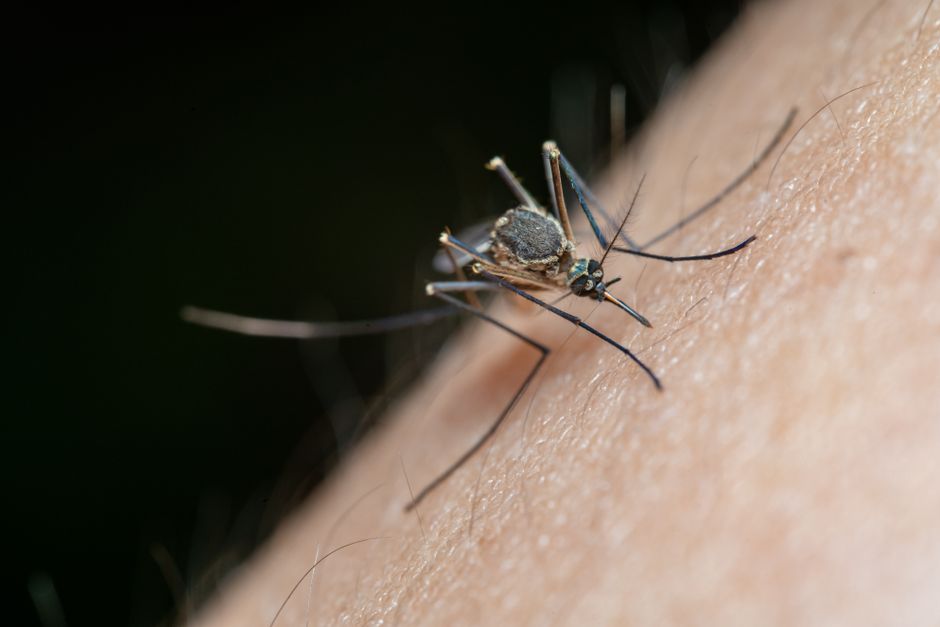
Only female mosquitoes bite. They need the protein and iron from blood to develop their eggs. Males feed on plant nectar and never bite at all. That single fact explains most of what follows — the bite is not an attack, it is reproduction.
Understanding why mosquitoes bite also explains why they bite some people more than others, why certain times of day are worse, and why some bites swell more than others. The reasons are biological, and most of them are well established.
Why Do Mosquitoes Bite?
Female mosquitoes bite because blood provides nutrients their bodies cannot get from plants. Plant sugars fuel their flight and basic metabolism. Blood supplies the protein and iron needed for egg development.
After taking a blood meal, a female mosquito can produce a batch of eggs. She will seek blood repeatedly across her life, once per egg-laying cycle. A female mosquito may lay eggs several times, which is why she may bite more than once.
The bite itself is a small puncture. The mosquito inserts a proboscis — a thin, needle-like mouthpart — into the skin to find a blood vessel. She injects saliva as she feeds. That saliva contains proteins that prevent blood from clotting and numb the area slightly. Your immune system reacts to those proteins, not to the bite wound itself.
This is where a common misconception sits. People often blame the swelling on the bite. The swelling is your body’s response to mosquito saliva. Someone with no prior exposure to a particular mosquito species may have almost no reaction at all the first time. The familiar itchy bump usually appears after repeated exposure.
How Do Mosquitoes Find You?
Mosquitoes locate hosts using several senses at once. They detect carbon dioxide from your breath, body heat, and a range of skin chemicals. No single signal does all the work.
Carbon dioxide is the long-range cue. Mosquitoes can detect it from a distance and follow the gradient toward its source. Anyone breathing attracts attention — which is why mosquitoes find sleeping people in dark rooms.
At closer range, body heat and skin chemistry matter more. Human skin produces hundreds of volatile compounds through sweat and skin bacteria. Some of these compounds attract mosquitoes, and the mix varies from person to person.
Lactic acid, a byproduct of physical activity, is one of the better-studied attractants. This partly explains why mosquitoes seem to find people after exercise. Skin temperature and moisture also rise during activity, adding to the signal.
Mosquitoes also respond to visual cues. They are drawn to dark shapes against lighter backgrounds, which is one reason dark clothing may attract more bites than light clothing.
Why Do Mosquitoes Bite Some People More Than Others?
Mosquito bite rates genuinely differ between people. Researchers have measured this in controlled settings, and the differences are real. The exact causes are only partly understood.
Several factors have reasonable evidence behind them:
- Carbon dioxide output. Larger bodies and higher metabolic rates produce more CO2. This may partly explain why adults often report more bites than small children.
- Skin microbiome. The bacteria living on your skin influence which volatile compounds you emit. Skin bacterial communities differ between people, and some studies suggest certain compositions attract mosquitoes more.
- Body heat and sweat. Warmer skin and more sweat increase your attractiveness at close range.
- Pregnancy. Some studies suggest pregnant women attract more mosquitoes, possibly through higher CO2 output and body temperature. The evidence is suggestive rather than definitive.
- Alcohol. Some research has found that drinking beer increases mosquito landings on the skin. The mechanism is not fully clear, and this has not been studied with every type of alcohol.
Blood type has been studied as a possible factor. Some research suggests mosquitoes land more often on people with type O blood. The evidence is limited and has not translated into practical advice. Do not plan your health around it.
What does not have good evidence: eating bananas, garlic, or vitamin B supplements to repel mosquitoes. These are popular claims. Controlled studies have generally not confirmed them.


When Are Mosquitoes Most Active?
Activity patterns differ by species. This matters because the mosquitoes biting you at dusk are often a different species from the ones biting in daylight.
Many common mosquito species are most active around dawn and dusk. Others, including the species that transmit dengue and Zika viruses, are active during the day. Some are active at night.
Weather also shifts activity. Mosquitoes are cold-blooded, so their activity drops in cool temperatures. Many species become inactive below roughly 50°F (10°C), though this varies by species. Warm, humid conditions favor activity. Rain and standing water create breeding sites, but a heavy rain can temporarily wash out larvae and reduce adult activity for a short period.
Wind matters too. Mosquitoes are weak fliers, and steady wind makes it hard for them to follow scent trails. This is why bites are often worse on still, humid evenings.
Why Do Mosquito Bites Itch and Swell?
The itching and swelling are an immune reaction to proteins in mosquito saliva. When the mosquito injects saliva, your immune system recognizes foreign proteins and responds.
The response involves histamine, a chemical your body releases during allergic reactions. Histamine causes blood vessels to widen and fluid to leak into surrounding tissue. That produces the raised, red, itchy bump.
Reactions vary widely. Some people get a small itchy spot. Others develop a larger red swelling several centimeters across. A small number of people develop more significant local reactions or, rarely, systemic allergic reactions.
Because the reaction is immune-mediated, repeated exposure to the same mosquito species tends to produce a more predictable response over time. This is also why people who move to a new region often notice stronger reactions to local mosquitoes for a while.
Scratching makes it worse. It breaks the skin and can introduce bacteria, which is how mosquito bites occasionally become infected. Signs of infection include increasing pain, spreading redness, warmth, and pus. These warrant medical attention.
Do Mosquitoes Spread Disease When They Bite?
Yes. Mosquitoes are among the most important disease vectors worldwide. The bite is how pathogens move from mosquito to human.
When a mosquito feeds on an infected person or animal, it can take up pathogens along with the blood. Those pathogens may then multiply or develop inside the mosquito. When the mosquito bites again, its saliva can carry the pathogen into the next host.
Diseases spread this way include malaria, dengue, yellow fever, West Nile virus, Zika virus, and chikungunya. Not every mosquito species carries every disease. Each pathogen has specific mosquito species that can transmit it, which is why disease risk varies by region and species.
This is also why prevention matters more than treatment for most mosquito-borne illness. Reducing bites reduces risk. Established public health guidance includes using EPA-registered insect repellents, wearing long sleeves and pants when outdoors, and removing standing water around the home where mosquitoes breed.
One clarification worth knowing: mosquito bites do not transmit HIV. The virus does not survive or reproduce in mosquitoes, and the small amount of blood a mosquito takes is not enough to transmit it. This has been studied and the conclusion is firm.
Why Do Mosquitoes Bite at Night?
Not all do. The idea that mosquitoes are night creatures is only partly true. Many species are most active at dusk and dawn, some are active during the day, and some bite at night.
The species that bite at night often rest in dark, humid places during the day. They are drawn to sleeping people because breathing and body heat provide a steady signal. A sleeping person produces carbon dioxide continuously and moves little, making an easy target.
Mosquito nets work because they physically block access during the hours when night-biting species are most active. This is one of the best-supported public health interventions for malaria prevention.
If you are being bitten during the day, the species involved is likely a day-biting one. Knowing this helps you time your prevention efforts. Repellent applied before an evening walk targets different species than repellent applied during a daytime hike.
Frequently Asked Questions
Why do mosquitoes bite me and not others?
Mosquitoes are drawn to carbon dioxide, body heat, and skin chemicals, and these vary between people. Some research suggests skin bacteria and blood type play a role, but the full picture is not settled.
Do all mosquitoes bite humans?
No. Only females of species that need blood bite, and many mosquito species prefer animals over humans. Males never bite and feed only on plant sugars.
Why do mosquito bites itch so much?
The itch comes from your immune system reacting to proteins in mosquito saliva, which triggers histamine release. Scratching makes it worse and can lead to infection.
Can mosquitoes transmit HIV?
No. HIV does not survive or reproduce in mosquitoes, and the amount of blood a mosquito takes is far too small to transmit the virus.
