
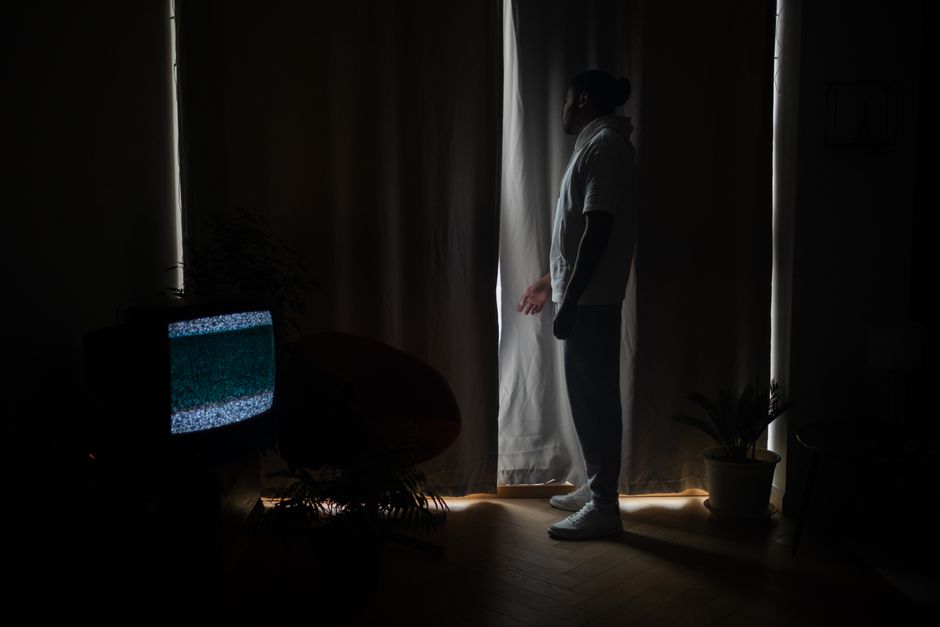
You are lying in bed with the lights off, and the darkness does not look empty. It looks grainy. Faint speckles of light and color shift and shimmer, like an old television tuned to a dead channel. What you are seeing is not a sign that the room is glowing. It is the visual system running with the signal turned down. In near-total darkness, your eyes keep firing on their own, and your brain interprets that background activity as a faint visual “noise” — the static you notice.
The medical term for this is the idiopathic photopsia and visual snow phenomenon, more commonly called “visual snow” or “the Ganzfeld effect” depending on the cause. For most healthy people it is harmless and temporary. For a smaller group, a constant grainy overlay persists even in daylight, and that pattern has a name of its own.
Why Do I See Static In The Dark?
Your eyes are not cameras that switch off. Even in complete darkness, the cells in your retina keep sending small, random signals to your brain. In bright light, real images are strong enough to drown out this background chatter. In the dark, there is nothing to drown it out.
The retina contains light-sensitive cells called photoreceptors — rods and cones. Rods are the ones that work in dim light. They are so sensitive that a single photon can trigger a response. That sensitivity has a cost: rods also fire spontaneously, without any light at all. This is called dark noise or spontaneous isomerization.
Your visual cortex, the part of the brain that processes sight, is also never fully quiet. It has its own baseline activity. When there is no real image coming in, the brain amplifies whatever small signals it is getting. The result is a faint, moving field of dots and colors — what researchers call eigengrau, the “intrinsic gray” of the visual system.
In short: the static is real, but it is inside your visual system, not in the room. It is normal background noise that becomes visible when there is no brighter signal to mask it.
Is Seeing Static In The Dark Normal?
Yes, for most people it is completely normal. Almost everyone can detect some visual noise if they sit in a dark, featureless room for long enough. This is the basis of the Ganzfeld effect, a well-documented phenomenon in vision science. When you stare at a uniform field of color or darkness, the brain fills in the gaps with its own activity, and people report seeing speckles, swirls, and flashes.
What varies is how much noise each person notices. Some people barely see anything. Others see a clear, moving grain. Both can fall within the range of normal. The difference often comes down to attention — the more you look for it, the more you find.
There is one important distinction. Seeing static only in the dark, especially when you first turn off the lights, is common and generally benign. Seeing a constant grainy overlay in daylight too, along with other symptoms, is a different pattern and worth discussing with a doctor.
What Is Visual Snow Syndrome?
Visual snow syndrome is a recognized neurological condition in which people see a persistent, TV-static-like flicker across their entire field of vision, not just in the dark. The grainy pattern continues in bright light, on white walls, and against the sky.
It is usually accompanied by other symptoms. These commonly include:
- Palinopsia — trailing images or afterimages that linger longer than usual
- Photophobia — increased sensitivity to light
- Nyctalopia — difficulty seeing in low light
- Floaters and flashes of light
- Migraine, often with aura
- Tinnitus (ringing in the ears)
- Brain fog or difficulty concentrating
Visual snow syndrome is considered a disorder of how the brain processes visual information, not a problem with the eyes themselves. Eye exams in people with the condition typically come back normal. The exact mechanism is still being studied, and researchers have proposed that it involves hyperexcitability in the visual cortex.
The evidence on treatment is genuinely limited. No medication is approved for visual snow syndrome, and no large controlled trials have established an effective treatment. Some clinicians report that certain medications used for migraine or epilepsy help some patients, but this is based on small studies and clinical experience, not strong trial evidence. Anyone considering treatment should discuss it with a neurologist familiar with the condition.
What Causes Flashes And Static In The Dark?
Several different things can produce light or static in the dark, and they are not all the same. Distinguishing them matters, because some are harmless and a few are not.
Normal dark noise is the faint grain described above. It is steady, subtle, and disappears or fades when you turn on a light.
Phosphenes are flashes or patterns of light caused by pressure or stimulation of the eye or visual pathway. Rubbing your eyes and seeing swirls is a common example. They can also be triggered by a blow to the head or by standing up quickly.
Photopsia is the medical term for seeing flashes of light. Unlike the steady grain of dark noise, photopsia often appears as brief sparks, streaks, or lightning-like flashes. A common cause is the vitreous gel inside the eye pulling on the retina as it shrinks with age. This is called posterior vitreous detachment and is very common after middle age.
Retinal tears or detachment can also cause flashes, but these are usually accompanied by a sudden shower of new floaters or a curtain-like shadow across part of the vision. This is a medical emergency and needs immediate attention.
Migraine aura can produce shimmering, zigzag patterns or flickering lights, often lasting several minutes to about an hour. It can occur with or without a headache.
When Should Static In The Dark Worry You?
Most dark-time static is not a reason for concern. But some visual symptoms do need prompt medical attention. Seek care the same day if you notice any of the following:
- A sudden shower of new floaters, especially many at once
- Flashes of light that appear suddenly and repeatedly
- A dark curtain or shadow moving across part of your vision
- A sudden loss or marked change in vision
- Static or visual changes that begin after a head injury
These can be signs of a retinal tear or detachment, which is treatable if caught early. Delay can lead to permanent vision loss in the affected eye.
If you have a constant grainy overlay in daylight along with migraine, tinnitus, or trailing images, it is reasonable to see a doctor. Visual snow syndrome is not dangerous to the eyes, but it is worth getting an accurate diagnosis so other conditions can be ruled out.
Does The Static Mean Something Is Wrong With My Eyes?
Usually not. The grain you see in the dark comes from normal activity in the retina and brain, not from damage to the eye. A standard eye exam in someone with ordinary dark noise typically shows healthy eyes.
This is the part many people find surprising: the static is often generated after the eye. The retina sends a noisy signal, and the brain’s visual processing amplifies it when there is nothing else to see. This is why the pattern can feel like it is “in front of” you even though it originates inside your own visual system.
That said, the eye and brain are connected, and some conditions that affect either can change what you see. That is why persistent or new visual symptoms deserve a professional look rather than self-diagnosis.
Can You Reduce The Static You See In The Dark?
You cannot switch off the normal background noise of your visual system, but you can change how much you notice it. The static becomes most visible when you stare into featureless darkness and pay attention to it.
Practical steps that may help:
- Keep a dim light on if the static is distracting at night.
- Avoid staring into complete darkness for long periods if it bothers you.
- Reduce screen time before bed, since eye strain and fatigue can make visual noise more noticeable.
- If you have migraine, managing triggers may reduce aura-related visual symptoms.
None of these eliminate the phenomenon, because it is a normal feature of how vision works. They simply reduce how much it draws your attention.
For people with visual snow syndrome, the evidence for any specific intervention is weak. Some patients report that tinted lenses or certain medications help, but these reports come from small studies and individual experience, not large trials. Anyone with persistent symptoms should work with a doctor rather than relying on unproven remedies.
Frequently Asked Questions
Why do I see static in the dark?
You see static in the dark because your retina and visual cortex keep sending small random signals even when there is no light, and your brain interprets this background noise as a faint grainy field. In bright light, real images mask this noise; in darkness, there is nothing to hide it.
Is seeing static in the dark normal?
Yes, for most people it is a normal effect of how the visual system works, often called dark noise or the Ganzfeld effect. It is generally harmless when it appears only in dim or dark conditions.
What is visual snow syndrome?
Visual snow syndrome is a neurological condition in which a TV-static-like flicker is present all the time, including in daylight, often with migraine, tinnitus, and trailing images. It is considered a disorder of visual processing in the brain, not a problem with the eyes.
When should I worry about flashes in the dark?
Seek same-day medical care if you suddenly see many new floaters, repeated flashes of light, or a dark curtain across your vision, as these can signal a retinal tear or detachment. Ordinary faint static in the dark alone is not an emergency.
