
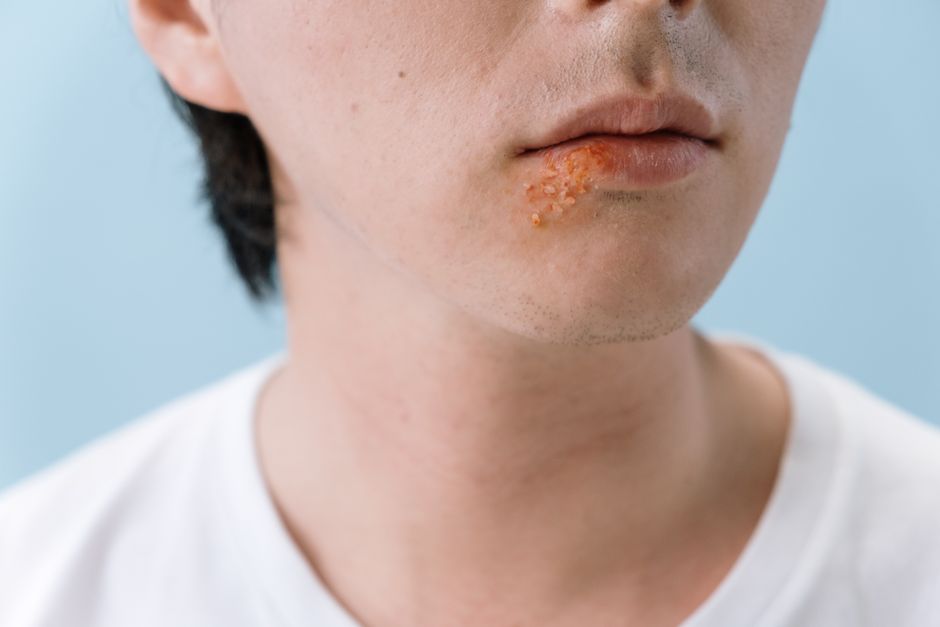
A cold sore on your lip is caused by the herpes simplex virus type 1, usually called HSV-1. The virus infects the skin around your mouth and then stays in your body for life, hiding in nerve cells near your spine. Most of the time it sits quietly. When something stresses your body or immune system, the virus can wake up, travel back down the nerve, and produce a blister on or around your lip.
That is why cold sores come back. The first infection is often mild or silent. Later outbreaks are triggered by things like fever, sun exposure, stress, or skin injury. Understanding those triggers is the most practical way to reduce how often they happen.
Why Do I Have A Cold Sore On My Lip Causes Triggers?
HSV-1 is the main cause of cold sores. The virus enters through small breaks in the skin or the lining of the mouth, often during childhood. Once inside, it travels along a sensory nerve to a cluster of nerve cells called a ganglion, where it stays dormant.
Dormancy does not mean the virus is gone. It means the virus is inactive. Certain conditions reactivate it, and the virus travels back along the same nerve to the skin near where it first entered. That is why cold sores tend to appear in roughly the same spot each time.
HSV-1 is extremely common. The World Health Organization estimates that billions of people worldwide carry it. Many never get a visible sore, but they can still carry and transmit the virus.
It helps to separate two things people often blend together: the cause (the virus) and the triggers (what wakes it up). You cannot remove the virus. You can often manage the triggers.
What Triggers a Cold Sore to Come Back?
Triggers vary from person to person. A trigger for one person may do nothing for another. The most commonly reported ones share a theme: they place stress on the body or the skin.
- Illness and fever. This is where the old name “fever blister” comes from. A cold, flu, or other infection that raises your body temperature can reactivate the virus.
- Sun and wind exposure. Ultraviolet light and cold, drying wind are frequently reported triggers. Sunburn on the lips is a common one.
- Physical or emotional stress. Stress is widely reported by people who get recurrent cold sores, though the exact biological link is not fully pinned down.
- Skin injury. A cut, scrape, or even cosmetic procedures on the lip area can set off an outbreak.
- Fatigue and lack of sleep. Being run down is a frequently cited trigger.
- Hormonal changes. Some women notice outbreaks around their menstrual period.
- Weakened immunity. People whose immune system is suppressed, whether from illness or certain medications, tend to have more frequent and longer outbreaks.
It is worth being honest about the evidence here. Many of these triggers are based largely on what patients report and on clinical observation, not on large controlled trials. The link between fever and reactivation is well established. The links to stress and fatigue are plausible and commonly reported but harder to prove in studies.
What Does a Cold Sore Look and Feel Like?
Most people notice a warning sign before a blister appears. This is called a prodrome. It usually involves tingling, itching, or a burning feeling on the lip, often a day or so before anything is visible.
Then a small cluster of fluid-filled blisters forms on a red, raised patch of skin. The blisters break, ooze, and crust over. The whole cycle typically runs its course over about one to two weeks in healthy people. First infections can last longer and may come with fever, sore throat, or swollen glands.
Cold sores usually appear on or around the outer lip, sometimes under the nose or on the chin. They are different from canker sores, which form inside the mouth on the soft tissue and are not caused by HSV-1.
Is It Contagious, and How Does It Spread?
Yes. HSV-1 spreads through direct contact with infected skin, saliva, or the fluid from a blister. It is most contagious when a blister is present and oozing.
One point many people do not realize: the virus can also spread when there is no visible sore. This is called asymptomatic shedding. It happens less often than during an active outbreak, but it is a major reason the virus is so widespread.
Practical steps reduce spread during an outbreak:
- Do not kiss anyone, especially infants, while a sore is present.
- Avoid sharing utensils, cups, lip balm, or towels.
- Wash your hands after touching the sore.
- Avoid touching your eyes. HSV can cause a serious eye infection if it reaches the eye.
Newborns are a special concern. HSV infection in a newborn can be severe, so anyone with an active cold sore should avoid close contact with a baby. This is one of the situations where the risk is real and worth taking seriously.
How Are Cold Sores Treated?
There is no cure for HSV-1. The virus stays in the body. Treatment aims to shorten outbreaks, ease symptoms, and reduce how often they happen.
Antiviral medications are the main medical option. Some are available over the counter in some countries, and others require a prescription. When started early, ideally at the first tingle, antivirals can reduce how long an outbreak lasts. For people with frequent outbreaks, a clinician may recommend a daily antiviral to reduce recurrence. That decision is made with a healthcare provider, not self-directed.
General comfort measures that are widely used include cool compresses and over-the-counter pain relief. These ease symptoms but do not shorten the outbreak.
Be cautious with marketing claims. Many creams and patches sold for cold sores have little or no strong evidence behind them. Some provide a barrier or temporary relief. None cure the virus. If a product claims to “eliminate” cold sores, that claim is not supported by the evidence.
See a clinician if sores are large, last more than two weeks, occur very often, or appear near the eye. People with weakened immune systems should seek medical advice for any outbreak.
Can You Prevent Cold Sores From Coming Back?
You cannot prevent every outbreak, but you can lower the odds by managing your known triggers. Because triggers differ, the most useful approach is to notice your own patterns.
- Use lip balm with sun protection and shade your face in strong sun.
- Get enough rest, especially when you feel run down.
- Treat fevers and illnesses promptly.
- Keep lips moisturized to avoid cracking and injury.
- Manage stress where you can, though this is easier said than done.
For people with frequent, disruptive outbreaks, a clinician may discuss daily antiviral suppression. Studies indicate this can reduce recurrence in some people. It is a clinical decision, not a universal recommendation.
One clarification worth making: cold sores are not a sign of poor hygiene or a weak character. They are a near-universal viral infection that most adults carry. The frequency of outbreaks says more about your immune system and triggers than about anything you did wrong.
Frequently Asked Questions
Are cold sores caused by herpes?
Yes, cold sores are usually caused by herpes simplex virus type 1 (HSV-1). A related virus, HSV-2, more often causes genital herpes but can also cause oral sores.
What is the most common trigger for a cold sore?
Fever and illness are among the most well-established triggers, which is why they were once called fever blisters. Sun exposure and stress are also commonly reported.
Can I spread a cold sore when I have no blister?
Yes, the virus can sometimes spread through asymptomatic shedding when no sore is visible. The risk is highest when a blister is present and oozing.
How long does a cold sore last?
Most cold sores heal in about one to two weeks in healthy people. First infections can last longer and may bring fever or swollen glands.
