
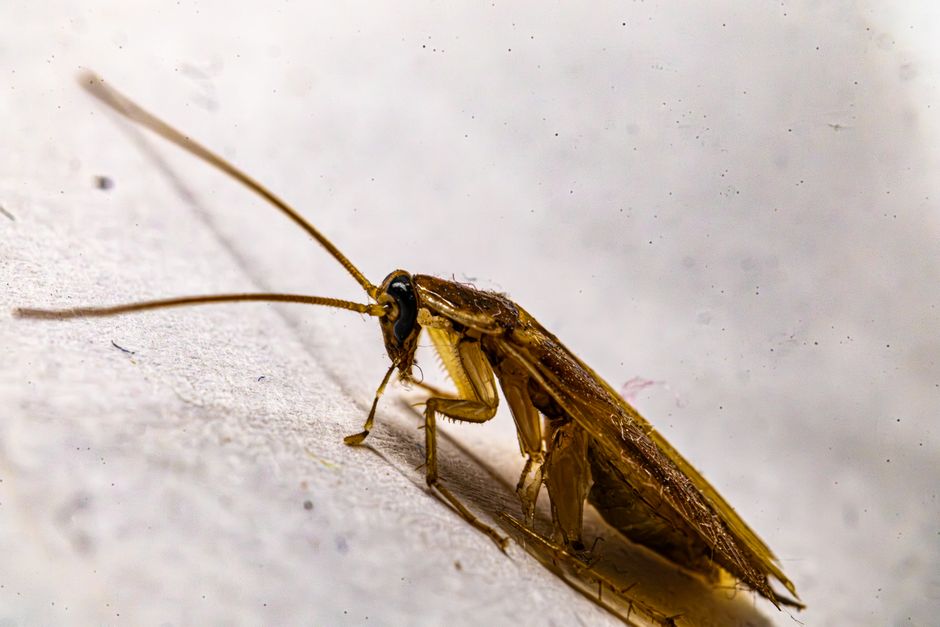
If you keep finding cockroaches lying on their backs, you are almost certainly looking at dead or dying insects, not a strange new behavior. A cockroach on its back is usually a roach that has lost its ability to stay upright, and that loss of balance is the real story. The most common reasons are insecticide exposure, a fungal or bacterial infection, physical injury, or simply old age and dehydration. In each case, the roach’s nervous system or muscles have failed enough that it can no longer right itself.
Why does dying on the back happen so often? A roach’s body is top-heavy and its legs are built for pushing off flat surfaces. Once the legs stop coordinating, the insect tips over and often cannot recover. That single mechanical fact explains most of what you are seeing.
Why Do I Find Roaches On Their Backs?
Roaches end up on their backs because their nervous system stops controlling the muscles that keep them upright. When that control fails, gravity does the rest.
Insects do not have a balancing organ like the human inner ear. They rely on their legs, sensory hairs, and a network of nerve clusters called ganglia to sense their position and correct it. If any part of that system is disrupted, the roach loses its grip on the surface and rolls onto its back. Because the legs curl inward as the insect weakens, righting itself becomes nearly impossible.
This is why you rarely see a healthy cockroach on its back. A roach in good condition can flip itself over quickly on most surfaces. Finding one stuck on its back is a sign that something has already gone wrong inside the insect.
Does Bug Spray Make Roaches Flip Over?
Insecticides are the leading cause of roaches found on their backs indoors. This is a well-documented effect of how these chemicals work.
Most common household insecticides are neurotoxins. They interfere with signals in the insect’s nervous system. The result is a loss of muscle control, tremors, and eventually paralysis. As the roach loses coordination, it tips over and cannot right itself. It may stay on its back for hours or days before it finally dies.
Two broad classes of insecticide do this in slightly different ways:
- Pyrethroids — common in sprays and foggers. They overstimulate nerve cells, causing rapid loss of control.
- Organophosphates and carbamates — less common in homes now. They disrupt a key nerve enzyme and produce similar paralysis.
Gel baits and some newer products work more slowly. A roach that eats a bait may die in its harborage rather than out in the open. That is actually the goal of baiting. So if you are seeing many roaches on their backs in the open, that often points to a spray or contact insecticide rather than a bait.
One thing worth knowing: a roach on its back is not always dead. Some insecticides cause paralysis that wears off, and some roaches recover. If you see one twitch or move a leg, it may still be alive.
Can a Fungus or Infection Cause This?
Yes. Certain infections can leave a cockroach on its back, and this is a real phenomenon studied in insect pathology.
Fungal infections are among the best known. Some fungi that attack insects grow through the body and disrupt normal function. As the infection progresses, the insect loses coordination and often dies in an abnormal posture, frequently on its back or side. You may sometimes notice a roach that looks stiff or has a fuzzy or powdery appearance, though not always.
Bacterial and viral infections can produce similar effects. Insects that are sick often move less, lose their grip, and end up inverted.
Here is the honest limit: from a single dead roach on your floor, you cannot tell whether the cause was a fungus, a virus, a pesticide, or old age. Those distinctions require laboratory testing. For a homeowner, the practical takeaway is simpler — a sick roach on its back is not a separate problem you need to treat. It is a sign the insect died.





What About Old Age and Dehydration?
Roaches die of natural causes too, and when they do, they often end up on their backs.
Cockroaches have a limited lifespan, and as they age, their coordination and muscle strength decline. A weak or dehydrated roach has trouble staying upright. Without enough moisture, the body loses the internal pressure that helps the legs function. The insect becomes sluggish, tips over, and cannot recover.
This is common in homes during dry periods or in areas with low humidity. A roach that wanders away from a damp harborage can dehydrate within a day or so. You may then find it on its back somewhere out in the open.
Physical injury does the same thing. A roach that has been stepped on, crushed, or damaged by a trap may survive for a while but lose the ability to right itself. The result looks identical to a pesticide kill.
Does Seeing Roaches on Their Backs Mean an Infestation?
Not by itself. One or two roaches on their backs is not proof of a large infestation. It tells you that some roaches have died, not how many are alive.
What matters more is the pattern. If you are finding roaches on their backs repeatedly, in different rooms, over days or weeks, that suggests a population is present and something is killing them. That could be your own pest control efforts working, or a natural cause. Either way, it is worth investigating.
Signs that point more strongly to an active infestation include:
- Live roaches seen during the day, especially in kitchens and bathrooms
- Droppings that look like small dark specks or smears
- Egg cases, called oothecae, in cracks and behind appliances
- A musty odor in enclosed spaces
- Shed skins from growing nymphs
Dead roaches alone are weak evidence. Live roaches, droppings, and egg cases are stronger signs.
Which Roach Species Are You Likely Seeing?
The species matters less than the situation, but it helps to know what you are dealing with. Different roaches behave differently and show up in different places.
- German cockroach — small, light brown, the most common indoor pest. Found near warmth and moisture, especially kitchens and bathrooms.
- American cockroach — large, reddish-brown. Often enters from drains, basements, and sewers.
- Oriental cockroach — dark, almost black. Prefers cool, damp areas like basements and crawl spaces.
All three can end up on their backs when they die. None of them normally rest in that position. If you can identify the species, you get a clue about where they are coming from, which is more useful than the posture of a dead one.
What Should You Do About It?
Focus on the living roaches, not the dead ones. A roach on its back is a symptom, not a problem to solve on its own.
Steps that address the underlying situation:
- Remove food and water sources. Fix leaks, wipe up crumbs, and store food in sealed containers.
- Reduce clutter and seal cracks where roaches hide and breed.
- If you are using insecticide, follow the label exactly. More is not better and can be unsafe.
- Consider bait stations for ongoing control, since they target the colony rather than individual roaches.
- For a persistent problem, a licensed pest control professional can identify the species and source.
If you find a roach on its back and it is still moving, it may be dying from something you applied. If it is stiff and dry, it has been dead for a while. Either way, the insect itself is not a health threat once it stops moving, though roaches in general can carry bacteria on their bodies and trigger allergies in sensitive people.
One clarification worth making: you do not need to worry that a roach on its back is “playing dead” as a trick. Cockroaches do not do that. What you are seeing is a real loss of function.
Frequently Asked Questions
Why do I find roaches on their backs?
Roaches end up on their backs when they lose the muscle control needed to stay upright, most often from insecticide exposure, infection, injury, or old age. A healthy roach can right itself quickly, so finding one stuck on its back usually means it is dying or already dead.
Does bug spray make roaches flip over?
Yes. Most household insecticides are neurotoxins that disrupt the insect’s nervous system, causing loss of coordination and paralysis that leaves the roach on its back. This is a well-documented effect of common products like pyrethroid sprays.
Is a roach on its back always dead?
No. Some insecticides cause temporary paralysis, and a roach may recover. If you see any leg movement or twitching, the insect may still be alive.
Does finding dead roaches on their backs mean I have an infestation?
Not necessarily. A few dead roaches do not prove a large infestation, since they only show that some roaches died. Repeated findings plus live roaches, droppings, or egg cases are stronger signs of an active problem.
