

Gnats fly in your face because they are attracted to the carbon dioxide you exhale, the warmth of your skin, and the moisture around your eyes, nose, and mouth. To a gnat, your face is the most interesting part of you. It is also the easiest target, because these insects are weak fliers that get pushed around by air currents and tend to drift wherever the air takes them.
That combination explains most of what feels like personal targeting. You are not unlucky. You are a warm, breathing, moist source of exactly what gnats are built to find.
Why Do Gnats Fly In Your Face?
Your face concentrates several signals that gnats detect from a distance. The two most important are carbon dioxide and body heat.
Every time you exhale, you release a plume of carbon dioxide. Many biting flies and gnats can detect that plume and follow it upwind toward its source. This is a well-documented behavior in insects that feed on blood or on the fluids around the eyes of animals. The carbon dioxide tells them something living is nearby.
Body heat is the second signal. Gnats respond to warmth, and your face and neck release more heat than most covered parts of your body. Add the moisture from your breath and the thin film of tears and sweat on your skin, and the area around your head becomes a concentrated target.
There is also a simple physical reason. Gnats are small and weak in flight. They cannot easily hold a straight line against moving air, so they collect in the calm pocket of air that forms around a person’s head. That pocket is often right in front of your face. When you walk, you create a slipstream that pulls them along with you.
Are Gnats Attracted to Carbon Dioxide and Body Heat?
Yes. Carbon dioxide and body heat are two of the best-studied attractants for biting insects, and gnats are no exception.
Researchers have long used carbon dioxide as bait in insect traps precisely because it draws so many biting species. The insects have specialized sensors that pick up carbon dioxide in the air, and they use it as a long-range cue to find a host. Once they get closer, warmth and skin chemicals take over as the guiding signals.
This is why you may notice gnats gathering around your head rather than your feet. The carbon dioxide you exhale stays concentrated near your face and disperses as it drifts away. The closer they get, the stronger the signal.
Your skin also releases small amounts of other compounds, including lactic acid and ammonia from sweat. Some biting insects respond to these as well. The exact mix that attracts gnats varies by species, and scientists do not fully agree on how much each cue matters. What is clear is that carbon dioxide and heat together create a strong pull.
Why Do Gnats Swarm Around Your Head Specifically?
Your head sits at the top of your body, and that position matters. Warm, moist air rises, so the air around your head carries more of your heat and breath than the air around your legs.
There is another factor that surprises many people. Some gnats, including certain species that form visible swarms, are not trying to bite you at all. They are males gathering to mate. These swarms often form around a visual marker, and a person’s head is a convenient landmark. The insects hover in a column above or in front of that marker, waiting for females to pass through.
This is why a swarm can seem to follow you. You are not being hunted. You are standing where the swarm already wanted to be, and you keep carrying the landmark with you as you move.
Wind plays a role too. Gnats avoid strong airflow and gather in sheltered spots. The space just in front of your face, partly blocked by your body, can be calmer than the open air around it. That calm zone becomes a gathering point.

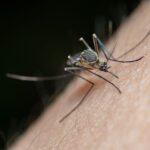



Do Gnats Bite, and Why Do They Target Eyes and Nose?
Not all gnats bite. The word “gnat” is a loose term that covers many small flying insects, including some that bite and some that do not.
Among the biting types, a few are known for targeting the eyes and the area around the nose and mouth. Certain black flies and biting midges are drawn to the moisture and thin skin in those areas. The eyes stay wet, the skin there is delicate, and the fluids they seek are easy to reach.
This behavior is not personal. It is the same reason these insects gather at the eyes of livestock and other animals. The tissues around the eye offer moisture and warmth in a spot where the skin is thin.
Bites from these insects can be itchy and, in some people, cause swelling. Scratching can break the skin and lead to infection. If you are bitten, washing the area and avoiding scratching is the sensible response. Seek medical care if a bite swells significantly, spreads, or shows signs of infection such as increasing redness, warmth, or pus.
What Actually Keeps Gnats Out of Your Face?
No method removes every gnat, but a few approaches reduce how many reach your face. The evidence behind them varies, so it helps to know which are well supported and which are mostly traditional.
- EPA-registered repellents. Products containing DEET, picaridin, IR3535, or oil of lemon eucalyptus are registered with the U.S. Environmental Protection Agency and are the most reliable options for repelling biting insects. Follow the label directions.
- Permethrin-treated clothing. Permethrin is applied to fabric, not skin, and can reduce bites from a range of biting insects. Treat clothing according to the product label.
- Air movement. A fan or a breeze disrupts the calm air pocket gnats gather in. This can reduce how many hover near your face.
- Covering up. Long sleeves, long pants, and a head net reduce exposed skin and the moisture and heat that draw insects in.
- Avoiding peak times and places. Many biting gnats are most active around dawn and dusk and near water, marshes, and damp vegetation.
Some popular home remedies have little supporting evidence. Things like vanilla extract, dryer sheets, and various essential oil blends are widely shared online, but no large human trials have confirmed that they keep gnats away. They may seem to work for some people, but that is not the same as proven protection. If you want dependable repellency, an EPA-registered product is the safer bet.
It is also worth knowing that insect repellents are not the same as insecticides. Repellents make you harder to find and less appealing to land on. They do not clear an area of insects. For that, you would need to address where the gnats are breeding, which for many species means standing water or damp organic material nearby.
Do Some People Attract More Gnats Than Others?
Yes, and the reasons are only partly understood. Differences in body size, breathing rate, skin temperature, and skin chemistry all change how much carbon dioxide, heat, and scent a person gives off.
Larger people and those who are more active exhale more carbon dioxide and radiate more heat, which can make them easier for insects to find. Skin bacteria also break down sweat into compounds that some insects find attractive, and the mix of bacteria on your skin differs from person to person. This is one reason two people standing side by side can have very different experiences.
Scientists have studied these differences for decades, but the picture is not complete. There is no single trait that guarantees you will or will not attract gnats. It is a combination of signals, and the balance shifts with the species of gnat, the weather, and where you are.
One practical takeaway: if you seem to attract more than everyone around you, it is not a sign of anything wrong with you. It is a matter of how much carbon dioxide, heat, and skin scent you happen to release, and how those signals line up with what the local insects are looking for.
Frequently Asked Questions
Why do gnats fly around your face and not your body?
Your face releases the most carbon dioxide, heat, and moisture, which are the main signals gnats use to find a host. Warm, moist air also rises, so the air around your head carries more of those cues than the air near your legs.
Do gnats actually bite or are they just annoying?
Some gnats bite and some do not, because “gnat” covers many small flying insects. Biting types can leave itchy welts, while swarming types may simply be gathering to mate and never bite at all.
What is the best way to keep gnats away from your face?
EPA-registered repellents containing DEET, picaridin, IR3535, or oil of lemon eucalyptus are the most reliable option, along with moving air from a fan and covering exposed skin. Home remedies like vanilla or dryer sheets have little supporting evidence.
Why do gnats swarm around one person and not another?
People differ in how much carbon dioxide they exhale, how much heat they give off, and the mix of bacteria and sweat compounds on their skin. Those differences help explain why gnats may favor one person over another.
