
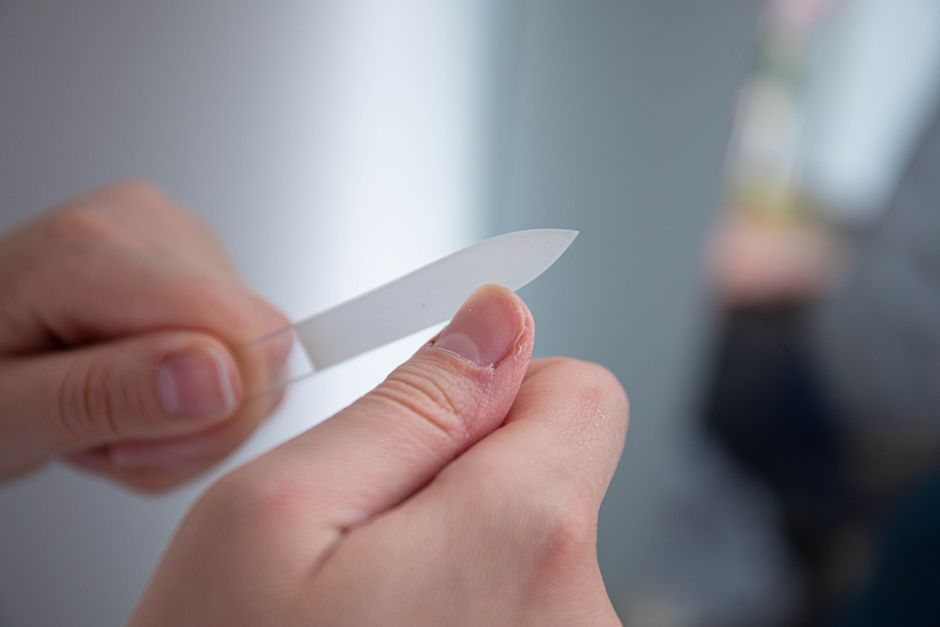
Brittle nails are extremely common, and they are not just a cosmetic problem. The medical term is onychorrhexis, and it describes nails that split, peel, crack, or break easily along the length of the nail. Most cases come down to everyday wear and tear, moisture loss, or repeated contact with water and chemicals — not a hidden disease. But brittle nails can also be the first visible sign of a nutritional deficiency or a thyroid problem, which is why the pattern and timing matter.
Why Are Your Nails Brittle?
Nails are made mostly of keratin, the same protein found in hair and skin. A healthy nail plate is layered and slightly flexible. When it loses water or the bonds between keratin fibers are damaged, the layers separate and the nail becomes fragile.
The most common drivers fall into a few groups:
- Moisture loss. Nails that dry out become rigid and crack. This happens with frequent hand washing, dishwashing, and dry indoor air.
- Chemical exposure. Nail polish remover, household cleaners, and detergents strip oils from the nail plate.
- Repeated wet-dry cycling. Nails swell when wet and shrink when dry. Do this many times a day and the layers weaken.
- Age. Nail growth slows and the nail plate thins over time. Brittleness becomes more common after age 50.
- Nutritional gaps. Low iron, low thyroid hormone, and certain vitamin deficiencies can show up in the nails.
Notice that most of these are mechanical or environmental. That is why a brittle nail often improves simply by changing how the hands are treated, without any supplement.
What Causes Brittle Nails Besides Dryness?
Dryness explains a large share of cases, but it is not the whole story. When nails break despite good hand care, it is worth looking at internal causes.
Iron deficiency is one of the better-documented links. Low iron can produce a condition called koilonychia, where nails become thin and spoon-shaped with raised edges. This is a recognized clinical finding, not a fringe claim. If you also feel tired, short of breath, or unusually pale, that combination is worth a doctor’s visit.
Hypothyroidism — an underactive thyroid — is associated with dry, brittle nails that grow slowly. The thyroid controls metabolism, and when it runs low, skin, hair, and nails all tend to suffer. Other signs include fatigue, cold intolerance, and weight changes.
Raynaud’s phenomenon reduces blood flow to the fingers in cold or stressful conditions. Poor circulation to the nail bed can leave nails weak and slow-growing.
Psoriasis can affect the nails directly. It causes pitting, crumbling, and separation of the nail from the nail bed. If you have skin plaques elsewhere, that connection is worth raising with a dermatologist.
One clarification worth knowing: the idea that brittle nails always signal a serious underlying illness is overstated. In most people, the cause is on the hands, not inside the body.
Does a Vitamin Deficiency Cause Brittle Nails?
Deficiencies can cause brittle nails, but they are far less common than most supplement marketing suggests. The honest position is that if your diet is varied and you have no diagnosed deficiency, adding biotin or a “nail formula” is unlikely to change anything.
Biotin gets the most attention. It is a B vitamin, and a true biotin deficiency does cause brittle nails and hair loss. But genuine biotin deficiency is rare in people eating a normal diet, because biotin is present in eggs, nuts, seeds, and many vegetables. What is not well established is whether biotin helps people who are not deficient. No large, well-controlled human trials have confirmed that biotin strengthens nails in people with normal levels.
There is also a real safety point. High-dose biotin supplements can interfere with certain laboratory tests, including some thyroid and cardiac tests, producing misleading results. If you take biotin and have blood work done, tell your clinician.
Iron is a different case. Iron deficiency is common, especially in menstruating women, and it is a documented cause of nail changes. Iron should be checked with a blood test rather than guessed at, because too much iron is harmful.
Zinc, vitamin A, and vitamin C deficiencies have all been linked to nail problems in the medical literature. Again, these matter mainly when a deficiency actually exists.
The takeaway: supplements are not a general fix for brittle nails. Testing comes before supplementing.




Which Habits Make Nails More Brittle?
Everyday habits are the biggest single factor for most people. The pattern is usually obvious once you look for it.
- Frequent hand washing or wet work. Nurses, cooks, cleaners, and new parents often notice this first.
- Using nails as tools. Opening cans, scraping labels, and prying things apart puts stress exactly where nails are weakest.
- Harsh polish removers. Acetone-based removers are effective but drying, especially with frequent use.
- Gel and acrylic manicures. The filing and removal process thins the nail plate. Repeated cycles leave nails weaker than before.
- Cold, dry weather. Low humidity pulls moisture from the nail plate.
- Smoking. It reduces blood flow, including to the fingers.
If several of these apply, the fix is often to reduce the exposure rather than to add a product. That is not a satisfying answer for someone hoping for a quick supplement, but it is the accurate one.
What Actually Helps Brittle Nails?
Practical measures work better than most marketed remedies. The goal is to keep the nail plate from losing water and to stop mechanical damage.
Keep nails short. A shorter free edge has less leverage to catch and tear. This is the single most effective step for nails that split constantly.
Moisturize the nails, not just the hands. Products containing urea, lactic acid, or phospholipids have shown some benefit in small studies for brittle nails. A thick hand cream applied after every wash helps.
Wear gloves for wet work and cleaning. Rubber or nitrile gloves keep water and detergents off the nail plate. Cotton liners help if your hands sweat.
Limit polish remover. Use acetone-free removers when possible and give nails breaks between manicures.
Don’t bite or pick. Biting damages the nail and the surrounding skin, and it can introduce infection.
Patience matters here. A fingernail takes roughly six months to fully regrow from base to tip. Toenails take considerably longer. Any real change in nail quality shows up gradually, not in a week. If a product promises fast results, that is a signal to be skeptical.
When Should You See a Doctor About Brittle Nails?
Most brittle nails do not need medical attention. Certain patterns do.
See a clinician if you notice:
- Nails separating from the nail bed, or crumbling
- Discoloration — yellow, green, brown, or black streaks
- Thickening, especially on the toes
- Pitting or ridges that appear suddenly
- Pain, swelling, or redness around the nail
- Brittleness alongside fatigue, hair loss, or unexplained weight change
A dark streak under a single nail that appears without injury deserves prompt evaluation, because it can occasionally signal a serious condition. This is uncommon, but it should not be ignored.
If brittle nails come with symptoms pointing to thyroid or iron problems, a simple blood test can clarify things. That is a reasonable conversation to have with a primary care clinician rather than something to self-treat with supplements.
Do Nail Hardening Products Work?
Nail hardeners are a mixed bag. Some contain formaldehyde or similar cross-linking agents that temporarily stiffen the nail. The effect is real but short-lived, and it does not address the underlying cause. Overuse can make nails more brittle over time because the nail becomes rigid and less able to flex.
Products that add moisture — the urea and phospholipid creams mentioned earlier — are generally a better direction, because dryness is a more common root cause than softness. There is no single product that reliably fixes brittle nails for everyone, and no clinical evidence supports the idea that a hardening polish will repair the nail itself.
Frequently Asked Questions
What deficiency causes brittle nails?
Iron deficiency is the best-documented nutritional cause, and it can produce thin, spoon-shaped nails. Biotin deficiency also causes brittle nails, but it is rare in people eating a normal diet.
Can brittle nails be a sign of thyroid problems?
Yes. An underactive thyroid is associated with dry, brittle nails that grow slowly, often alongside fatigue and cold intolerance. A blood test can confirm or rule this out.
How long does it take for brittle nails to improve?
A fingernail takes about six months to fully regrow, so improvements appear gradually. Toenails take considerably longer.
Does biotin actually help brittle nails?
Biotin helps only if you are genuinely deficient, which is uncommon. No large controlled trials have confirmed that biotin strengthens nails in people with normal levels.
