
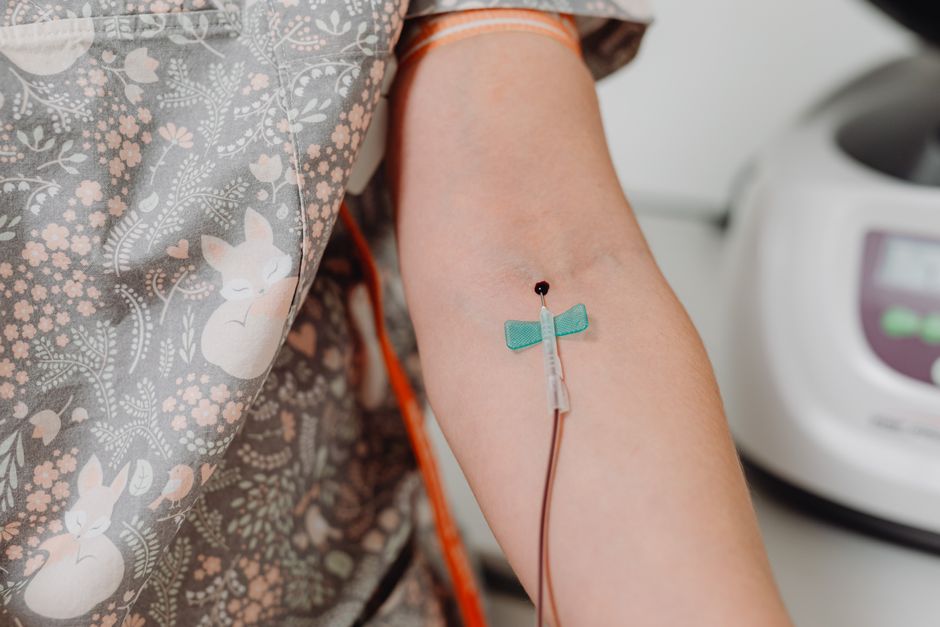
Your blood type is determined by specific molecules on the surface of your red blood cells. These molecules, called antigens, act like identification tags. Your immune system learns to recognize its own tags and attacks any blood cells that carry unfamiliar ones. The root cause of different blood types comes down to small genetic variations that control which antigens your cells display. These variations likely arose millions of years ago as a defense against infectious diseases.
How Do Genes Determine Blood Type?
Your blood type is inherited from your parents. The ABO blood group system is controlled by a single gene on chromosome 9. This gene has three common versions, or alleles: A, B, and O. You inherit one allele from each parent.
The A and B alleles each produce a specific enzyme that adds a sugar molecule to the surface of your red blood cells. The A allele adds one type of sugar. The B allele adds a different type. The O allele produces a non-functional enzyme, so no sugar is added. This is why type O blood has no A or B antigens.
Your Rh status, which makes your blood type positive or negative, is controlled by a separate gene on chromosome 1. If you have the RhD antigen, you are Rh positive. If you lack it, you are Rh negative. About 85 percent of people in the US are Rh positive.
The combination of your ABO alleles and your Rh status gives you one of eight common blood types: A+, A-, B+, B-, AB+, AB-, O+, and O-.
Why Are There Different Blood Types Explained Through Evolution?
The leading scientific theory is that different blood types evolved as a response to infectious diseases. Pathogens like bacteria and viruses often attach to specific sugar molecules on your cells to infect you. If your ancestors lacked that particular sugar, they were naturally resistant to that infection.
For example, the O allele is thought to have become more common in regions with severe malaria. The malaria parasite has a harder time invading red blood cells that lack A or B antigens. This survival advantage may explain why type O blood is more frequent in parts of Africa and South America where malaria was historically common.
Similarly, some evidence suggests that people with type A blood may have had better resistance to certain pox viruses. The exact relationships are still being studied. But the overall pattern is clear: blood type diversity is not random. It reflects a long history of humans adapting to local disease threats.
What Are the Four Main Blood Groups?
The ABO blood group system divides blood into four main types based on which antigens are present.
- Type A has the A antigen on red blood cells and anti-B antibodies in the plasma.
- Type B has the B antigen on red blood cells and anti-A antibodies in the plasma.
- Type AB has both A and B antigens and no ABO antibodies. This is the universal plasma donor.
- Type O has neither A nor B antigens and has both anti-A and anti-B antibodies. This is the universal red blood cell donor.
Your body naturally produces antibodies against the antigens you lack. This happens without ever being exposed to another person’s blood. The reason is that your immune system encounters similar sugar molecules on bacteria in your gut and environment. It learns to recognize those sugars as foreign and produces antibodies against them.





What Is the Rh Factor and Why Does It Matter?
The Rh factor is a separate protein found on red blood cells. If you have it, you are Rh positive. If you do not, you are Rh negative. Unlike the ABO system, your body does not naturally produce anti-Rh antibodies. You only develop them if you are Rh negative and are exposed to Rh positive blood.
This becomes important during pregnancy. If an Rh negative mother carries an Rh positive baby, her immune system can develop antibodies against the baby’s red blood cells. This usually does not affect a first pregnancy. But in later pregnancies with Rh positive babies, the antibodies can cross the placenta and destroy the baby’s red blood cells. This condition is called hemolytic disease of the newborn.
This is preventable. Rh negative mothers receive an injection of Rh immunoglobulin during pregnancy and after delivery. This prevents their immune system from making antibodies.
How Common Is Each Blood Type in the US Population?
Blood type frequency varies by ethnic background and geographic region. In the United States, the distribution is roughly as follows:
| Blood Type | Approximate Percentage of US Population |
|---|---|
| O+ | 38 percent |
| O- | 7 percent |
| A+ | 28 percent |
| A- | 7 percent |
| B+ | 9 percent |
| B- | 2 percent |
| AB+ | 3 percent |
| AB- | 1 percent |
Type O is the most common overall. Type AB is the rarest. The exact numbers vary slightly depending on the population studied. But the pattern is consistent across most US surveys.
Can Your Blood Type Change?
Your blood type is set for life. It is determined by your DNA and does not change under normal circumstances. There are rare exceptions. A bone marrow transplant can change a person’s blood type if the donor has a different type. This happens because the new stem cells produce blood cells with the donor’s antigens.
Some medical conditions can temporarily alter how your blood type appears on a lab test. For example, certain cancers or infections can suppress antigen production. This is called acquired blood type change. It is temporary and the original type returns once the underlying condition is treated.
If you see claims online that diet or lifestyle can change your blood type, ignore them. There is no clinical evidence that anything you eat, drink, or do can permanently alter your blood type.
Does Blood Type Affect Health or Personality?
Some studies have found associations between blood type and risk for certain conditions. For example, people with type O blood have a lower risk of blood clots. People with type A have a slightly higher risk of stomach cancer. These are statistical associations, not guarantees. The effect sizes are generally small.
The evidence linking blood type to personality is very weak. This idea is popular in Japan and South Korea, where blood type personality tests are common. But large scientific studies have found no consistent relationship between blood type and personality traits. The claims do not hold up under scrutiny.
Blood type may also influence how your body responds to certain infections. Research during the COVID-19 pandemic suggested that people with type O blood had a slightly lower risk of severe illness. The reasons are not fully understood and the effect was modest.
Why Is Blood Type Matching Important for Transfusions?
If you receive blood that is incompatible with your own, your immune system attacks the donor red blood cells. This triggers a transfusion reaction. Symptoms include fever, chills, back pain, and in severe cases, kidney failure or death.
Type O negative blood is considered the universal donor for red blood cells because it lacks A, B, and Rh antigens. It can be given to anyone in an emergency when the recipient’s blood type is unknown. Type AB positive is the universal recipient for red blood cells because it has no ABO antibodies.
Blood banks always cross-match donor and recipient blood before a transfusion. This double-checks compatibility beyond just ABO and Rh. Even with matching types, there are other minor blood group systems that can sometimes cause reactions.
Are There Other Blood Group Systems Beyond ABO and Rh?
Yes. There are over 30 recognized blood group systems, though most are less important for routine transfusions. The ABO and Rh systems are the most clinically significant because they cause the strongest immune reactions.
Other systems include Kell, Duffy, Kidd, and Lewis. These matter in specific situations. For example, the Duffy system is relevant to malaria resistance. People of African descent often lack the Duffy antigen, which makes their red blood cells resistant to a particular malaria parasite.
Blood banks screen for several of these minor systems when matching blood for patients who need frequent transfusions, such as those with sickle cell disease. This reduces the risk of developing antibodies against these less common antigens.
Frequently Asked Questions
What determines if my blood is A, B, AB, or O?
A single gene on chromosome 9 determines your ABO blood type based on which allele you inherited from each parent.
Can two parents with type A blood have a child with type O blood?
Yes, if both parents carry the O allele. Type A parents who are AO can each pass the O allele to their child, resulting in type O blood.
Is type O blood really the safest for everyone in a transfusion?
Type O negative red blood cells are safe for most people in emergencies, but type O plasma can only be given to other type O recipients.
Does blood type affect how I should eat or exercise?
There is no strong scientific evidence that blood type determines an ideal diet or exercise plan. These claims are not supported by reliable studies.
