
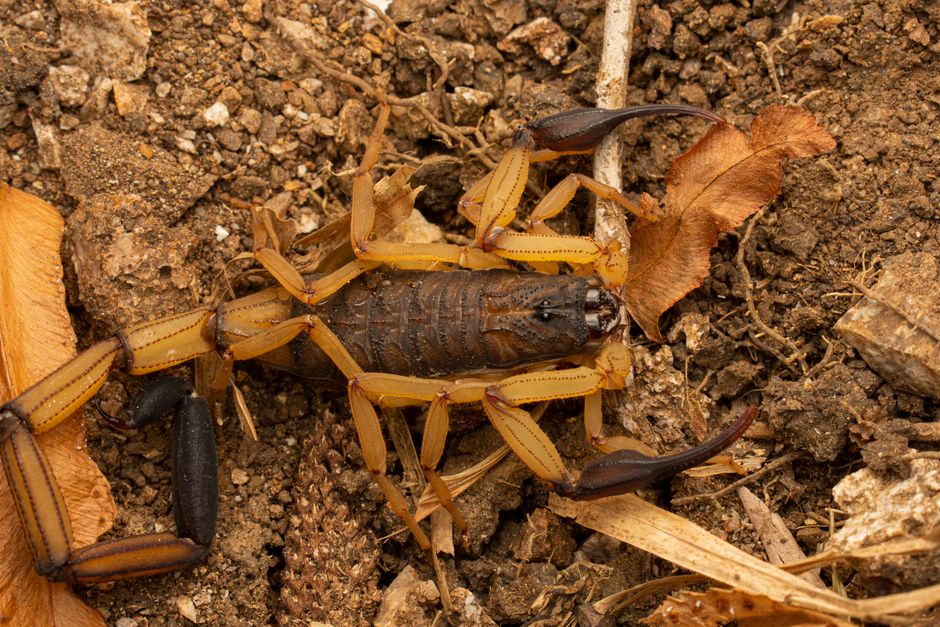
Scorpions have been on Earth for more than 400 million years, and in that time they have refined one of the most efficient chemical weapons in the animal kingdom. Their sting delivers a cocktail of neurotoxins that can hijack the nervous system, and a small number of species can produce effects serious enough to threaten human life. The danger comes down to two things: how the venom works at the level of nerve cells, and how much venom actually reaches the bloodstream.
Why Are Scorpions Dangerous The Science Of Their Venom?
Scorpion venom is a mixture of many compounds, but the dangerous part is a group of small proteins called neurotoxins. These proteins target ion channels — tiny pores in nerve and muscle cells that control electrical signals.
When a neurotoxin binds to these channels, it disrupts the normal flow of sodium or potassium ions. That disruption can cause nerves to fire repeatedly or to stop firing altogether. The result is a cascade of symptoms that can affect the heart, lungs, and skeletal muscles.
Not all scorpion venoms work the same way. Different species produce different toxin blends, which is one reason why a sting from one scorpion may cause only local pain while another can be life-threatening. The venom is also used primarily for defense and for subduing prey, so the amount injected varies with the situation.
How Does Scorpion Venom Affect The Human Body?
The effects of a scorpion sting depend on the species, the amount of venom injected, and the person’s age and health. Most stings cause pain, tingling, and swelling at the site. That is the body’s local reaction to the venom and the puncture itself.
When venom enters the bloodstream in significant amounts, it can affect the autonomic nervous system — the part that controls involuntary functions like heart rate, blood pressure, and sweating. This can lead to a racing heart, high blood pressure, sweating, and agitation. In severe cases, the venom can interfere with the heart’s electrical rhythm and with breathing.
Children are generally at higher risk of serious outcomes than adults. Their smaller body mass means a given amount of venom is a larger dose relative to their size. This is a well-established pattern in clinical reports of scorpion stings.
The most dangerous scorpion species belong to the family Buthidae. This family includes the deathstalker scorpion found in North Africa and the Middle East, and several Centruroides species found in parts of Mexico and the southwestern United States. Even within these groups, most stings do not cause severe illness, but the potential is real.
What Are The Symptoms Of A Dangerous Scorpion Sting?
Mild stings typically cause immediate pain, numbness, and a sensation of tingling or burning around the sting site. These symptoms usually stay local and improve over hours to a few days.
More serious envenomation can produce symptoms that go beyond the sting site. These include:
- Muscle twitching, spasms, or involuntary jerking movements
- Rapid heart rate or irregular heartbeat
- Difficulty breathing or a feeling of tightness in the chest
- Excessive salivation, tearing, or sweating
- Nausea, vomiting, or abdominal pain
- Restlessness, agitation, or confusion
- High blood pressure followed by a drop in blood pressure
The timeline matters. Severe symptoms usually appear within minutes to a few hours after the sting. If someone develops trouble breathing, muscle spasms that do not stop, or signs of heart rhythm problems, that is a medical emergency.
One thing that is often misunderstood: the severity of pain at the sting site does not reliably predict how serious the envenomation will become. A sting that seems minor at first can progress. This is why monitoring for a few hours is important, especially in children.





Which Scorpions Are The Most Dangerous?
Out of roughly 2,000 known scorpion species, only a small fraction are considered dangerous to humans. The ones that matter most belong to the Buthidae family.
The deathstalker (Leiurus quinquestriatus) is widely considered one of the most dangerous. It is found in desert regions of North Africa and the Middle East. Its venom is a potent mix of neurotoxins that can cause severe cardiovascular and respiratory effects.
In the United States, the most medically significant species is the Arizona bark scorpion (Centruroides sculpturatus), found in Arizona and parts of neighboring states. Its sting can cause severe pain and neurological symptoms, particularly in children, though deaths are rare with modern medical care.
In Mexico, several Centruroides species are responsible for a significant number of stings each year. In parts of South America, Africa, and India, other species in the Buthidae family also cause serious illness.
A useful rule that is often repeated: scorpions with thick, bulky pincers tend to rely more on crushing prey and have less potent venom, while those with slender pincers tend to have more potent venom. This is a general pattern, not a guarantee, and it should not be used to identify a scorpion in an emergency.
How Is A Scorpion Sting Treated?
Treatment depends on how severe the symptoms are. For mild stings, care focuses on pain relief and cleaning the wound. Over-the-counter pain relievers and cold compresses are commonly used. Some clinicians recommend keeping the affected limb still and at about heart level.
For moderate to severe envenomation, hospital care is needed. Supportive treatment may include intravenous fluids, medications to control pain and agitation, and monitoring of heart rhythm and breathing. In some countries, antivenom is available for specific scorpion species.
Antivenom is not a universal treatment. It is species-specific, and its availability varies widely by region. In the United States, antivenom for scorpion stings has been used in severe pediatric cases, but it is not stocked everywhere. Whether to use it is a decision made by treating clinicians based on the severity of symptoms and the species involved.
What you should not do: do not cut the sting site, do not try to suck out the venom, and do not apply a tight tourniquet. These approaches are not supported by evidence and can cause additional harm. Do not give alcohol or sedatives to someone with a scorpion sting.
How Can You Reduce Your Risk?
Scorpions are most active at night and tend to hide in dark, cool places during the day. In areas where they are common, shaking out shoes, clothing, and bedding before use is a practical step. Wearing closed shoes outdoors at night reduces exposure.
Inside the home, sealing cracks and gaps around doors and windows helps keep them out. Removing piles of debris, wood, and rocks near the house reduces hiding spots. Ultraviolet blacklights can make scorpions easier to spot at night because their exoskeleton fluoresces under UV light — a useful tool in regions where they are common.
If you are stung, the priority is to watch for signs that the venom is affecting the whole body. Local pain alone is usually not an emergency. But muscle spasms, breathing difficulty, or heart symptoms require immediate medical attention.
There is no vaccine or preventive medication for scorpion stings. Avoidance and prompt medical care when symptoms are severe are the main strategies.
Frequently Asked Questions
Are all scorpions dangerous to humans?
No. Only a small number of the roughly 2,000 scorpion species are considered medically dangerous to humans. Most stings cause pain and local symptoms but are not life-threatening.
What should I do immediately after a scorpion sting?
Clean the area, apply a cold compress, and take a pain reliever if needed. Watch for symptoms like muscle spasms, trouble breathing, or heart palpitations, and seek emergency care if any appear.
Can a scorpion sting kill you?
Deaths from scorpion stings are rare, especially in regions with access to modern medical care. The risk is higher for children, older adults, and people with heart or lung conditions.
Is there antivenom for scorpion stings?
Antivenom exists for some scorpion species, but it is not available everywhere and is not used for every sting. Whether it is given depends on the severity of symptoms and the species involved.
