
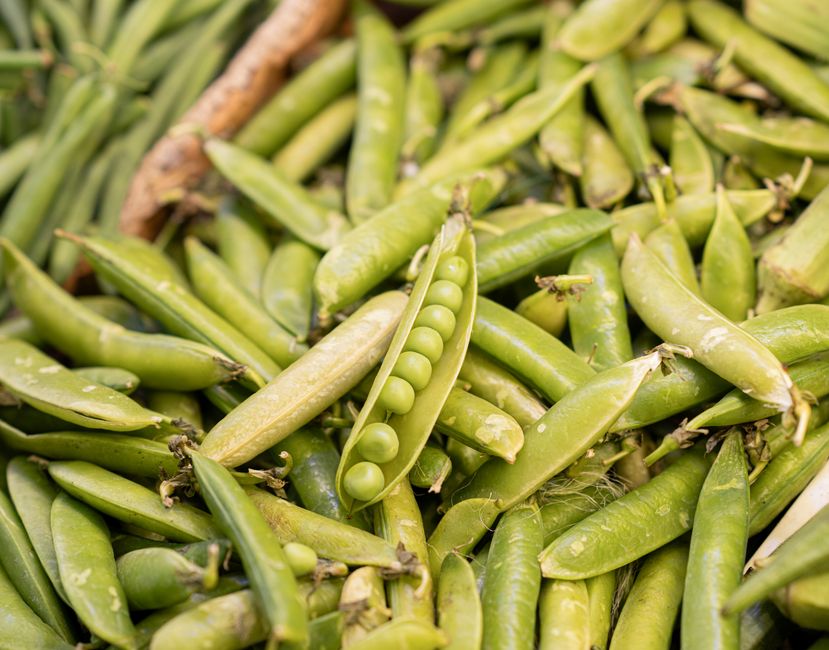
Gregor Mendel published his work on pea plants in 1866. It was largely ignored for about 34 years. Then, in 1900, three separate researchers rediscovered his findings and the science of genetics was born. The reason his experiments worked so well comes down to the plant itself.
Peas are a good model for studying heredity because they have distinct, easy-to-track traits, they normally self-pollinate but can be cross-pollinated by hand, they grow quickly, and they produce many offspring. These features let Mendel control which plants bred with which and count results across thousands of plants. That combination of control and large numbers is what made the underlying patterns of inheritance visible.
Why Are Peas A Good Model For Studying Heredity?
Mendel needed an organism where he could see clear differences between traits and control exactly which plants mated. Pea plants gave him both. He tracked seven traits, each with two obvious forms: round versus wrinkled seeds, yellow versus green seeds, purple versus white flowers, inflated versus constricted pods, green versus yellow unripe pods, axial versus terminal flower position, and tall versus short stems. There was no guessing where one form ended and the other began.
The second advantage was control over reproduction. Pea flowers have both male and female parts and normally self-pollinate. That means a pea plant usually fertilizes itself, so its offspring are highly inbred and genetically uniform. Mendel could also open a flower by hand, remove the male parts before they released pollen, and dust on pollen from a different plant. This let him set up crosses with precision.
The third advantage was volume. Pea plants grow in a single season and produce many seeds. Mendel could run the same cross across thousands of plants and count the results. Large numbers matter because inheritance involves chance. Small samples can mislead. Counting across many plants is what let the patterns emerge from the noise.
What Did Mendel Actually Discover Using Peas?
Mendel found that traits are passed down in discrete units, not blended together. Before his work, a common assumption was that offspring were a smooth mix of their parents, like paint. Peas showed something different. When he crossed a round-seeded plant with a wrinkled-seeded plant, the first generation was all round. No blending.
Then he let that first generation self-pollinate. In the next generation, wrinkled seeds reappeared. The trait had not been lost. It had been hidden in the first generation and came back in the second.
Mendel described this using terms we still use today. Each plant carries two copies of a factor for a trait. One copy comes from each parent. When the two copies differ, one version can mask the other. The masking version is now called dominant. The hidden version is called recessive. A plant only shows a recessive trait when it carries two recessive copies.
He also proposed that the two copies separate when sex cells form, so each sex cell carries only one copy. This is now called the law of segregation. He further found that different traits were inherited independently of each other, now called the law of independent assortment. Both principles were later confirmed at the level of chromosomes and genes.
Why Did Mendel’s Choice Of Seven Traits Matter So Much?
The seven traits he picked happened to sit on different chromosomes or far apart on the same one. That mattered enormously. If two traits are close together on the same chromosome, they tend to be inherited together rather than independently. Had Mendel chosen traits that were tightly linked, his results would have looked messy and the clean ratios might not have appeared.
This is a point worth pausing on. Mendel’s success was partly skill and partly luck. He designed careful experiments, but he also happened to choose traits that behaved independently. A different set of traits could have obscured the very patterns he was trying to find.
His ratios came out close to predictable values. In a cross of two plants that each carry one dominant and one recessive copy, the second generation shows roughly a 3 to 1 ratio of dominant to recessive forms. When tracking two traits at once, the ratio is roughly 9 to 3 to 3 to 1. These are the patterns that follow from the rules of segregation and independent assortment.
How Do Peas Compare To Other Organisms Used In Genetics?
Peas were ideal for Mendel’s question, but they are not ideal for every question. Different organisms suit different problems. The table below compares some common model organisms on the features that matter for genetic study.
| Organism | Generation time | Offspring number | Key strength |
|---|---|---|---|
| Pea plant | One growing season | Many seeds per plant | Clear traits, easy hand-crossing |
| Fruit fly | About two weeks | Hundreds per mating | Fast breeding, small chromosomes |
| Bacterium | Minutes to hours | Very large numbers | Rapid reproduction, simple genome |
| Mouse | A few months | Several per litter | Similar biology to humans |
The fruit fly became central to genetics in the early 1900s because it breeds fast and has visible chromosome features under a microscope. Bacteria let researchers study genes at the molecular level because they multiply quickly and are simple. Mice are used when a question needs a mammal. Peas remain a teaching tool because their traits are so easy to see and the experiments are so clean.
Why Are Peas Still Used To Teach Genetics Today?
Peas persist in classrooms for practical reasons. The traits are visible without equipment. A student can look at a seed and tell round from wrinkled. The crosses follow predictable ratios that can be worked out on paper and then checked in a garden or greenhouse. The timeline fits a school term.
There is also a historical value. Learning genetics through peas connects students directly to the experiments that started the field. The same logic Mendel used — control the cross, count the offspring, look for patterns — is the logic behind modern genetic studies, just with more advanced tools.
One clarification worth making: Mendel did not know about DNA, genes, or chromosomes. He worked entirely from observable traits and the numbers he counted. His “factors” were an abstract idea. It took decades and the work of many other scientists to connect those factors to physical structures inside cells. The fact that his abstract rules matched real biology so well is part of why his work endured.
What Are The Limits Of Peas As A Genetic Model?
Peas cannot answer every genetic question. They have a relatively long generation time compared to bacteria or fruit flies, which slows down experiments that need many generations. Their genome is large and complex compared to some model organisms. And some traits are influenced by many genes or by the environment, which peas are not well suited to untangle.
Peas also cannot model human-specific diseases or behaviors. For those questions, researchers use other systems. The value of peas is specific: they are excellent for demonstrating the basic rules of inheritance in a clear, countable way. They are not a universal tool.
It is also worth noting that not all inheritance follows Mendel’s simple rules. Some traits are controlled by many genes at once. Some genes are linked. Some traits depend on which parent passed on a gene, a phenomenon called imprinting. Mendel’s rules describe a core set of patterns, not the full picture. Later discoveries added layers of complexity he could not have seen.
How Did Mendel’s Pea Experiments Change Science?
Mendel’s work turned inheritance from a mystery into a measurable process. Before him, people knew traits ran in families but had no framework for how. After his work was rediscovered, researchers had testable rules they could apply and check. Those rules became the foundation of genetics.
The impact reached far beyond agriculture. Understanding how traits pass down is central to medicine, evolutionary biology, and modern crop breeding. When researchers trace a genetic disorder through a family, they are using logic that traces back to counting pea plants in a monastery garden.
Mendel’s story also carries a lesson about evidence. His conclusions were based on thousands of counted plants, not on a few observations. That insistence on large numbers and clear records is a standard that still defines good genetic research. The peas worked because the method was sound.
Frequently Asked Questions
Why did Mendel choose pea plants for his experiments?
Pea plants have clear, contrasting traits that are easy to tell apart and they can be cross-pollinated by hand. They also grow quickly and produce many offspring, which let Mendel count results across thousands of plants.
What are the seven traits Mendel studied in peas?
He studied seed shape, seed color, flower color, pod shape, unripe pod color, flower position, and stem length. Each trait had two distinct forms, such as round versus wrinkled seeds.
Why are peas still used to teach genetics?
Their traits are visible without special equipment and their crosses follow predictable ratios that students can calculate and then observe. The experiments also fit within a single growing season.
What is the main limitation of using peas to study heredity?
Peas have a relatively long generation time compared to organisms like bacteria or fruit flies, which slows experiments needing many generations. They also cannot model human-specific diseases or traits controlled by many genes.
