
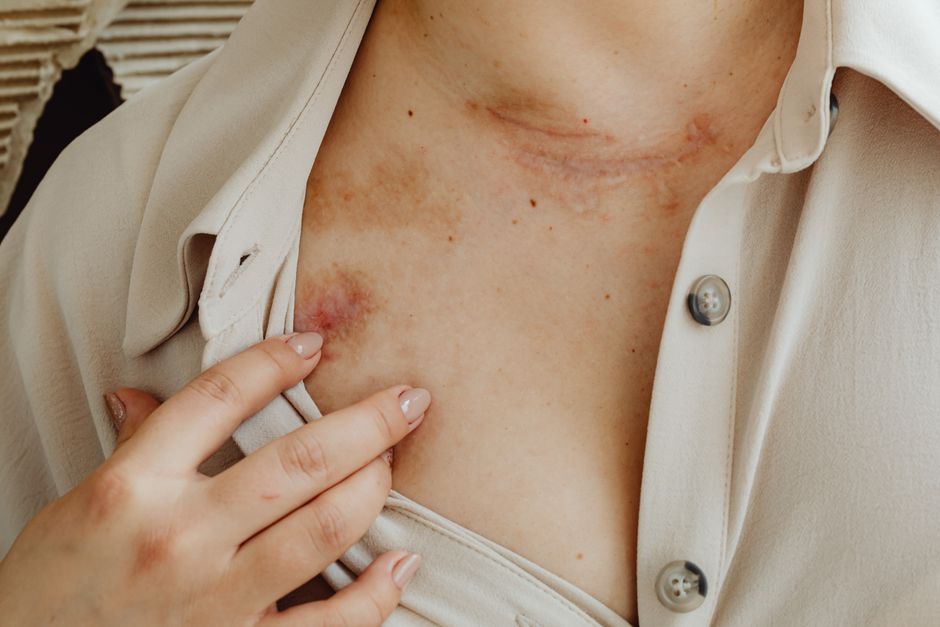
If you have noticed that minor cuts, scrapes, or bug bites are leaving marks that stick around far longer than they used to, the reason usually comes down to how your skin heals. Scarring easily is not a sign of weak skin. It reflects a mix of genetics, age, skin tone, hormones, and how your body builds and breaks down collagen. In most cases, the tendency is normal. In some cases, it points to a health condition worth checking.
Why Am I Scarring So Easily?
Scars form when the deeper layer of skin, the dermis, is damaged. The body cannot rebuild that layer exactly as it was. Instead, it lays down collagen to close the wound fast. That collagen patch is a scar. The faster and thicker the patch, the more visible the mark.
Whether a wound leaves a lasting scar depends on several things at once. Depth of injury matters most. A scrape that only touches the surface rarely scars. A cut that reaches the dermis almost always does. Wound care, infection, and the amount of tension across the wound also change the outcome.
Some people simply produce more collagen in response to injury. Others produce less, or break it down faster. This is why two people with the same cut can heal with very different marks. The difference is not effort or hygiene. It is biology.
What Are the Main Root Causes of Easier Scarring?
Most easy scarring traces back to one or more of a small set of factors. Understanding which ones apply to you helps you know what is worth addressing and what is not.
Genetics
Your genetic makeup strongly shapes how your skin responds to injury. Some families produce raised, thick scars. Others produce flat, pale ones. If a parent or sibling scars heavily, you likely will too. This is one of the strongest predictors and also one of the hardest to change.
Skin Tone
People with darker skin tones are more prone to two specific problems. One is hyperpigmentation, where the healed area stays darker than the surrounding skin. The other is keloid formation, where scar tissue grows beyond the original wound. This is not a sign of poor healing. It reflects differences in how melanin-producing cells and collagen-producing cells respond to inflammation.
Age
Skin changes with age. Collagen production slows, the skin thins, and elasticity drops. Older skin heals more slowly and can scar differently than younger skin. Interestingly, very young skin is not automatically better. Children and teenagers often scar more prominently than adults, partly because their collagen turnover is more active.
Hormones
Hormonal shifts can affect scar formation. Pregnancy, puberty, and some hormonal conditions change how skin responds to injury and inflammation. This is one reason scarring patterns can change at different life stages without any obvious change in behavior.
What Health Conditions Make You Scar More Easily?
Sometimes easy scarring is a signal of an underlying condition. This is worth taking seriously, but it is also less common than the everyday causes above.
Conditions that affect connective tissue can change how skin heals and how much it stretches. Some of these conditions are inherited and affect collagen throughout the body, not just the skin. A doctor may consider them if easy scarring comes with other signs, such as unusually stretchy skin, joint problems, or a family history of similar issues.
Poorly controlled blood sugar is another factor. Elevated blood glucose can impair wound healing and raise the risk of infection, which in turn worsens scarring. If you notice that cuts are healing slowly, getting infected often, or leaving worse marks than before, that pattern is worth mentioning to a clinician.
Nutritional status also plays a role. The body needs adequate protein, vitamin C, and zinc to build collagen and repair tissue. A genuine deficiency in any of these can slow healing. Mild shortfalls are common but usually do not cause dramatic scarring on their own.





What Causes Raised or Dark Scars Specifically?
Not all scars look the same, and the type tells you something about the cause.
- Keloids grow beyond the original wound and can keep expanding for months. They are more common in darker skin tones and in certain body areas such as the chest, shoulders, and earlobes.
- Hypertrophic scars stay within the wound boundaries but are raised and often red. They tend to improve over time more than keloids do.
- Hyperpigmentation is a color change rather than a raised bump. It happens when inflammation triggers extra melanin at the healing site. It is especially common after acne, insect bites, and eczema.
- Atrophic scars are sunken. They form when too little collagen is laid down, which is typical of some acne scars and chickenpox marks.
The key difference is whether the body overbuilt collagen, underbuilt it, or simply left a color mark. Each type responds differently to treatment, so identifying which one you have matters before trying anything.
Why Do Some Wounds Scar More Than Others?
Where and how a wound happens often matters as much as your biology.
| Factor | Effect on Scarring |
|---|---|
| Wound depth | Deeper wounds reaching the dermis scar more |
| Infection | Increases inflammation and worsens the final mark |
| Skin tension | Areas that pull, like the chest and joints, scar more |
| Sun exposure | Darkens healing skin and can make marks permanent |
| Picking or scratching | Reopens the wound and adds inflammation |
Tension is a factor many people overlook. Skin that is constantly stretched, such as over the shoulder or across the chest, heals under mechanical stress. That stress signals the body to lay down more collagen, which produces a thicker scar.
Can You Reduce How Easily You Scar?
You cannot change your genetics, but you can change how a wound heals. Good wound care is the most reliable lever you have.
Keep wounds clean and covered while they heal. Avoid picking at scabs, which reopens the wound and adds inflammation. Protect healing skin from the sun, since ultraviolet exposure can darken a fresh scar and make it more noticeable. Once a wound has closed, some clinicians recommend silicone gel or sheeting to help flatten and soften scars, though results vary and are not dramatic for everyone.
For existing scars, options include silicone products, pressure therapy, steroid injections, and laser treatments. These are typically handled by a dermatologist. No single approach works for every scar type, and results depend heavily on the kind of scar and how old it is.
If you have a condition that affects healing, such as poorly controlled diabetes, managing that condition is more important than any topical product. Healing starts from the inside.
When Should You See a Doctor About Scarring?
Most easy scarring is not dangerous. But certain patterns deserve a medical look.
See a clinician if scars keep growing long after the wound has healed, if a scar becomes painful or itchy, or if you notice that wounds are healing unusually slowly or getting infected often. Slow healing combined with easy scarring can point to an underlying issue such as a blood sugar problem or a nutritional deficiency.
Also worth checking: a sudden change in how your skin scars when nothing else has changed. A shift like that can reflect a new health issue rather than a permanent trait.
Frequently Asked Questions
Why am I scarring so easily all of a sudden?
A sudden change in scarring often points to something new, such as slower wound healing, a hormonal shift, or an underlying condition like poorly controlled blood sugar. It is worth mentioning to a doctor if the change is noticeable and persistent.
Is easy scarring a sign of a health problem?
Usually not. Most easy scarring comes down to genetics, skin tone, and age. It is more likely to signal a health issue when it comes with slow healing, frequent infections, or other symptoms.
Why do my scars stay dark for so long?
Dark marks after healing are usually post-inflammatory hyperpigmentation, where inflammation triggers extra melanin at the site. This is more common in darker skin tones and can fade slowly over months, especially with sun protection.
Can I stop myself from scarring easily?
You cannot change your genetics, but good wound care, avoiding picking, and protecting healing skin from the sun can reduce how noticeable a scar becomes. Some clinicians also recommend silicone products once a wound has closed.
