
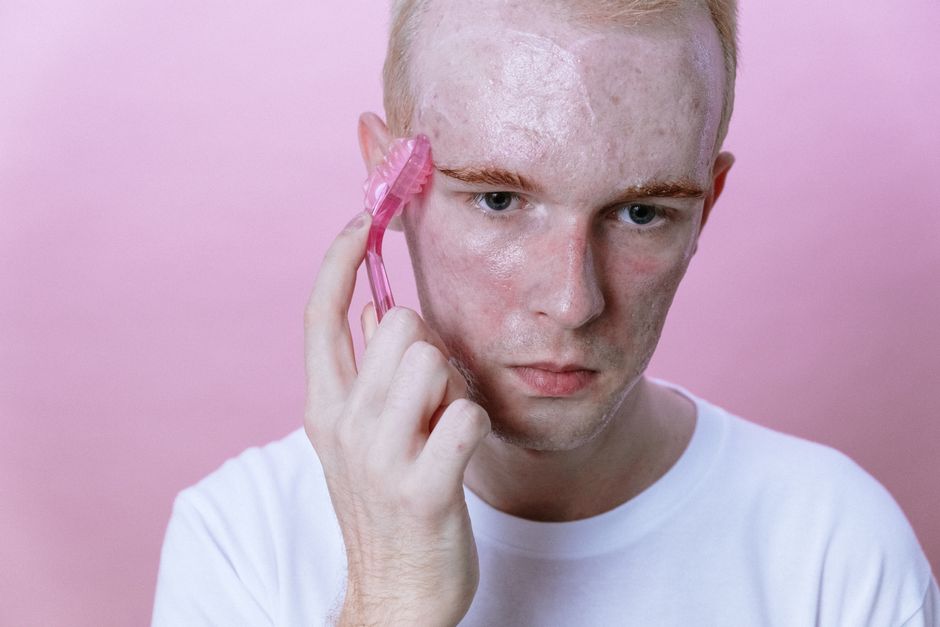
Acne in your 30s as a man is not a hygiene problem or a sign that something is wrong with your diet. It happens because sebaceous glands in your skin are still responding to androgens — mainly testosterone and its more potent byproduct, DHT — and that hormonal signaling does not switch off at 25. Adult male acne is common, and it has specific drivers that differ from the teenage version.
The short answer: your oil glands are still hormonally active, your pores still clog the same way they did at 17, and a few adult-specific factors — stress, certain medications, shaving irritation, and in some cases low or fluctuating testosterone — can keep breakouts going. It is not “just stress” and it is not a phase. It has a mechanism, and understanding it changes what is worth trying.
Why Am I Getting Acne In My 30S As A Man?
Acne requires four things to happen at once: excess sebum (oil), dead skin cells that do not shed normally, a bacterium called Cutibacterium acnes that lives in the follicle, and inflammation. In adult men, the first driver — sebum — is the one that stays switched on.
Sebaceous glands have androgen receptors. When testosterone and DHT bind those receptors, the glands enlarge and produce more oil. This is why acne is nearly universal in puberty and why it can persist well past it in men who remain hormonally responsive. The gland does not know you are 34.
What changes with age is not the mechanism but the context. Adult male acne tends to cluster differently than teen acne. It shows up more on the jawline, chin, lower cheeks, and sometimes the back and shoulders, rather than the forehead and nose. It also tends to be more inflammatory — deeper, redder, slower to heal — and it often leaves marks that linger longer than they did when you were younger.
There is a useful distinction here that gets lost in most acne advice. Teen acne is largely driven by the hormonal surge of puberty acting on a newly active system. Adult acne in men is driven by the same hormones acting on a system that has already been sensitized — sometimes for years. That difference matters because it explains why a routine that worked at 18 may do nothing at 35.
Is It Really Acne, Or Something Else?
Not every bump on an adult man’s face is acne. Several conditions look similar and are treated differently, and getting this wrong wastes months.
- Folliculitis — inflamed hair follicles, often from shaving, sweating, or friction. Tends to be uniform small red bumps in shaved areas.
- Rosacea — redness, flushing, and small bumps, usually without blackheads or whiteheads. More common in fair-skinned adults.
- Keratosis pilaris — rough, small bumps, often on upper arms and sometimes the face. Not inflammatory acne.
- Seborrheic dermatitis — flaky, greasy patches, often along the hairline and eyebrows. Sometimes confused with acne along the T-zone.
- Fungal acne (malassezia folliculitis) — itchy, uniform bumps, often on the chest and back, that do not respond to standard acne treatment.
True acne has comedones — blackheads and whiteheads — as its defining feature. If you have no comedones and only uniform red bumps, the diagnosis may be something else. A dermatologist can usually tell the difference in a single visit. This is worth doing if standard acne treatment has failed.
What Actually Triggers Adult Male Acne?
Several factors genuinely drive adult male breakouts. Others are widely repeated but poorly supported.
Androgens. This is the core driver. Testosterone and DHT stimulate sebum production. Men with higher androgen activity tend to have more active oil glands. This is biology, not a lifestyle failure.
Stress. Psychological stress raises cortisol, which can increase sebum production and inflammation. The relationship is real but modest — stress worsens acne, it does not create it from nothing.
Medications. Some prescription drugs can trigger or worsen acne. These include certain corticosteroids, some anticonvulsants, lithium, and anabolic steroids. If acne appeared or worsened after starting a medication, that timing is worth mentioning to your doctor.
Anabolic steroid use. This is a well-documented and often underdiscussed cause of severe adult male acne. Exogenous androgens drive sebum production hard, and the acne can be severe and resistant to standard treatment.
Shaving and friction. Razor irritation, tight collars, helmets, and backpacks can all mechanically worsen acne in the areas they contact.
Testosterone therapy. Men on testosterone replacement can develop or worsen acne, particularly in the first months of treatment. This is a recognized side effect and worth discussing with the prescribing clinician.
What about diet? The evidence here is mixed and often overstated. Some studies suggest high-glycemic diets and dairy — particularly skim milk — may be associated with acne in some people. The effect sizes are generally small, and the studies are mostly observational, meaning they cannot prove cause. Cutting dairy is not a guaranteed fix, and the evidence does not support presenting it as one.
Does Low Testosterone Cause Acne?
Low testosterone does not typically cause acne. High or fluctuating androgens do. This is a common point of confusion because both “hormonal imbalance” and “testosterone” get used loosely in acne discussions.
That said, hormonal fluctuations can matter. If testosterone levels swing — from stopping and starting therapy, from significant weight change, from sleep disruption, or from certain medical conditions — the change itself can trigger breakouts in some men. The absolute level matters less than the direction and speed of change.
If you suspect a hormonal issue, the right move is a blood test ordered by a clinician, not self-diagnosis. Acne alone is not a reliable sign of low testosterone, and treating it as one can send you down the wrong path.
What Actually Helps Adult Male Acne?
Treatment depends on severity, but the evidence base is reasonably clear for the main options.
Topical retinoids (such as tretinoin, adapalene, or tazarotene) are considered first-line for most acne. They normalize how skin cells shed inside the follicle, which addresses one of the four root causes. They take 8 to 12 weeks to show full effect and can cause irritation early on.
Benzoyl peroxide reduces C. acnes and has mild anti-inflammatory effects. It is available over the counter and is one of the better-supported non-prescription options. It can bleach fabrics.
Topical antibiotics (such as clindamycin) are often combined with benzoyl peroxide to reduce bacterial resistance. Used alone, resistance develops quickly.
Oral antibiotics (such as doxycycline) may be prescribed for moderate to severe inflammatory acne. They are typically used for a limited course, not indefinitely.
Isotretinoin is the most effective treatment for severe or treatment-resistant acne. It requires medical supervision and monitoring because of its side effect profile, including effects on liver enzymes, blood lipids, and mood. It is not a casual option, but for some men it is the one that finally works.
Spironolactone is sometimes used in women but is not standard for men because of hormonal side effects. This is worth knowing if you have read about it as a general acne treatment.
What does not have strong evidence: most “detox” products, LED masks marketed for acne (evidence is limited and mixed), and dietary elimination strategies presented as universal fixes. Some people do respond to dietary changes, but the effect is individual and generally modest.
What About Skincare And Shaving?
A simple, consistent routine beats a complicated one. For adult male acne, the goal is to reduce irritation and support whatever treatment you are using.
- Wash with a gentle, non-comedogenic cleanser twice daily. Overwashing makes acne worse.
- Use a non-comedogenic moisturizer. Dry skin produces more oil, not less.
- Use a clean razor and shave with the grain. Consider a single-blade or electric razor if traditional razors irritate.
- Change pillowcases regularly and clean anything that contacts your face — phone, helmet straps, hats.
- Do not pick or squeeze. It increases inflammation and scarring risk.
Sunscreen matters, especially if you are using a retinoid, because retinoids increase sun sensitivity. Choose a non-comedogenic formula.
When Should You See A Doctor?
See a dermatologist if acne is moderate to severe, if it is causing scarring, if it is affecting your confidence or mood, or if over-the-counter treatment has not worked after about three months of consistent use.
Also see a doctor if acne appeared suddenly and severely, if it is accompanied by other symptoms like fatigue or changes in libido or weight, or if you started a new medication shortly before the breakouts began. Those patterns can point to a cause that acne treatment alone will not fix.
Adult male acne is treatable. It is not something you have to accept as a permanent feature of your 30s, and it is not evidence that you are doing something wrong.
Frequently Asked Questions
Why am I getting acne in my 30s as a man?
Your sebaceous glands are still responding to androgens like testosterone and DHT, which drive oil production well past puberty. Adult male acne is common and has the same root mechanism as teen acne, just with different triggers and distribution.
Does testosterone cause acne in adult men?
Yes — androgens stimulate sebum production, which is a core driver of acne. Men on testosterone therapy or using anabolic steroids often see acne worsen, especially in the first months of treatment.
Can low testosterone cause acne?
No, low testosterone does not typically cause acne. High or fluctuating androgen levels do, and sudden hormonal shifts can trigger breakouts in some men.
How long does adult male acne take to clear with treatment?
Most topical treatments take 8 to 12 weeks to show full effect, and consistency matters more than speed. If there is no improvement after about three months of correct use, see a dermatologist.
