
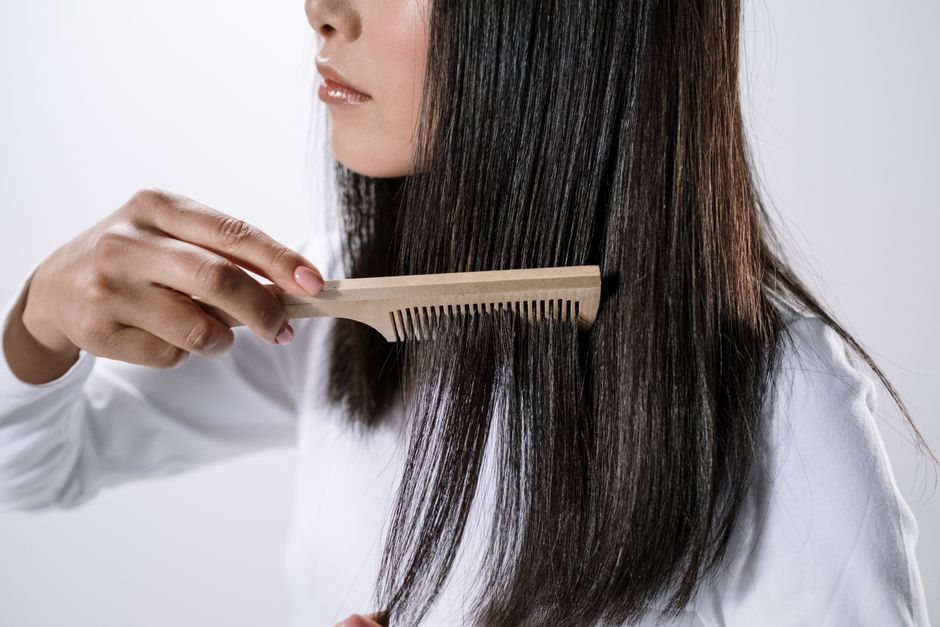
Straight hair comes from your genes, specifically the shape of the hair follicle you inherited from your parents. A straight hair follicle is round and symmetrical, which allows the hair shaft to grow straight out of the scalp. Your genetic code determines this follicle shape, and that code is passed down through generations, which is why straight hair often runs in families.
What Causes Hair to Be Straight Instead of Curly?
The shape of your hair follicle is the main physical factor. A round follicle produces straight hair. An oval or asymmetrical follicle produces wavy or curly hair. The more oval the follicle, the tighter the curl.
This is not just about the outside of the follicle. The way the hair shaft itself is built matters too. In straight hair, the keratin proteins inside the hair strand line up evenly. In curly hair, those proteins are distributed unevenly, which causes the strand to bend as it grows.
Scientists have identified several genes that influence this process. The most studied one is called the trichohyalin gene, often shortened to TCHH. This gene produces a protein that helps build the hair follicle. Variations in this gene are strongly linked to whether a person has straight or curly hair.
Which Genes Control Hair Texture?
Hair texture is not controlled by a single gene. It is a polygenic trait, meaning multiple genes work together to produce the final result. This is why two parents with curly hair can have a child with straight hair, and why siblings can have completely different hair textures.
Research published in the American Journal of Human Genetics identified several gene variants associated with hair texture. The TCHH gene showed the strongest link, but other genes like EDAR and FGFR2 also play a role. These genes influence not just hair shape but also hair thickness and how the hair grows from the follicle.
Your specific combination of these gene variants determines your hair type. Because so many genes are involved, predicting a child’s hair texture from the parents’ hair is not reliable. The genetic math simply does not work that way.
Is Straight Hair Dominant or Recessive?
This is a common question, and the answer is more complex than the old high school biology version. Straight hair is often described as a recessive trait, meaning you need two copies of the straight-hair gene variant to have straight hair. Curly hair is often described as dominant.
That simplified model works for some families, but it does not explain every case. Because hair texture involves multiple genes, the dominant-recessive pattern is not clean. A person can carry a curly-hair gene variant and a straight-hair gene variant and end up with wavy hair, which is a middle ground.
Some population studies suggest that straight hair is more common in certain ancestral groups, particularly East Asian and Northern European populations. But genetic variation within these groups is still significant. Hair texture is not a reliable marker of ethnicity or ancestry.
Does Hair Texture Change Over Time?
Yes, and this is where genetics meets environment. Your genes set the baseline, but hormones and aging can alter how those genes are expressed. Many people notice their hair gets finer or straighter as they age. Others find their hair becomes curlier after pregnancy or during menopause.
Hormonal shifts affect the hair follicle directly. Estrogen, testosterone, and thyroid hormones all influence follicle shape and hair growth cycles. When these hormone levels change, the follicle can produce a different hair texture temporarily or permanently.
This does not mean your genetics changed. Your DNA stays the same. But the way your body reads that DNA can shift with age and hormonal status. The result is that your hair at 50 may look very different from your hair at 20, even though your underlying genetic code is identical.
Why Do Some Families Have All Straight Hair?
When a family consistently produces straight-haired children, it usually means both parents carry the gene variants associated with straight hair. Since these variants are passed down, the trait appears generation after generation.
This pattern can make straight hair seem like a dominant trait in that family. But that is a family-specific observation, not a universal genetic rule. In another family, the same gene variants might be distributed differently, producing a mix of hair textures.
Genetic inheritance is about probability, not certainty. Each child receives one set of genes from each parent, and the combination is random. A family with all straight-haired children simply hit the same genetic combination repeatedly.
Can You Predict Your Child’s Hair Type?
No. There is no reliable way to predict a child’s hair texture before birth. Genetic testing can identify which variants a person carries, but the interaction between multiple genes makes prediction unreliable.
Some online tools claim to estimate hair type based on parental traits, but these are based on simplified models that do not reflect the true genetic complexity. They are entertainment, not science.
If you want to know what your child’s hair will look like, you will have to wait. The genes will do their work, and the follicle shape will develop according to the unique combination your child inherits. That combination is essentially a genetic lottery.
Does Hair Straightening Damage the Follicle?
Chemical straightening treatments and heat styling change the hair shaft, not the follicle. The follicle sits below the scalp surface, and most treatments only affect the visible hair strand. Once the treated hair grows out, new hair will grow in with your natural texture.
That said, improper use of heat tools can damage the hair shaft itself. High heat can break the protein bonds in the hair, leading to dryness, split ends, and breakage. This damage is cosmetic, not genetic. It does not change your underlying hair texture.
Some people worry that straightening treatments alter their genes and permanently change their hair. That is not accurate. Your genes and your follicle shape remain unchanged. The new hair that grows after treatment will match your natural texture.
Where Does Straight Hair Come From Genetically?
Straight hair comes from the specific combination of gene variants you inherited from both parents. The most influential gene is TCHH, which codes for a protein in the hair follicle. Variations in this gene affect whether the follicle is round or oval.
A round follicle produces a straight hair shaft. The keratin proteins in the shaft align evenly, and the hair grows straight out of the scalp. This is the physical mechanism behind straight hair.
Your ancestry matters only in the sense that certain gene variants are more common in certain populations. But straight hair appears across all ethnic groups. It is not exclusive to any one population, and no single gene guarantees straight hair.
The genetic story of straight hair is about follicle shape, protein alignment, and the combined effect of multiple genes. It is a well-studied area of human genetics, and the basic mechanism is clearly established.
Frequently Asked Questions
Can two curly-haired parents have a straight-haired child?
Yes. Because hair texture involves multiple genes, a child can inherit a combination that produces straight hair even if both parents have curly hair. Each parent carries two copies of each gene, and they can pass on the straight-hair variant without having straight hair themselves.
Is straight hair more common in certain populations?
Straight hair is more common in East Asian and Northern European populations, but it appears in all ethnic groups. The gene variants associated with straight hair exist worldwide, just at different frequencies.
Does hair texture change permanently after chemical straightening?
No. Chemical straightening affects only the existing hair shaft, not the follicle or your genes. New hair grows in with your natural texture once the treated hair is cut off.
Can you change your hair texture naturally?
Your genetic hair texture cannot be permanently changed without altering your DNA. Hormonal changes and aging can shift your natural texture over time, but no product can permanently change your follicle shape.
