
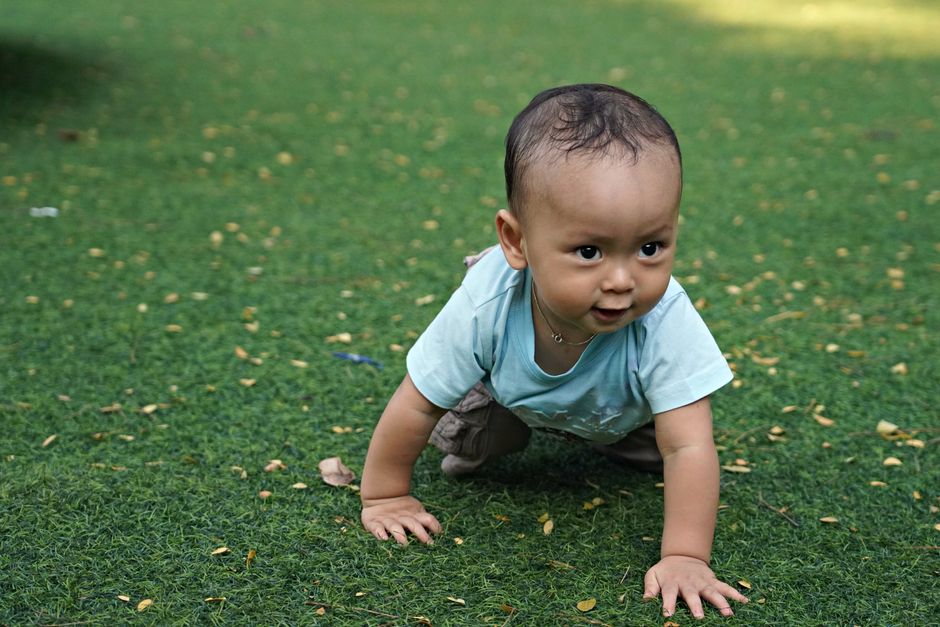
Most babies start crawling between 6 and 10 months of age. Some babies skip crawling entirely and go straight to pulling up and walking. Both paths are normal. Crawling is a milestone, but it is not a mandatory one. What matters most is that your baby is developing new motor skills over time and showing interest in moving independently.
When Should A Baby Crawl?
The typical window for crawling is 6 to 10 months. Many babies begin showing early signs of crawling around 7 months. These signs include rocking on hands and knees, pushing backward, or doing an army-style belly crawl.
By 9 months, most babies can get around in some way. That might be a classic hands-and-knees crawl, a bottom scoot, or a commando crawl using the forearms. By 12 months, many babies have moved on to pulling up and cruising along furniture.
Your baby’s exact style of crawling matters less than the fact that they are moving. Some babies never crawl on all fours. They may scoot on their bottom or roll across the room instead. These babies often walk right on schedule.
What Counts as Crawling?
Crawling is not one single movement. Pediatricians look at several different styles of mobility, and all of them can be considered normal.
- Classic crawl: Moving on hands and knees with the belly off the floor.
- Bear crawl: Moving on hands and feet with the legs straight and the bottom in the air.
- Commando crawl: Dragging the belly on the floor while pulling with the arms.
- Bottom scoot: Sitting and moving forward using the arms and legs.
- Rolling: Some babies get around mainly by rolling from place to place.
All of these count as independent mobility. The key is that your baby is learning to move their body intentionally. The style matters far less than the progress.
Why Do Some Babies Skip Crawling?
Some babies simply prefer other ways of moving. A baby who bottom scoots or pulls up early may never spend time on all fours. This is not a sign of a problem by itself.
Research has not found a strong link between skipping the crawling phase and later developmental issues. Many children who never crawl develop completely normally. The old idea that crawling is essential for brain development is not supported by solid evidence.
Crawling does build strength in the shoulders, arms, and core. It also helps with coordination. But babies who skip crawling still build these skills through other movements like pulling up, cruising, and eventually walking.





Signs Your Baby Might Crawl Soon
Before crawling happens, babies usually show readiness signs. Recognizing these can help you know what to expect.
- Tummy time comfort: Your baby can lift their head and chest off the floor during tummy time.
- Rocking: Your baby gets on hands and knees and rocks back and forth.
- Reaching: Your baby reaches for toys or objects just out of reach.
- Pivoting: Your baby turns their body while on their belly.
- Pushing backward: Many babies crawl backward before they figure out forward movement.
These signs usually appear between 5 and 8 months. Once your baby starts rocking on hands and knees, crawling often follows within a few weeks.
Pushing backward is common and can frustrate some babies. They reach for a toy and move away from it instead. This is a normal part of learning. Most babies figure out forward movement within a few weeks.
How to Encourage Crawling Safely
You cannot force a baby to crawl, but you can create conditions that make it more likely. The most important factor is floor time. Babies who spend plenty of time playing on the floor have more opportunities to practice movement.
Try these simple approaches:
- Daily tummy time: Start from birth with short sessions and build up to longer ones. By 6 months, aim for at least 30 minutes total across the day.
- Place toys just out of reach: This gives your baby a reason to move toward something interesting.
- Use a mirror: Many babies are motivated to move toward their own reflection.
- Get on the floor with your baby: Your face and voice are powerful motivators.
- Give barefoot time: Bare feet help babies grip the floor better than socks.
Limit time in containers like bouncy seats, swings, and baby walkers. Babies need unrestricted floor time to build the muscles and coordination for movement. The American Academy of Pediatrics recommends against baby walkers entirely because of injury risk.
When to Talk to Your Pediatrician
Every baby develops on their own timeline. But certain patterns warrant a conversation with your pediatrician.
Talk to your doctor if your baby shows any of these signs:
- Not showing any interest in moving by 9 months
- Not bearing weight on their legs by 9 months
- Unable to sit without support by 9 months
- Using only one side of the body to move
- Dragging one arm or leg while moving
- Showing strong stiffness or floppiness in the arms or legs
These signs do not mean something is wrong. They mean a professional should take a look. Early intervention services can help babies who need extra support with motor development. Pediatricians can also check for vision problems or other issues that might affect movement.
Low muscle tone is one reason some babies move later. This is not a diagnosis on its own. A pediatrician or pediatric physical therapist can assess whether your baby’s muscle tone is within a typical range.
What Happens After Crawling?
Crawling usually leads to pulling up. Between 8 and 12 months, most babies start pulling themselves to standing using furniture. From there, they begin cruising — walking sideways while holding onto furniture.
Independent walking typically follows between 9 and 15 months. Some babies walk as early as 9 months. Others wait until 16 or 17 months. Both are within the normal range.
If your baby skipped crawling, they may still follow the same sequence of pulling up and cruising. Or they may simply stand up one day and start walking. The progression looks different for every child.
Once your baby is mobile, childproofing becomes urgent. Get down to floor level and look for hazards. Cover electrical outlets, secure furniture to walls, and remove small objects that could be choking hazards. Stairs need gates at both the top and bottom.
Common Myths About Crawling
Several myths about crawling circulate among parents. Knowing what the evidence actually shows can reduce unnecessary worry.
Myth: Babies must crawl before they walk. Many babies skip crawling and walk normally. There is no evidence that crawling is a required step for walking.
Myth: Crawling is required for reading readiness. Some older theories claimed crawling builds neural pathways needed for reading. Research has not confirmed this link. Children who crawled, skipped crawling, or bottom scooted all learn to read at similar rates.
Myth: Late crawling means a developmental delay. Crawling at 11 months is not automatically concerning if other motor skills are progressing. The pattern of development matters more than any single milestone date.
Myth: Baby walkers help babies learn to walk. Baby walkers do not teach walking. They may actually delay it by limiting floor time. They also cause thousands of emergency room visits each year in the United States.
Frequently Asked Questions
Is it normal for a baby not to crawl at 9 months?
Yes, some babies do not crawl by 9 months and still develop normally. Talk to your pediatrician if your baby also shows no interest in moving or cannot sit without support.
What is the latest age a baby should start crawling?
Most babies crawl between 6 and 10 months, but some start as late as 12 months. If your baby is not showing any interest in mobility by 9 months, it is worth mentioning to your pediatrician.
Can a baby skip crawling and go straight to walking?
Yes, many babies skip crawling entirely and walk normally. Research has not found that skipping crawling causes developmental problems.
Should I worry if my baby crawls backward instead of forward?
No, backward crawling is a normal early stage. Most babies figure out forward movement within a few weeks of practice.
