
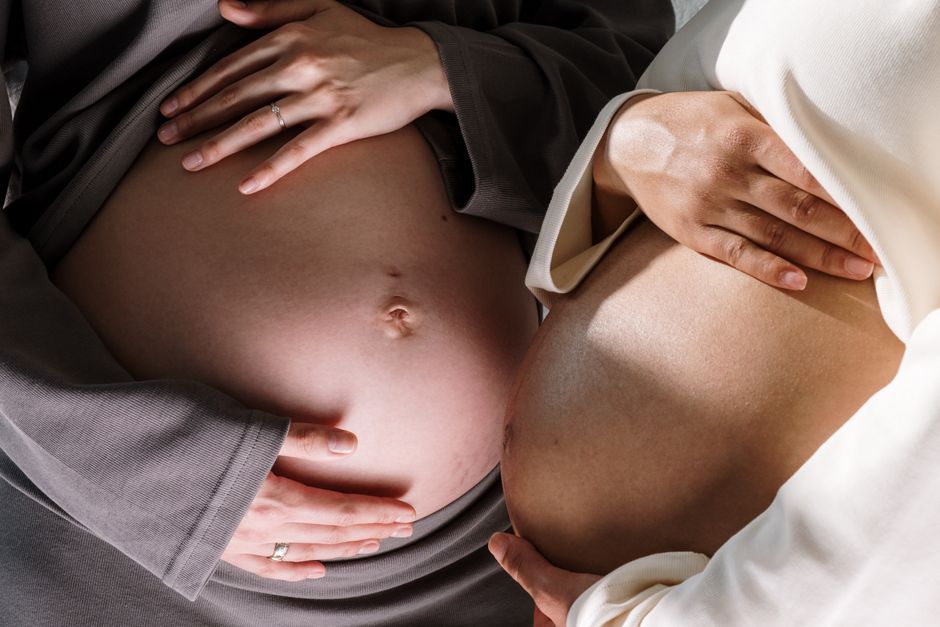
Most women start to show between 12 and 16 weeks of pregnancy. For first-time mothers, it often happens closer to 16 weeks. For women who have been pregnant before, it can happen earlier, sometimes around 10 to 12 weeks. Your belly may not look round at first. Early on, it often looks more like mild bloating or weight gain than a distinct baby bump.
Why Does It Happen at Different Times for Different Women?
There is no single week when every woman starts to show. The timing depends on several physical factors, not on the health of your baby.
Your body type plays a large role. Women with shorter torsos often show earlier because the uterus has less vertical space and must push forward. Women with longer torsos may show later because the baby has more room to grow upward before the belly visibly protrudes.
Abdominal muscle tone also matters. Stronger, tighter abdominal muscles hold the uterus in longer. Weaker or more relaxed muscles allow the uterus to push outward sooner. This is why many athletes and first-time mothers show later, while women who have had previous pregnancies often show earlier.
Weight before pregnancy influences the timeline as well. Women with a lower starting body weight may notice a bump sooner. Women with more abdominal fat may not notice the change until the uterus grows large enough to push past that layer.
What Is Happening Inside During the First Trimester?
Your uterus is a pear-shaped organ that normally sits deep inside your pelvis. During the first 12 weeks, it is still mostly contained within the pelvic bones. This is why most women do not have a true baby bump during the first trimester.
At around week 12, the top of the uterus, called the fundus, begins to rise above the pubic bone. From this point forward, the uterus grows upward into the abdominal cavity. This is the anatomical change that makes a visible bump possible.
If you notice your clothes feeling tight before week 12, that is usually bloating, not the baby. Pregnancy hormones slow digestion, which causes gas and water retention. This can make your lower abdomen look fuller even though your uterus has not yet risen above the pelvis.
When Does Your Belly Show In Pregnancy Week By Week: A General Timeline
Keep in mind that this timeline describes what is typical, not what is required. Every pregnancy is different.
Weeks 1 to 8: No visible bump. Your uterus is still behind the pubic bone. Bloating may be noticeable, especially in the evenings.
Weeks 9 to 12: The uterus is growing but remains low in the pelvis. Some women notice their lower abdomen looks slightly fuller. Most still cannot tell the difference between bloating and a bump.
Weeks 12 to 16: The uterus rises above the pubic bone. This is when most women begin to see a small, low bump. First-time mothers often notice this closer to week 16. Women who have been pregnant before often notice it closer to week 12.
Weeks 16 to 20: The bump becomes more obvious and rounder. The top of the uterus is now about halfway between the pubic bone and the belly button. Most women cannot hide the pregnancy at this point unless they wear very loose clothing.
Weeks 20 to 24: The top of the uterus reaches the belly button. The bump is clearly visible to others. This is when many women are asked when they are due.
Weeks 24 to 28: The uterus continues to rise above the belly button. The bump grows larger and more prominent. This is often when the belly changes from looking like a small mound to a full, round pregnancy shape.





What If You Show Much Earlier or Much Later?
Showing earlier than 12 weeks is usually not a sign of a problem. It is often just bloating, or it may reflect your body type, weight, or prior pregnancies. Some women simply carry differently.
Showing much later than 16 weeks can also be normal. Women with strong abdominal muscles or longer torsos may not have an obvious bump until 20 weeks or beyond. The position of the baby, the position of the placenta, and the amount of amniotic fluid all affect how the belly looks.
Your healthcare provider tracks your baby’s growth using measurements of your uterus, not by how your belly looks from the outside. The fundal height, measured from the pubic bone to the top of the uterus, is a more reliable indicator. Starting around week 20, the fundal height in centimeters roughly matches the week of pregnancy. For example, at 24 weeks, the measurement is often close to 24 centimeters.
If your provider is concerned about growth, they will order an ultrasound. That gives a direct measurement of the baby rather than relying on external appearance.
Second Pregnancy and Beyond: Why the Bump Appears Faster
Women who have been pregnant before often show earlier and look larger sooner. This is not because the baby is bigger. It is because the abdominal muscles and skin have already been stretched.
After a first pregnancy, the abdominal wall does not return to its original tension. The uterus also sits slightly higher and more forward in the pelvis. Both factors mean the bump becomes visible sooner in subsequent pregnancies.
This difference is normal and does not indicate a problem with the current pregnancy. Your healthcare provider will still track growth using the same measurements.
What About Multiple Babies?
Women carrying twins or more show earlier and have larger bumps. The uterus grows faster because it must accommodate more than one baby. A woman pregnant with twins may have a bump that looks like a singleton pregnancy several weeks further along.
Even with multiples, the exact timing of when the belly shows varies. Some women with twins do not show until the second trimester. Others show in the late first trimester. Both situations can be normal.
Can You Control When You Show?
No. The timing of your bump is determined by your anatomy, your muscle tone, and your baby’s position. It is not something you can influence through diet, exercise, or posture.
Wearing maternity clothes early can make the bump look more defined, but it does not change when the uterus actually rises above the pelvis. The visible bump follows the anatomy, not the clothing.
When to Talk to Your Provider
You should not compare your belly to another woman’s belly. The range of normal is very wide. However, you should mention any concerns to your provider during routine visits.
If you notice that your belly is not growing at all over several weeks, or if it suddenly changes shape, bring it up with your care team. They can measure your fundal height and, if needed, order an ultrasound to confirm the baby is growing well.
Sudden rapid growth can also be a reason to check in. This can happen with excess amniotic fluid or, less commonly, with gestational diabetes. Your provider can determine whether any evaluation is needed.
Frequently Asked Questions
When do first-time moms usually start showing?
First-time mothers typically start showing between 14 and 16 weeks. Their abdominal muscles have not been stretched before, so the uterus takes longer to push outward visibly.
Can you start showing at 8 weeks pregnant?
An 8-week bump is usually bloating, not the baby. The uterus is still behind the pubic bone at this stage, so a true bump is not anatomically possible.
Why does my belly look bigger at night than in the morning?
This is normal and is caused by gas and fluid building up during the day. Pregnancy hormones slow digestion, and the growing uterus puts pressure on your intestines, making evening bloating common.
Is it normal not to show at 20 weeks?
Yes, it can be normal, especially for first-time mothers with strong abdominal muscles or a longer torso. Your provider measures the uterus directly, so external appearance is not the only way to confirm normal growth.
