
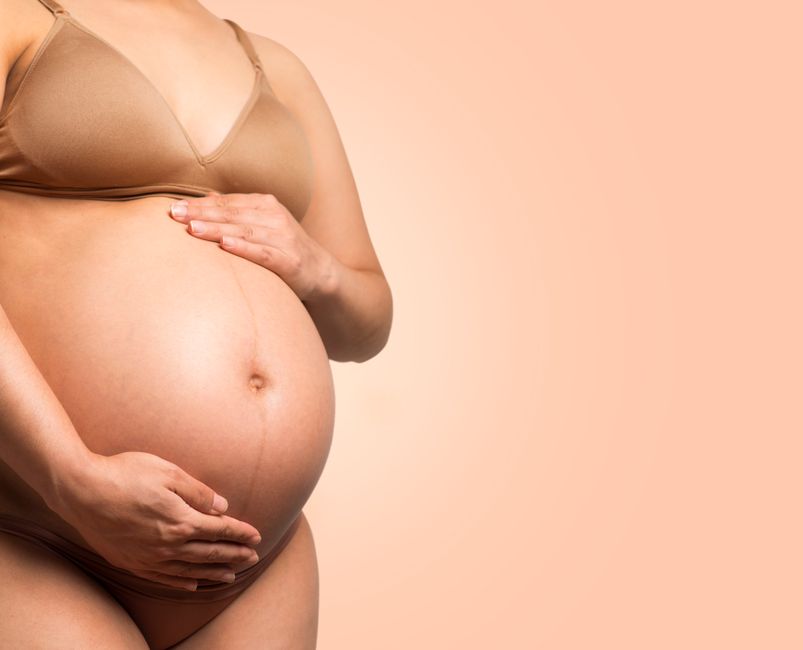
The dark vertical line that appears on a pregnant belly is called the linea nigra. For most women, it becomes noticeable during the second trimester, usually between weeks 18 and 20. However, some women see it earlier, and some never see it at all. It is a normal skin change caused by pregnancy hormones and typically fades within months after delivery.
What Exactly Is the Pregnancy Line on the Stomach?
The linea nigra is a dark line that runs vertically down your abdomen. It usually stretches from the pubic bone up to the belly button, though it can extend higher toward the ribcage in some women.
This line is actually a darkening of a structure that already exists in your body. Everyone has a faint white line called the linea alba running down the center of their abdomen. This line is where your abdominal muscles meet in the middle. During pregnancy, hormones cause this line to darken, turning it into the linea nigra.
The word “nigra” means black in Latin, but the line is usually brown or dark brown rather than truly black. The color can vary significantly from woman to woman. Women with darker skin tones often notice a darker line, while women with lighter skin may see a lighter brown version.
When Does Pregnancy Line on Stomach Appear? The Typical Timeline
The linea nigra most commonly appears during the second trimester. For most women, this means sometime between the 18th and 20th week of pregnancy. Some women notice it as early as week 12, while others do not see it until the third trimester.
The appearance of the line is linked to rising hormone levels. Your body produces more estrogen and progesterone during pregnancy, and these hormones stimulate melanocytes, the cells that produce pigment in your skin. The increased pigment production causes the line to darken.
Not every pregnant woman develops a linea nigra. Research suggests that roughly three out of four pregnant women notice this line. If you do not develop one, that is completely normal and does not indicate any problem with your pregnancy.
What Causes the Linea Nigra to Form?
The linea nigra forms because of hormonal changes during pregnancy. The placenta produces increased amounts of estrogen and progesterone, and these hormones affect melanin production in your skin. Melanin is the pigment that gives color to your skin, hair, and eyes.
This same hormonal mechanism causes other skin changes during pregnancy. Many women notice their areolas darken, and some develop dark patches on their face called melasma. These changes are all related to increased melanin production triggered by pregnancy hormones.
The line follows the linea alba because that area of skin has a slightly different structure. The tissue in this region responds differently to hormonal signals, making it more likely to darken than surrounding skin.
It is important to understand that the linea nigra is not a sign of nutritional deficiency or an underlying health problem. It is a cosmetic change that occurs naturally in response to pregnancy.





Does the Line Go Away After Pregnancy?
Yes, the linea nigra typically fades after you give birth. The line does not disappear instantly, but it gradually lightens over several months. Most women notice the line is significantly lighter by six months postpartum, and it often disappears completely within a year.
Breastfeeding does not appear to speed up or slow down the fading process. The line fades as your hormone levels return to normal after pregnancy. Once your body no longer produces elevated levels of estrogen and progesterone, the extra melanin production stops and the skin slowly returns to its normal color.
If the line persists beyond a year after delivery, it is worth mentioning to your healthcare provider. While this is uncommon, a persistent dark line could indicate a hormonal imbalance that deserves evaluation. However, for the vast majority of women, the line fades on its own without any treatment.
Can You Prevent the Linea Nigra?
There is no reliable way to prevent the linea nigra from forming. Because it is caused by normal hormonal changes during pregnancy, you cannot stop it through skincare products or lifestyle changes.
Some sources suggest that avoiding sun exposure may help minimize the darkening. The sun stimulates melanin production, which could make the line temporarily darker. Wearing sunscreen on your belly when you are outdoors may help, but it will not prevent the line from forming in the first place.
Be cautious about products that claim to lighten or remove the linea nigra during pregnancy. Most skin-lightening creams contain ingredients that have not been proven safe for use during pregnancy. No clinical guidelines currently support the use of any product to treat this condition while pregnant.
If the line bothers you cosmetically, the safest approach is simply to wait. The line will fade on its own after pregnancy without any intervention.
When Should You Be Concerned About the Line?
The linea nigra itself is harmless and does not require medical attention. However, there are situations where skin changes during pregnancy warrant a conversation with your healthcare provider.
If the line is accompanied by intense itching, redness, or a raised rash, this could indicate a different condition. Some pregnancy-related skin conditions, such as pruritic urticarial papules and plaques of pregnancy (PUPPP), produce rashes that can be confused with normal skin changes.
You should also mention any mole that changes shape, size, or color during pregnancy. Pregnancy hormones can affect moles, but any significant change deserves professional evaluation to rule out skin cancer.
If you develop dark patches on your face or other parts of your body that seem unusual, bring this to your provider’s attention. While melasma is common and harmless, other pigment changes may need investigation.
Myths About the Linea Nigra You Should Ignore
Several myths about the linea nigra circulate on social media and parenting forums. The most common myth claims that the length of the line predicts your baby’s sex. Some say a line that extends to the ribcage means you are having a boy, while a shorter line means a girl.
No scientific evidence supports this claim. The length and darkness of the line are determined by your skin type and hormonal response, not by your baby’s sex. The only reliable way to know your baby’s sex is through ultrasound or genetic testing.
Another myth suggests that the darkness of the line correlates with how much morning sickness you will experience. Again, no research confirms this connection. Hormonal changes cause both symptoms, but the severity of one does not predict the other.
Some traditional beliefs claim that the line appearing early indicates a more difficult labor. There is no medical basis for this claim. The timing of the line’s appearance has no known relationship to labor outcomes.
Skin Changes During Pregnancy Beyond the Linea Nigra
The linea nigra is just one of several skin changes that can occur during pregnancy. Understanding these changes can help you distinguish normal variations from signs that need medical attention.
Stretch marks are perhaps the most well-known skin change. These occur when the skin stretches rapidly and the underlying connective tissue tears. They appear as red or purple lines on the abdomen, breasts, thighs, and buttocks. Like the linea nigra, stretch marks fade over time but may not disappear completely.
Melasma, sometimes called the “mask of pregnancy,” causes dark patches on the face. These patches typically appear on the cheeks, forehead, and upper lip. Sun exposure makes melasma worse, so wearing sunscreen is recommended.
Spider veins and varicose veins also become more common during pregnancy. Increased blood volume and pressure from the growing uterus contribute to these changes. Most improve after delivery, though some may persist.
Acne can worsen or improve during pregnancy depending on your hormone levels. Some women experience clearer skin, while others develop breakouts. Over-the-counter acne treatments should be reviewed with your provider, as some ingredients are not recommended during pregnancy.
Practical Tips for Managing the Linea Nigra
If the linea nigra bothers you, there are a few practical steps you can take. These will not remove the line, but they may help reduce its appearance.
Wearing sunscreen on your abdomen when exposed to the sun can prevent additional darkening. Choose a broad-spectrum sunscreen with SPF 30 or higher. This is generally recommended during pregnancy anyway, as pregnancy can make your skin more sensitive to the sun.
Moisturizing your belly will not lighten the line, but it can help with dryness and itching as your skin stretches. Use a fragrance-free moisturizer to minimize irritation.
If the line is still visible after your baby is born and you want to address it cosmetically, talk to your dermatologist. Some prescription treatments may be appropriate once you are no longer pregnant or breastfeeding. However, these treatments have not been studied specifically for the linea nigra, and results vary.
For most women, the simplest approach is patience. The linea nigra is a temporary change that resolves on its own. It is one of many visible reminders of the significant physiological work your body performs during pregnancy.
Frequently Asked Questions
Does every pregnant woman get a linea nigra?
No, about one in four pregnant women never develops a linea nigra. Not having the line is completely normal and does not indicate any problem with your pregnancy.
Can the linea nigra appear before 12 weeks?
Yes, some women notice the line as early as the first trimester, though this is less common. Most women see it between weeks 18 and 20 of pregnancy.
How long does the linea nigra last after birth?
The line typically fades significantly within six months after delivery and often disappears completely within a year. It lightens gradually as your hormone levels return to normal.
Does the linea nigra mean I am having a boy or a girl?
No, the linea nigra does not predict your baby’s sex. The length, darkness, and timing of the line are determined by your skin type and hormonal response, not by whether you are carrying a boy or girl.
