
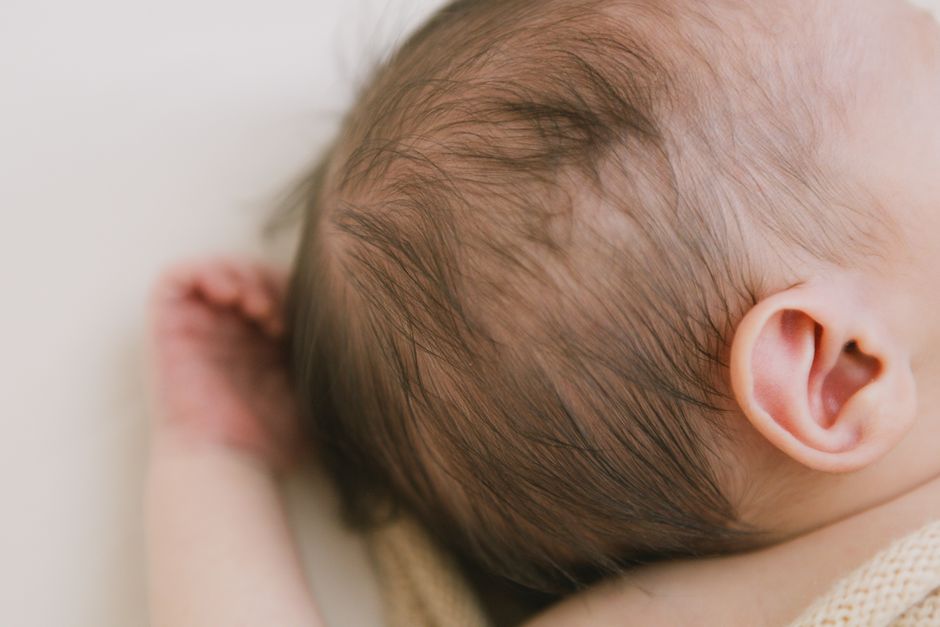
Most newborns lose some or all of their first hair between two and six months of age. The pattern is predictable: hair thins first at the temples and back of the head, then gradually across the scalp, before new hair grows in. For some babies, the change is barely noticeable. For others, a full head of dark hair turns into a sparse, patchy covering within weeks.
This is a normal part of infant development, not a sign of illness or a reaction to anything the parents did. The timing and pattern depend on how much hair the baby was born with, how long individual hairs stay in their resting phase, and how quickly the hair follicles reset for the next growth cycle.
When Does Newborn Hair Fall Out?
Newborn hair loss typically begins within the first few weeks after birth and continues until roughly six months of age. It rarely happens all at once. Most parents notice a slow thinning rather than clumps of hair falling out.
The process is driven by the hair growth cycle. Every hair on the human body moves through three phases: a growing phase, a transitional phase, and a resting phase. After resting, the hair sheds and the follicle starts over. Before birth, a baby’s hair follicles are synchronized. Many of them enter the resting phase around the same time, which means many hairs are ready to shed around the same time after delivery.
Hormones play a role too. During pregnancy, maternal hormones cross the placenta and keep the baby’s hair follicles in a prolonged growing phase. After birth, those hormone levels drop. The follicles shift into rest, and the hair that was being held in place begins to fall out.
This is the same basic mechanism behind the heavy hair shedding many women experience a few months after giving birth. The trigger is different — a mother’s own postpartum hormone shift rather than a newborn’s — but the biology of the hair cycle is similar.
What Causes Hair Loss in Newborns?
Two separate processes account for most newborn hair loss, and they often overlap.
The first is hormonal shedding, described above. It affects the whole scalp and usually starts in the first few weeks to months.
The second is friction. Babies spend a great deal of time on their backs, and the back of the head rubs against mattresses, car seats, and blankets. This mechanical rubbing can wear away hair in a band around the back of the scalp. Parents often describe this as a bald spot or a ring of thin hair.
Friction-related hair loss is common and generally harmless. It tends to fade as the baby becomes more mobile and spends less time with the back of the head in constant contact with a surface.
A third factor is simply the natural replacement of the baby’s first hair. The fine, soft hair a baby is born with — sometimes called lanugo when it is very fine — is gradually replaced by a thicker, more mature hair type. This transition can look like hair loss even when the follicles are perfectly healthy.
Is Newborn Hair Loss Normal?
Yes. Losing the first hair is an expected part of infant development, and the vast majority of cases require no treatment or investigation.
Hair regrowth usually follows within a few months. The new hair may differ from the hair the baby was born with. It can come in a different color, texture, or thickness. A baby born with dark hair may grow in lighter hair, or straight hair may be replaced by curls. These changes are normal and are not a sign that anything is wrong.
There is no reliable way to predict what a baby’s permanent hair will look like from the hair they are born with. The hair present at birth is not a preview of adult hair.





When Should Parents Be Concerned About Hair Loss?
Most newborn hair loss does not need medical attention. A few situations are worth raising with a pediatrician.
Hair loss that continues well past the first year, or that is accompanied by patches of completely smooth, hairless skin, may have causes other than normal shedding. So may hair loss combined with a rash, scaling, redness, or broken hairs.
Other signs that warrant a conversation with a clinician include:
- Hair loss along with poor weight gain, lethargy, or feeding difficulty
- Patches of hair loss that are sharply defined rather than diffuse
- Hair that breaks easily or pulls out without resistance
- Hair loss that appears only on one side of the scalp
- Any hair loss accompanied by swelling, tenderness, or signs of infection
These features are uncommon in routine newborn shedding. They can point to other conditions, and a pediatrician is the right person to evaluate them.
It is also worth noting that some parents mistake normal shedding for something more serious because of how quickly it can happen. A baby can go from a full head of hair to a noticeably thinner scalp in a matter of weeks. That speed is normal and does not by itself indicate a problem.
Does Cradle Cap Cause Hair Loss?
Cradle cap — the greasy, yellowish, flaky patches that commonly appear on a baby’s scalp in the first months — does not usually cause permanent hair loss, but it can temporarily interfere with hair growth in affected areas.
The flakes and crusts can mat down existing hair and make it look thinner than it is. In some cases, inflammation around the follicles may slow hair growth. Once the cradle cap clears, hair typically grows back normally.
Cradle cap is common and generally not a sign of poor hygiene or an allergy. Gentle washing and, in some cases, a soft brush to loosen scales can help. If the scalp looks inflamed, oozes, or spreads beyond the scalp, a pediatrician should take a look.
How Long Does It Take for Newborn Hair to Grow Back?
New hair usually begins to appear within a few months of shedding, though the timeline varies from baby to baby. By around the first birthday, most babies have a full head of hair, even if it is still fine or slow to fill in.
Some babies take longer. It is not unusual for a toddler to have sparse hair well into the second year, particularly if the parents also had slow hair growth as infants. Genetics influence both the timing and the final density of hair.
There is no product, supplement, or home remedy that has been shown to speed up newborn hair regrowth. The follicles are doing what they are programmed to do on their own schedule.
What About Hair Loss on Other Parts of the Body?
Newborn hair loss is not limited to the scalp. Some babies also shed fine body hair in the first weeks after birth. This is normal and follows the same hormonal logic as scalp shedding.
Eyebrows and eyelashes may also thin slightly. This is usually subtle and resolves on its own.
If hair loss appears in unusual locations, is accompanied by skin changes elsewhere on the body, or seems to be progressing unusually fast, it is reasonable to ask a pediatrician about it. Most of the time, the answer is that it is part of normal development.
What Parents Can Do
There is no intervention that changes the course of normal newborn hair loss. What parents can do is keep the scalp clean, avoid harsh products, and give the process time.
Gentle washing with a mild baby shampoo a few times a week is enough for most babies. Rubbing the scalp vigorously, using adult hair products, or applying oils or creams that have not been recommended by a clinician is not necessary and can sometimes irritate the skin.
If a baby has a bald patch from friction, changing sleep and play positions during supervised waking hours can reduce pressure on that area. This does not speed up hair growth, but it can limit further rubbing.
Parents who are unsure whether what they are seeing is normal should ask their pediatrician. A quick look is usually all it takes to tell the difference between routine shedding and something that needs a closer look.
Frequently Asked Questions
How long does newborn hair loss last?
Most newborn hair shedding starts in the first few weeks after birth and continues until about six months of age. Regrowth typically begins within a few months after shedding slows.
Is it normal for a newborn to lose all their hair?
Yes, it is normal for some babies to lose nearly all of their first hair. The hair that grows back may differ in color, texture, and thickness from the hair they were born with.
Can cradle cap cause permanent hair loss?
No. Cradle cap can temporarily affect hair growth in affected areas, but hair normally returns once the condition clears. Permanent hair loss from cradle cap alone is not typical.
When should I worry about my baby’s hair loss?
Talk to a pediatrician if hair loss continues past the first year, appears in sharply defined patches, or comes with rash, scaling, poor weight gain, or other symptoms. Routine shedding does not need treatment.
