
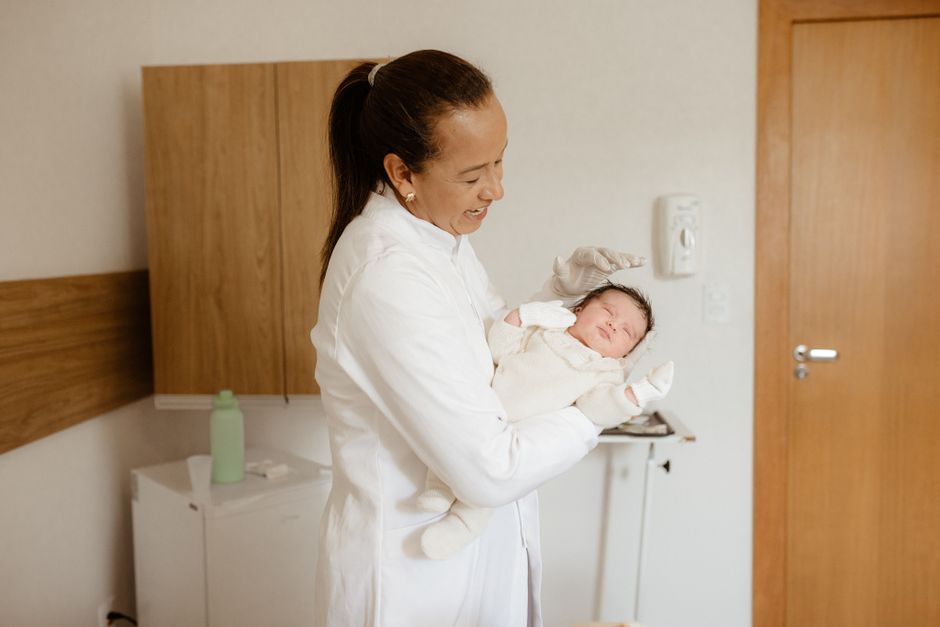
Most newborns start smiling in response to a face or voice at around 6 to 8 weeks of age. Before that, you will likely see smiles that seem to come out of nowhere — often during sleep or after feeding — and those are real, but they are not yet social. The first true social smile usually appears between 6 and 8 weeks, though some babies get there a little earlier and some a little later. Both are normal.
That gap between the reflex smiles of the first month and the deliberate smile of the second is one of the most striking changes in early development. It marks a shift from automatic brainstem activity to something more intentional. Understanding what is happening — and what is not yet happening — helps parents know what to expect and when to check in with a pediatrician.
When Do Newborns Smile At You?
The social smile — a smile that appears in response to your face or voice — typically emerges between 6 and 8 weeks of age. This is one of the earliest clear milestones of social development, and it is generally consistent across healthy babies.
Before 6 weeks, most smiles are what clinicians call reflex or endogenous smiles. They happen during sleep, often during active sleep phases, and sometimes after feeding. They are not a response to you. They come from spontaneous electrical activity in the brainstem and are a normal part of neurological development.
The distinction matters. A parent who sees a smile at two weeks and assumes it is a reaction to their face may feel confused when the baby does not repeat it. That early smile is real, but it is not yet social. The brain is not yet wiring the connection between seeing a face and producing a smile on purpose.
Around 6 to 8 weeks, something changes. The visual system has matured enough to focus on faces at close range. The social brain regions begin responding to familiar faces. The smile becomes a two-way exchange. This is when parents typically notice the first clear, deliberate smile — often in response to a parent’s voice or face at close range.
What Is the Difference Between Reflex Smiles and Social Smiles?
Reflex smiles are involuntary. Social smiles are intentional. That is the core difference, and it reflects two different stages of brain development.
Reflex smiles appear in the first weeks of life. They occur most often during sleep — particularly during the active phase of sleep when the brain is highly active. They can also appear briefly after feeding or during diaper changes. They are not directed at anyone and do not repeat in response to stimulation.
Social smiles begin to appear around 6 to 8 weeks. They are triggered by specific things: a familiar face, a parent’s voice, eye contact. They are reproducible. If you smile at your baby and wait, they may smile back. If you repeat the same face or sound, the smile may return. That reproducibility is the hallmark of a social smile.
Some researchers describe the social smile as one of the first clear signs that the infant is beginning to distinguish familiar people from strangers. It is not just a happy expression — it is a form of communication. The baby is learning that their behavior produces a response in the caregiver, and that feedback loop is foundational to social development.
What If My Baby Smiles Later Than 8 Weeks?
Some healthy babies do not produce a clear social smile until closer to 10 or 12 weeks. A smile that arrives a few weeks later than average is not automatically a concern, especially in babies born prematurely.
Premature babies often reach developmental milestones on a timeline adjusted for their due date rather than their birth date. A baby born four weeks early may not smile socially until closer to 10 to 12 weeks of actual age — which is 6 to 8 weeks adjusted age. Pediatricians typically use adjusted age when assessing early milestones for this reason.
Other factors can affect when a social smile appears. Babies who are frequently sleepy, have had a difficult birth, or are recovering from illness may smile a little later. Temperament also plays a role — some babies are simply less expressive early on.
That said, there is a point at which a missing social smile warrants a conversation with a pediatrician. If a baby is not smiling in response to a face or voice by 3 months of age, most clinicians would want to take a closer look. This does not mean something is wrong — but it is a milestone worth discussing rather than waiting out.
Parents should also watch for other early social behaviors alongside smiling. Around the same time the social smile appears, babies often begin making eye contact more consistently, cooing, and responding to familiar voices with visible excitement. If those behaviors are also absent at 3 months, that combination is more informative than the missing smile alone.




Why Do Babies Smile in Their Sleep?
Sleep smiles are common in the first weeks of life and are a normal part of infant sleep. They are not dreams in the way adults experience them, and they are not signs of happiness in the social sense.
Newborn sleep is different from adult sleep. Infants spend a much larger proportion of their sleep in active sleep — a stage roughly analogous to REM sleep in adults — and that stage is associated with spontaneous muscle activity, including facial movements. Sleep smiles come from that spontaneous activity. They are not a response to anything and do not reflect the baby’s emotional state.
Many parents find this reassuring rather than disappointing. The sleep smile is a sign that the brain is active and developing normally. It is not a sign of pain, discomfort, or any problem. It is simply what a developing nervous system does.
One non-obvious point: sleep smiles can sometimes look like grimaces or asymmetrical expressions, and that is also normal. The facial muscles are still coordinating, and the movements are not always smooth or symmetrical. As the nervous system matures, sleep smiles become less frequent and social smiles become more common.
How Can Parents Encourage Early Smiling?
You cannot speed up the neurological development that makes social smiling possible, but you can create the conditions that make it more likely to happen — and more noticeable when it does.
Face-to-face interaction at close range is the most reliable way to encourage early social smiling. Newborns can focus best at about 8 to 12 inches from their face, which is roughly the distance between a baby and a caregiver during feeding. Getting close, making eye contact, and smiling slowly gives the baby a clear target to respond to.
Talking and singing in a warm, familiar voice also helps. Babies respond to the rhythm and pitch of speech before they understand words. Using a slightly higher-pitched, slower voice — sometimes called infant-directed speech — is something parents do instinctively and is associated with better early social engagement.
Responding to the baby’s cues matters too. If the baby turns away, yawns, or becomes fussy, they are signaling that they need a break. Overstimulation can suppress social behavior. A calm, responsive interaction is more likely to produce a smile than an intense or prolonged one.
It is worth noting that some babies are simply more reserved. A baby who smiles less frequently is not necessarily less attached or less developed. Temperament varies widely in the first months, and a quieter baby may still be engaging in other ways — through eye contact, body movement, or calming when held.
When Should a Parent Be Concerned About a Missing Smile?
A missing social smile by 3 months of age is the general threshold most pediatricians use to prompt a closer look. Before 3 months, a late smile is usually within the range of normal variation.
The concern is not the smile itself. It is what the smile represents — early social engagement. If a baby is not smiling, not making eye contact, not cooing, and not responding to familiar voices by 3 months, that pattern is more meaningful than any single missing milestone. Pediatricians assess development in clusters, not isolated skills.
Parents should also bring up any regression. A baby who was smiling socially and then stops is a different situation from a baby who has not yet started. Loss of a previously achieved milestone is always worth discussing with a clinician.
Hearing concerns, vision issues, and some neurological conditions can affect early social behavior. Most of the time, a late smile is not a sign of any of these. But the assessment is not something parents can do at home, and there is no downside to asking.
Well-child visits in the first few months are designed to catch these questions. The 2-month visit is often when pediatricians first ask about social smiling, and the 4-month visit is when they expect to see it clearly established. If you are unsure between visits, a phone call to the pediatrician’s office is a reasonable step.
Frequently Asked Questions
When do newborns start smiling at you?
Most newborns begin smiling in response to a face or voice at around 6 to 8 weeks of age. Smiles before that time are usually reflex smiles that occur during sleep or after feeding and are not yet social.
Is a 2-week-old smiling at me real?
A smile at 2 weeks is real but is almost certainly a reflex smile, not a social one. Reflex smiles come from spontaneous brain activity and are not a response to your face.
What if my baby is not smiling by 3 months?
A social smile that has not appeared by 3 months is worth discussing with a pediatrician. This does not mean something is wrong, but it is a milestone that warrants a closer look when combined with other early social behaviors.
Do premature babies smile later?
Yes, premature babies often reach the social smile milestone later when measured by actual age. Pediatricians typically assess early milestones using adjusted age — the age the baby would be if born on their due date.
