
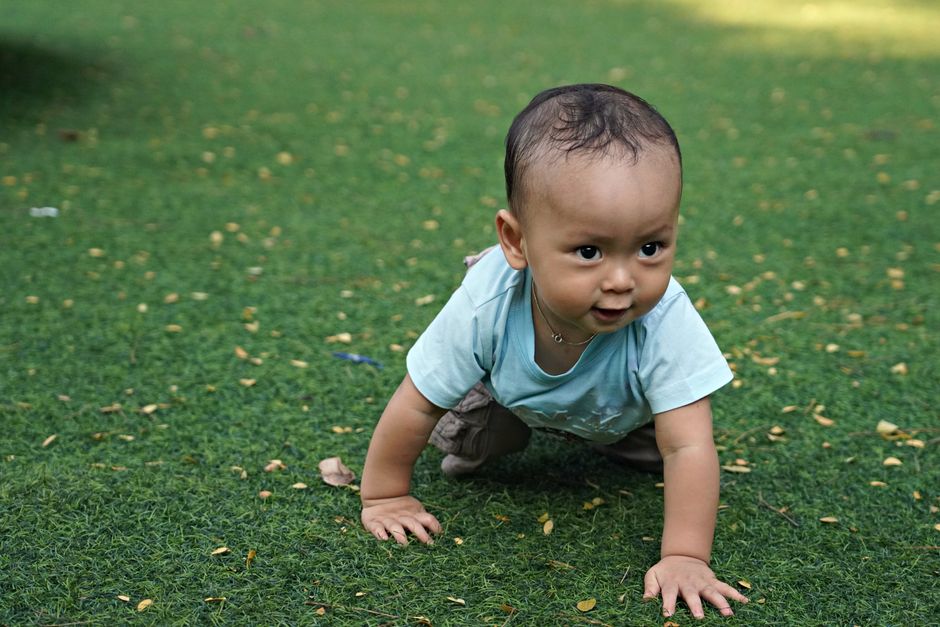
Most babies start crawling between 7 and 10 months of age. Some begin as early as 6 months, while others skip crawling entirely and move straight to walking around their first birthday. The range is wide, and most of it is completely normal. Crawling is a major milestone, but it is not a race, and the exact timing varies from child to child.
When Do Infants Begin To Crawl?
Infants typically begin crawling between 7 and 10 months. This window covers the vast majority of healthy babies. Around this time, most infants have developed enough upper body strength and coordination to push their chests off the floor and move their arms and legs in a coordinated pattern.
Some babies show early signs of crawling movements as young as 6 months. Others take until 11 or 12 months. If your baby is not crawling by 12 months, it is worth mentioning at a pediatric visit, but it is not automatically a cause for alarm. Many babies simply develop at their own pace.
It is important to understand that crawling is not a single skill. It is a sequence of movements that builds on earlier milestones like rolling over, sitting without support, and bearing weight on the arms. Each of these earlier skills prepares the muscles and coordination needed for crawling.
What Are the Different Types of Crawling?
Not all crawling looks the same. Parents often expect the classic hands-and-knees crawl, but babies find many ways to get from one place to another.
The most common styles include:
- Classic hands-and-knees crawl — baby moves with opposite arm and leg together. This is the pattern most people picture.
- Army crawl or belly crawl — baby drags the belly on the floor and pulls with the arms while legs trail behind.
- Bear crawl — baby moves on hands and feet with the bottom lifted high in the air.
- Bottom scoot — baby sits and moves forward using arms and legs while staying seated.
- Crab crawl — baby moves backward or sideways, often pushing with the arms.
All of these count as crawling or independent mobility. What matters is that the baby is moving purposefully from one place to another. The specific style is far less important than the fact that the baby is exploring the environment.
Some babies never crawl in any form. They may go straight to pulling up on furniture and cruising, then walking. Research suggests this is not harmful. The key developmental goal is independent movement, not the specific method.
What Skills Must Develop Before Crawling?
Crawling does not happen suddenly. It depends on several earlier milestones that build strength and coordination.
Babies first need adequate head and neck control. This develops around 3 to 4 months when babies can hold their heads steady during tummy time. Next comes rolling, usually between 4 and 6 months. Rolling requires core strength and shows that the baby can shift weight.
Sitting without support typically develops between 6 and 8 months. This milestone matters because it indicates strong trunk muscles. These same muscles stabilize the body during crawling.
Tummy time is the foundation for all of these skills. Babies who spend regular time on their stomachs develop stronger neck, shoulder, arm, and back muscles. These are the exact muscles used for crawling. The American Academy of Pediatrics recommends placing babies on their stomachs for short periods several times a day while awake and supervised, starting from birth.
A baby who has not had much tummy time may reach crawling milestones later. The muscles simply have not had enough opportunity to strengthen. It is never too late to start, though older babies may resist tummy time at first.





How Can Parents Encourage Crawling?
Parents cannot force a baby to crawl, but they can create conditions that make crawling more likely. The most effective approach is giving the baby plenty of supervised floor time.
Simple strategies that support crawling development include:
- Daily tummy time from birth, gradually increasing duration as the baby grows.
- Placing toys just out of reach during floor play to motivate movement.
- Playing on firm, flat surfaces rather than only in swings, bouncers, or car seats.
- Minimizing time in containers like baby seats and walkers, which limit movement practice.
- Allowing bare feet so the baby gets sensory feedback from the floor.
One common mistake is holding a baby in a crawling position and moving their arms and legs for them. This does not teach crawling. Babies learn by attempting movements themselves and receiving feedback from their own muscles.
Another useful approach is to let the baby watch older siblings or other babies move. Babies are natural imitators. Watching another child crawl can spark interest and motivation.
Pediatric physical therapists sometimes recommend specific positioning activities, but these are typically reserved for babies with identified delays. For typically developing infants, generous floor time is the most evidence-based approach.
Is It a Problem If My Baby Skips Crawling?
No. Skipping crawling is common and generally not a problem. Some babies move directly from sitting to pulling up to standing, then cruising along furniture, and finally walking.
There is an old belief that crawling is essential for brain development, particularly for reading and coordination later in life. This idea has been widely repeated in parenting circles, but the evidence does not support it. Studies have not found that babies who skip crawling have worse outcomes in childhood.
What matters is that the baby achieves independent mobility by some method. Whether that is crawling on hands and knees, scooting on the bottom, or moving directly to standing, the baby is developing strength, balance, and spatial awareness.
That said, a baby who does not crawl and also shows no interest in standing or moving by other means deserves attention. The concern is not the absence of crawling specifically. The concern is the absence of any independent mobility.
When Should Parents Be Concerned About Delayed Crawling?
Most variation in crawling age is normal, but some patterns warrant a conversation with a pediatrician. Parents should seek guidance if their baby shows any of the following:
- No attempts to move independently by 12 months
- Consistently dragging one side of the body while moving
- Very stiff or very floppy muscle tone
- Loss of previously gained motor skills at any age
- No interest in exploring the environment by 12 months
Pediatricians look at the whole picture, not just one milestone. They consider when the baby rolled over, sat, and reached for objects. They also assess muscle tone, reflexes, and overall development.
If a pediatrician has concerns, they may refer the family to early intervention services. These programs provide developmental assessments and physical therapy when needed. Early intervention is most effective when started early, which is why pediatricians take delayed milestones seriously.
Parents should trust their instincts. If something feels off about their baby’s movement development, a conversation with the pediatrician is always appropriate. It is better to ask and be reassured than to wait and worry.
What Safety Measures Are Needed Once Crawling Starts?
The moment a baby starts moving, the home environment changes. Crawling opens up a new world of exploration, and safety measures should be in place before the baby becomes mobile.
Parents should get down to the baby’s eye level and look for hazards. Common dangers include electrical outlets, cords, sharp furniture corners, small objects that could be swallowed, and cleaning supplies stored in low cabinets.
Key safety steps include:
- Installing outlet covers on all accessible electrical outlets
- Securing furniture like bookshelves and dressers to the wall to prevent tipping
- Adding corner guards to sharp furniture edges
- Moving cords out of reach, including blind cords which pose a strangulation risk
- Using baby gates at the top and bottom of stairs
- Locking cabinets that contain cleaning products, medications, or other hazards
Bare feet are best for crawling babies because they provide traction and sensory input. Socks on smooth floors can cause slipping, which may frustrate a new crawler. If the floor is cold, consider grippy socks or a warm room rather than regular socks.
Regularly inspecting the floor for small objects is important. Babies explore with their mouths, and anything within reach may end up there. A good rule is that if an object fits through a toilet paper roll, it is too small for a baby to have unsupervised.
Frequently Asked Questions
At what age do most babies start crawling?
Most babies start crawling between 7 and 10 months. Some begin earlier or later, and all of these variations can be completely normal.
Is crawling backward normal?
Yes, backward crawling is very common in the early stages. Many babies figure out how to push backward before they learn to move forward, and they typically correct this within a few weeks.
Do all babies crawl before they walk?
No. Many babies skip crawling entirely and move directly to pulling up, cruising, and walking. Research has not found this to be harmful.
When should I worry that my baby is not crawling?
Talk to your pediatrician if your baby shows no interest in any form of independent movement by 12 months. The concern is not the absence of crawling specifically, but the absence of any mobility method.
